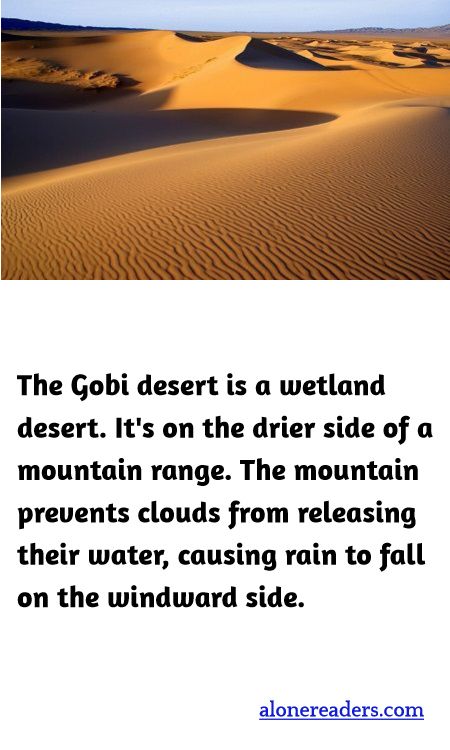
The Gobi Desert, often perceived as a mere vast expanse of sands and barren lands, is actually more complex in terms of its geographical and climatic attributes. Contrary to the typical portrayal of deserts as entirely arid and bereft of moisture, part of the Gobi has characteristics of a wetland. This unusual feature arises due to its unique location on the lee side of a mountain range.
The phenomenon that explains this facet of the Gobi Desert is known as the rain shadow effect. The mountain range that flanks the Gobi acts as a formidable barrier that clouds must overcome. As these moisture-laden clouds ascend the windward side of the mountains, they cool and condense, releasing precipitation in the form of rain or snow. By the time they reach the peak and begin their descent on the leeward side, they are significantly depleted of moisture. Consequently, the region beyond the mountains, in this case, the Gobi Desert, receives far less rainfall, leading to its arid conditions.
However, the Gobi is not entirely dry. Certain lower areas within the desert can accumulate underground water and sometimes surface as seasonal wetlands. These wet pockets in the desert can support a variety of life forms, adding to the biodiversity of the region. During periods of sufficient rainfall, these wetland areas provide a crucial habitat for several species of plants and animals that have adapted to the extreme fluctuations in the desert’s climate.
Moreover, the interaction between the dry desert winds and the wetter areas creates an environment where evaporation occurs rapidly, further contributing to the unique microclimate of the Gobi. This dynamic climatic interplay supports a range of ecosystems, from sparse grasslands to various shrubs, which in turn sustain a variety of wildlife including rare species like the Bactrian camel and the Gobi Bear.
Understanding the geographical and ecological nuances of regions like the Gobi Desert is essential for conservation efforts and for studying the impacts of climate change on diverse habitats. The Gobi’s example particularly illustrates how complex natural systems are and how factors such as mountain ranges can dramatically alter the climate of a region, thereby shaping the biodiversity and ecological health of a habitat.
