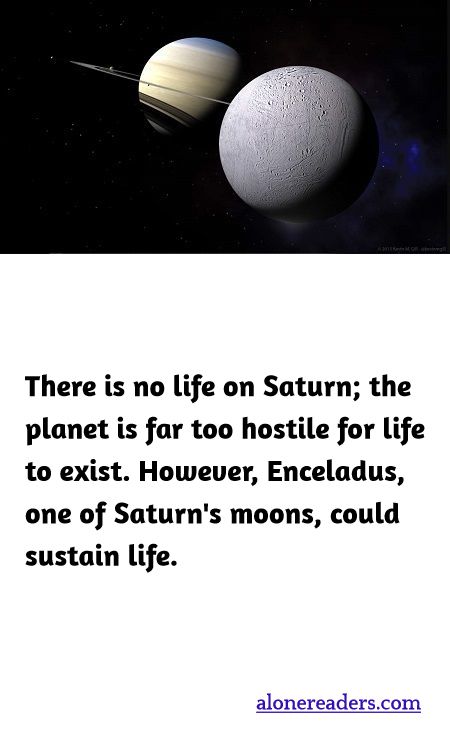
Saturn, the sixth planet from the Sun, is an inhospitable place for life as we know it. Characterized by its extensive ring system, Saturn is a gas giant primarily composed of hydrogen and helium. Its atmosphere features high-speed winds, freezing temperatures, and crushing pressures, conditions that are far from conducive to life. The planet lacks a solid surface, which is another critical barrier to the development and sustaining of life.
However, Enceladus, one of Saturn’s many moons, presents a stark contrast in the search for extraterrestrial life. Enceladus has captured the interest of scientists worldwide due to its potentially habitable conditions. Unlike the gas giant it orbits, Enceladus exhibits several features that could support life. The moon is encased in a thick outer shell of ice, but beneath this icy exterior lies a global ocean of liquid water, kept warm by hydrothermal activity. This activity is a result of the gravitational forces exerted by Saturn, which cause the moon’s interior to flex and produce heat.
What makes Enceladus particularly intriguing is the discovery of water vapor and ice particles being ejected from its surface into space through plumes. These plumes, first detected by NASA's Cassini spacecraft, suggest that the subsurface ocean is interacting with a rocky core, a critical interaction that could provide the chemical nutrients necessary for life. Analysis of the plume composition revealed molecules like methane, carbon dioxide, and organic compounds, all of which are significant in the context of life.
The chemical reactions between the water in Enceladus’s ocean and its rocky core could potentially mimic those that occurred on early Earth, leading to the development of life. If these interactions produce enough chemical energy, they could support microbial life within the ocean’s depths. Scientists are particularly excited about the similarities between Enceladus and hydrothermal vents on Earth’s ocean floors, which are teeming with life forms that thrive in extreme conditions, independent of sunlight.
While direct evidence of life on Enceladus has yet to be discovered, these findings represent a compelling case for the possibility of life. Future missions, potentially involving ice-penetrating radars or even a submarine to explore its ocean, could provide the definitive proof of life or, at the very least, further enhance our understanding of the conditions under which life can exist in celestial bodies. Enceladus stands as a beacon of hope in the quest to find life beyond Earth, demonstrating that even in the seemingly inhospitable vastness of space, there are niches where life might find a way.
