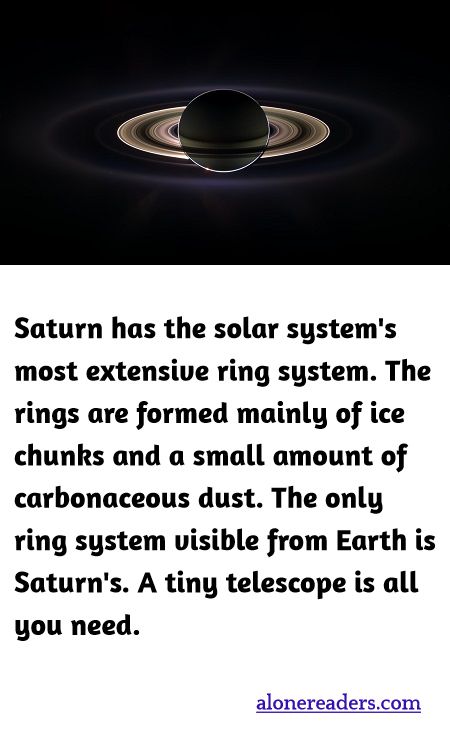
Saturn, the sixth planet from the Sun, boasts the most magnificent ring system in our solar system, distinguishing it as a unique celestial marvel. These rings are predominantly composed of countless small particles that primarily consist of water ice, with a sprinkle of carbonaceous dust. This composition reflects sunlight in such a way that the rings appear brilliantly luminous when viewed from Earth.
The origins of Saturn's rings are still a topic of debate among scientists. Some theories suggest they are remnants of a moon that was torn apart by Saturn's gravitational pull, or possibly debris left over from comets, asteroids, or even a destroyed moon. The age of the rings also remains uncertain, with estimates ranging from a few hundred million years to billions of years old, suggesting they could be as ancient as the solar system itself.
The beauty and structure of Saturn's rings can be appreciated even with modest astronomical equipment. With just a small telescope, one can observe the division of the rings, named after Giovanni Domenico Cassini, who discovered this separation in 1675. This gap, known as the Cassini Division, is a 4,800-kilometer-wide region between the A ring and the B ring, two of the most prominent rings of Saturn.
Observing Saturn’s rings from Earth provides not only a spectacular view but also valuable insights into the dynamics of other planetary ring systems. Each of Saturn's rings orbits at a different speed, showcasing intricate wave patterns and gravitational interactions both within the rings and with Saturn’s many moons. These interactions often create features such as brightness variations and braiding, which are captivating subjects of study for astronomers.
Therefore, Saturn not only serves as a jewel in the night sky but also as a natural laboratory for understanding celestial mechanics and the evolutive history of the solar system’s outer regions. Its extensive ring system remains an enduring symbol of the mysteries and wonders of space, inviting both professional scientists and amateur astronomers alike to explore and contemplate its complex beauty.
