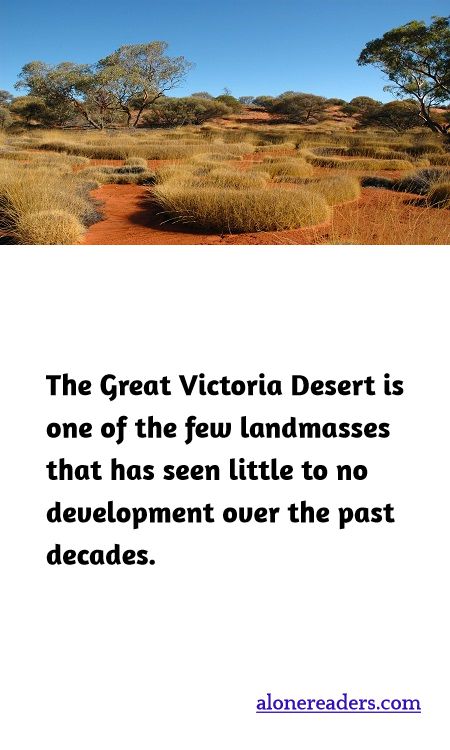
Spanning an impressive area of around 348,750 square kilometers, the Great Victoria Desert remains one of Australia's largest and most pristine deserts. Straddling the border between Western Australia and South Australia, it is a vast expanse of arid land characterized by sand dunes, small rocky hills, and grassland plains, all of which contribute to its untouched beauty. The lack of major urban development has left this desert largely uninhabited and in an almost original ecological state, providing an invaluable record of the natural environment.
The area sees very low rainfall throughout the year, supporting a unique range of biodiversity adapted to the harsh arid conditions. Vegetation primarily consists of dense scrub and hardy grasses, which in turn support a variety of wildlife including marsupials like the southern marsupial mole, and reptiles such as sand goannas. Moreover, the Great Victoria Desert is culturally significant, being a traditional home for Indigenous Australian groups like the Pitjantjatjara and the Mirning people, who have maintained a deep spiritual connection to the land through millennia.
Ecologically, the desert serves as a crucial habitat for numerous endemic species. Conservation efforts are particularly focused on the preservation of this unique ecosystem, especially given the threats posed by invasive species and climate change. These conservation initiatives are largely supported by the relatively low human footprint in the desert. The spread of non-native plants and animals is minimal compared to more populated areas, allowing native species a better chance to thrive without the pressure of competition and predation that accompanies more developed regions.
Moreover, the remote and unspoiled nature of the Great Victoria Desert makes it an important area for scientific research and environmental monitoring. Studies conducted in such untouched areas can provide critical data on natural processes and serve as baseline environments to assess the impacts of climate change globally.
Despite its remoteness and challenging living conditions, the desert attracts adventurers and scientists alike, drawn by its natural beauty and the mystery of its vast, unexplored landscapes. Its continued preservation as a place largely untouched by modern development not only safeguards its ecological and cultural heritage but also provides a sanctuary where nature can be studied and appreciated in its wild state. The Great Victoria Desert epitomizes the importance of untouched natural environments in a rapidly developing world, serving as a reminder of the delicate balance of Earth's ecosystems.
