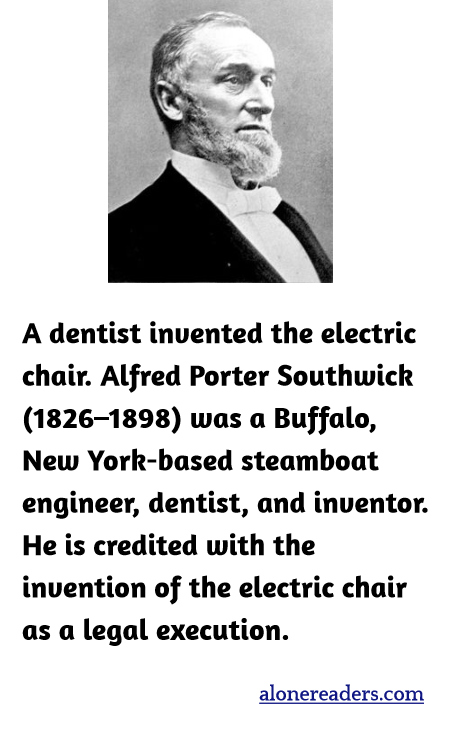
In the late 19th century, Alfred Porter Southwick, a multifaceted professional hailing from Buffalo, New York, made an unexpected leap from dentistry and steamboat engineering to a markedly different domain: the invention of the electric chair. His venture into this grim field began somewhat innocuously when, in 1881, he witnessed a distressing yet pivotal event—a drunken man accidentally killing himself by touching a live electric generator. This incident sparked Southwick's interest in electricity's lethal potential and its possible application in a more controlled and humane context compared to the prevalent methods of execution.
Southwick’s background in dentistry, which involved a detailed understanding of human anatomy and the nervous system, played a critical role in his conceptualization of the electric chair. Intrigued by the instantaneous nature of death by electrocution, he began experiments, initially using stray dogs, to determine the most humane and effective way to administer electrical currents to cause immediate unconsciousness and rapid death. These experiments laid the foundational knowledge necessary for developing a method of capital punishment that aimed to reduce physical suffering.
By 1888, Southick had become a leading advocate for electrocution as a method of legal execution. He played a pivotal role in convincing the New York state government to adopt this method over the more traditional hangings. His advocacy was influential in the establishment of a commission that eventually led to the passage of laws in 1888 making electrocution an official method of execution. The electric chair, designed by Southwick, was first used in 1890 at Auburn Prison in New York, marking a monumental shift in the American penal system.
Despite Southwick’s intention to create a more humane method of execution, the use of the electric chair has been mired in controversy over the years. Initial applications were often botched, leading to painful and protracted deaths, which sparked debates and legal battles over the constitutionality and morality of using such a method. Over the decades, as concerns about the humaneness of the electric chair continued to mount, many states in the U.S. have moved away from electrocution toward lethal injection.
Alfred Porter Southwick’s involvement in the creation of the electric chair is a strange footnote in the history of medicine and criminal justice. His transition from dealing with dental pains to addressing questions about life, pain, and humane methods of capital punishment illustrates the sometimes unexpected paths that scientific curiosity and innovation can take. The electric chair, a product of both compassion and practicality, remains a significant, if controversial, part of the history of capital punishment in the United States.
