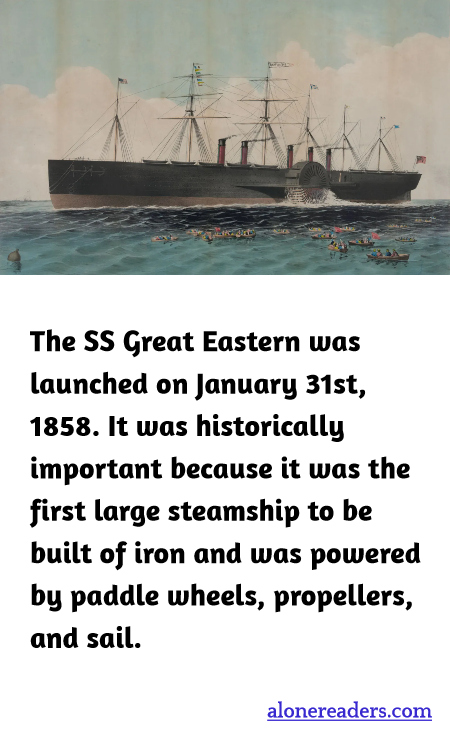
The SS Great Eastern, a marvel of maritime engineering, was launched on January 31, 1858, marking a significant evolution in the construction and capabilities of ocean-going vessels. Designed by Isambard Kingdom Brunel, a pioneering engineer of his time, the ship became notable not only for its size but also for its revolutionary design and multi-modal propulsion system. This included both paddle wheels and a screw propeller, as well as sails, making it one of the most versatile ships of its era.
Constructed from iron, the SS Great Eastern featured a double-hull, an innovative safety feature that was rare at the time for ships of such scale. Stretching 692 feet in length and measuring 83 feet in width, it was by far the largest ship ever built at the time of its launching. Its capacity to carry up to 4,000 passengers, along with its extensive cargo hold, made it uniquely suited for long voyages, including those on the emerging routes to the eastern parts of the British Empire and across the Atlantic.
The operational career of the SS Great Eastern was a mix of commercial challenges and technological successes. Initially intended for the England-to-Australia route, the ship failed to attract enough passengers to make its voyages profitable. It was plagued by financial problems and a series of unfortunate events, including a catastrophic explosion onboard in 1859. Despite these setbacks, the ship’s design proved crucial in laying the first successful transatlantic telegraph cable in 1866, which connected Europe to North America and marked a significant milestone in global communications.
The engineering ingenuity of the SS Great Eastern pioneered several aspects of modern naval architecture, including the use of a double-skin hull and the combination of multiple propulsion systems. The ship’s ability to operate under both steam and sail prefigured the flexible energy requirements of modern naval crafts, while construction techniques used in its assembly inspired future methods in shipbuilding.
The legacy of the SS Great Eastern extends beyond its own operational lifespan. As a symbol of industrial ambition and innovation, it helped set new standards in ship construction, influenced the development of steam navigation, and paved the way for the modern shipping industry. While its career as a passenger liner and cargo ship might not have been as successful as originally hoped, its contributions to maritime engineering and the advancement of global communication networks leave an indelible mark on technological and industrial history.
