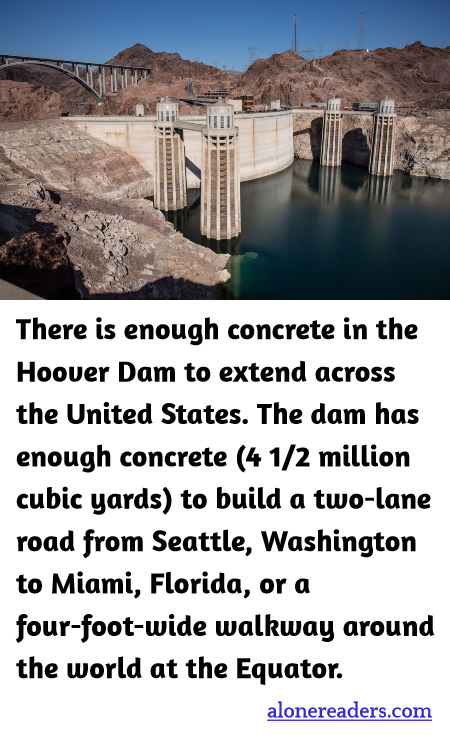
The Hoover Dam, an engineering marvel located on the border between Arizona and Nevada, is renowned not just for its vital role in water management and power supply, but also for its immense scale, notably in terms of the concrete used in its construction. Constructed during the Great Depression under challenging conditions, the dam required about 4.5 million cubic yards of concrete. This staggering volume is enough to conjure some truly impressive hypotheticals that underline the vast scale of the dam's construction.
For instance, the amount of concrete used in the Hoover Dam could construct a two-lane road stretching from the Pacific Northwest city of Seattle to the southeastern hub of Miami. This expansive hypothetical road would cross multiple states, showcasing the vast quantity of materials that were mobilized to create the dam. Alternatively, this same volume could be used to create a four-foot-wide walkway encircling the entire globe at the Equator. This fascinating comparison not only emphasizes the sheer volume of concrete involved but also highlights the global-scale implications of such a large undertaking.
The use of such a large amount of concrete had practical implications for construction as well. To counteract the natural heat generated by curing concrete, which could have jeopardized the structure’s stability, engineers embedded pipes within the concrete mass through which river water was circulated to absorb and dissipate the heat. This innovative cooling process was critical in facilitating the concrete's proper setting and ensuring the dam's structural integrity.
Today, the Hoover Dam stands not only as a crucial infrastructure system but also as a testimony to the ambitious capabilities of engineering and construction from its era. It remains a symbolic beacon of the power of human ingenuity to overcome natural and economic hurdles, while also serving as a stark visual representation of what can be achieved with vast resources like concrete.
