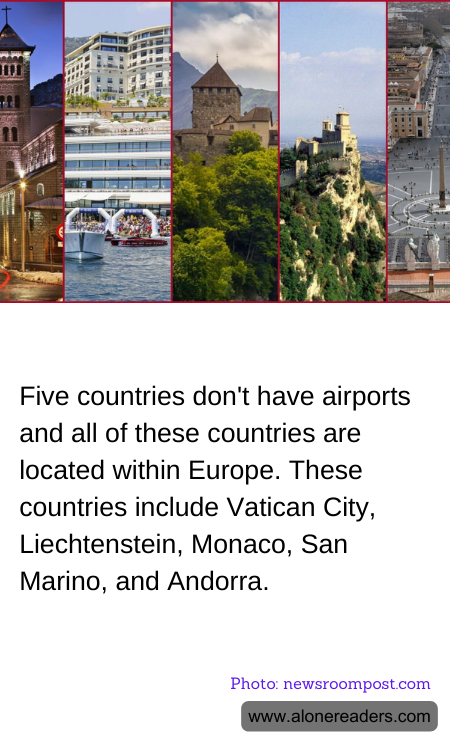
Europe, a continent rich in diversity and history, also boasts some unique geographic and infrastructural characteristics. Among these are the five European countries without airports: Vatican City, Liechtenstein, Monaco, San Marino, and Andorra. Each of these nations has its own reasons for lacking this common transport facility, mostly due to their small sizes or geographical constraints.
Vatican City, the smallest country in the world, is completely encircled by Rome. Given its size (about 44 hectares) and religious significance, it does not have its own airport. Instead, visitors can fly into Rome and reach the Vatican easily by car or public transport. Similarly, the Principality of Monaco, famed for its opulence and as a tax haven, is nestled along the French Riviera with limited land area, making the construction of an airport impractical. The nearest major airport is Nice Côte d'Azur Airport in France, just about 22km away.
Liechtenstein, a doubly landlocked alpine country, also finds itself without an airport. Instead, it relies on nearby airports in Switzerland and Austria, with Zurich Airport being the closest major one, approximately 130 kilometers away. Its mountainous terrain and small size (about 160 square kilometers) make an airport a challenging and unnecessary venture.
San Marino, surrounded by Italy, is an ancient microstate on the Italian Peninsula known for its medieval walled town and narrow, winding streets. The topography and historical preservation efforts make an airport in San Marino impractical. The nearest major airport, Federico Fellini International Airport, is around 27 kilometers away in Rimini, Italy.
Lastly, Andorra, tucked between France and Spain in the Pyrenees mountains, lacks an airport due to its mountainous landscape. The nearest airports are in Spain (Lleida-Alguaire Airport about 160 kilometers away) and France (Toulouse-Blagnac Airport about 165 kilometers away). Andorra's tourism and economy thrive on its winter sports and duty-free shopping, with visitors typically arriving by car or bus.
Despite their lack of airports, these countries maintain high levels of connectivity and accessibility thanks to their close proximity to neighboring countries' transport facilities. This integration within the European transport network ensures that these nations are not isolated, thereby supporting their tourism and economic activities.
