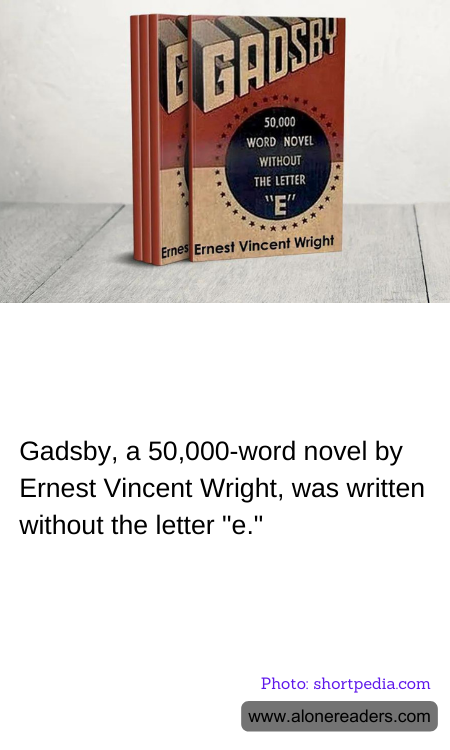
Published in 1939, "Gadsby" stands out as a monumental feat in the realm of constrained writing. Ernest Vincent Wright challenged himself with a peculiar constraint: to write an entire novel without using the most common letter in the English language, "e." This novel spans 50,000 words and sticks strictly to its unique lexical limitation, which is a part of a genre known as a lipogram.
The plot of "Gadsby" revolves around the protagonist, John Gadsby, a leader of a group of youths who are intent on revitalizing their declining hometown, Branton Hills. The narrative delves into his efforts and challenges in mobilizing the community to bring about various civic improvements such as building new infrastructure and revitalizing municipal facilities. Through its unfolding, the novel explores themes of leadership, community, youth empowerment, and civic responsibility.
Writing "Gadsby" was no small task, given the omnipresence of the letter "e" in English. Wright often found himself painstakingly seeking synonyms and restructuring sentences to adhere to the self-imposed constraint. Remarkably, his efforts are almost seamless, with the narrative flowing naturally, its prose remaining engaging despite the omission. The task was made even more difficult by the fact that typewriters of the time automatically spaced after a period, thus Wright had to use a custom typewriter that didn't automatically include the space, all to avoid inadvertently adding the letter "e."
The uniqueness of "Gadsby" isn't just in its constraint but in its demonstration of the elasticity of language. Wright’s undertaking shows a masterful command of English, revealing how it's possible to communicate effectively even under extreme lexical constraints. It pushes readers to ponder the essentiality of their own word choices and challenges writers to think about language in unconventional ways.
Even today, "Gadsby" serves as inspiration in literary circles and among enthusiasts of constrained writing, demonstrating that creativity can flourish under limitation. It remains a testament to human ingenuity and the endless possibilities within the art of writing. While the novel might be a curiosity, its legacy endures in the way it opens up new vistas for literary expression and experimentation.
