More About This Card
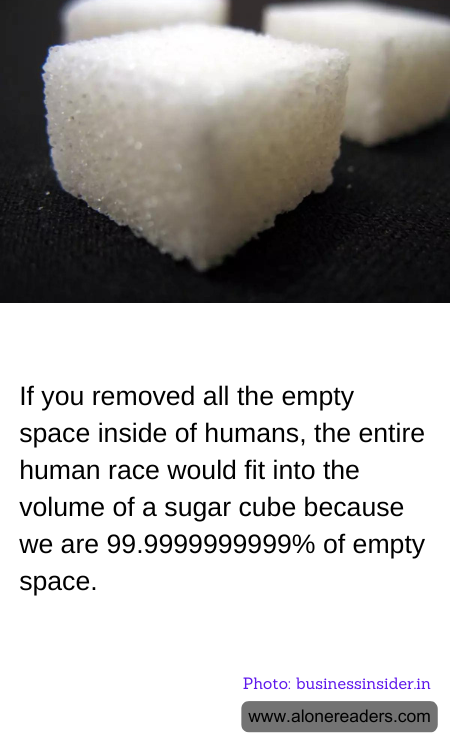
The idea that the entire human race could fit into a sugar cube if all the empty space within atoms were removed sounds like a concept straight out of a science fiction novel, yet it finds its roots in genuine scientific principles. At the atomic level, humans, like all matter, are composed predominantly of empty space. This seemingly paradoxical idea emerges from our understanding of atomic structure.
Atoms, the basic building blocks of matter, are composed of a central nucleus surrounded by electrons that orbit at incredible distances relative to the size of the nucleus. The nucleus—which contains protons and neutrons—is incredibly tiny compared to the overall size of the atom. In fact, if an atom were to be scaled up to the size of a sports stadium, the nucleus would be about the size of a small pea situated at center field, with the electrons zipping around the outer stands. Most of the volume of an atom is thus 'empty' space.
The staggering figure that we are 99.9999999999% empty space stems from the relative distances and dimensions within atomic structures. If the empty space within every human's atoms could somehow be eliminated, reducing each person to just the compact core of fundamental particles (protons, neutrons, and electrons), humanity could indeed be compressed into an astonishingly small volume. This theoretical minimum volume, not much larger than a sugar cube, underscores the vastness of the empty spaces that exist within the very fabric of our corporeal forms.
This conceptual compression is not just an intriguing thought experiment; it also emphasizes the powerful forces that operate at atomic levels. Electromagnetic forces between electrons and the nucleus, as well as nuclear forces within the nucleus itself, prevent our atoms from collapsing into such minuscule configurations under normal conditions. These forces, though invisible to the naked eye, are what give matter its solidity and stability, ensuring that we don't crumble into quantum confetti.
While it's a fascinating calculation to consider squeezing humanity into a volume as small as a sugar cube, such a scenario remains firmly within the realm of theoretical physics and far from practical realization. It serves, however, as a vivid illustration of the atomic emptiness that is a fundamental part not only of human existence but of all matter in the universe. This realization not only deepens our understanding of the physical world but also sparks curiosity and wonder at the profound and mysterious nature of the universe we inhabit.