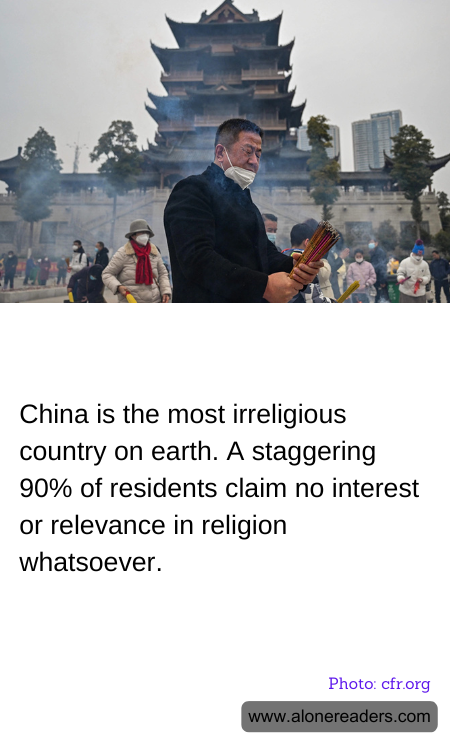
China is often cited as the most secular or irreligious country in the world. In numerous surveys and studies, a significant majority of the Chinese population claims no adherence to any religion. The Cultural Revolution, which took place from 1966 to 1976, played a crucial role in shaping contemporary Chinese attitudes toward religion. During this period, religious institutions were suppressed, and religious practices were discouraged as part of a broader move to cleanse society of what were considered old, feudal, or superstitious thoughts.
However, the picture is more nuanced than mere statistics might suggest. While it's true that a large proportion of the population expresses a lack of interest in religion, this doesn't necessarily equate to atheism or even agnosticism in the Western sense. Traditional Chinese religious practices are often intertwined with cultural identity, heritage, and family tradition rather than organized religious belief. Ancestor veneration and participation in traditional festivals linked to Confucianism, Taoism, and Buddhism can be common even among those who profess no religious affiliation.
Moreover, the Chinese government's control over religious expression has also impacted how religiosity is reported and expressed. Officially, the state recognizes five religions: Buddhism, Taoism, Islam, Protestantism, and Catholicism. Each of these is subject to state control and oversight to varying degrees, which might also influence how individuals relate to and report their religious affiliations. There is also a resurgence of interest in traditional Chinese spiritual practices and philosophies as the country has become more open and prosperous.
Thus, while the statistics might suggest that China is predominantly irreligious, the reality is that spirituality, religious practice, and cultural tradition are deeply woven into the fabric of Chinese life, albeit in a manner that might not be immediately recognizable to those from more conventionally religious societies. This blend of secularism, spiritual practice, and state control creates a unique religious landscape in China that continues to evolve.
