More About This Card
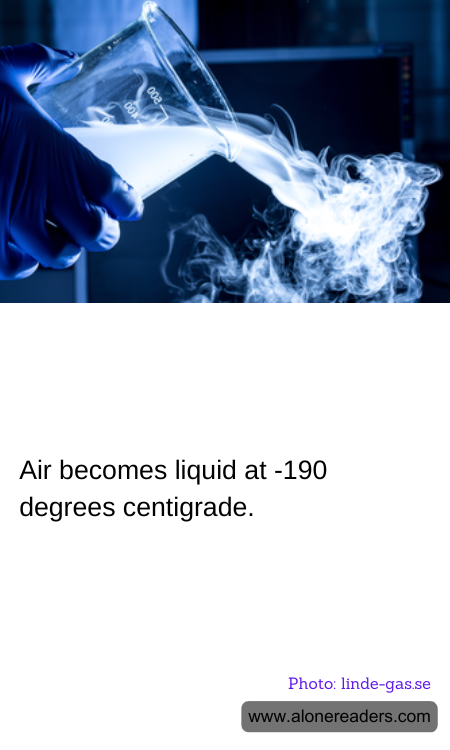
Air, as we experience it in our everyday lives, is a gaseous mixture primarily composed of nitrogen (78%), oxygen (21%), and smaller amounts of other gases such as carbon dioxide, argon, and water vapor. However, under certain conditions, this gaseous mixture can indeed be transformed into a liquid. This transformation occurs at extremely low temperatures, around -190 degrees Celsius (-310 degrees Fahrenheit). At this temperature, the kinetic energy of the gas molecules decreases sufficiently to allow them to condense into a liquid.
The process of liquefying air is a fundamental principle in various industrial processes and is primarily achieved through methods such as fractional distillation of liquefied air. The technique involves cooling the air to a point where it becomes liquid, then gradually increasing the temperature to separate different components based on their boiling points. For instance, nitrogen, which has a boiling point of -196 degrees Celsius, will evaporate before oxygen, which boils at -183 degrees Celsius. This method is used extensively to produce pure gases for various applications.
The ability to liquefy air has significant practical applications in industries and research. Liquid air can serve as a compact storage medium for gases used in medical facilities, scientific research, and industrial processes. Moreover, due to its high density compared to its gaseous form, liquid air can store substantial energy, which has research implications in energy storage and transport systems.
Additionally, the cryogenic properties of liquid air make it invaluable in the field of low-temperature research, where scientists study the behavior of materials at near-absolute zero temperatures. It also plays a crucial role in the field of medicine, particularly in cryopreservation – a method used to preserve organs, tissues, and cells at cryogenic temperatures.
Despite its benefits, the handling of liquid air requires stringent safety measures due to its extremely low temperatures and potential for rapid expansion into gas. This expansion can lead to dangerous situations if not properly managed, including pressure buildup and explosions in enclosed spaces.
In summary, the transformation of air into liquid form at -190 degrees Celsius is not just a fascinating scientific phenomenon but also a versatile tool in industry and research, holding profound implications across multiple fields from healthcare to energy management and beyond. However, it demands careful handling due to the risks associated with cryogenic substances.