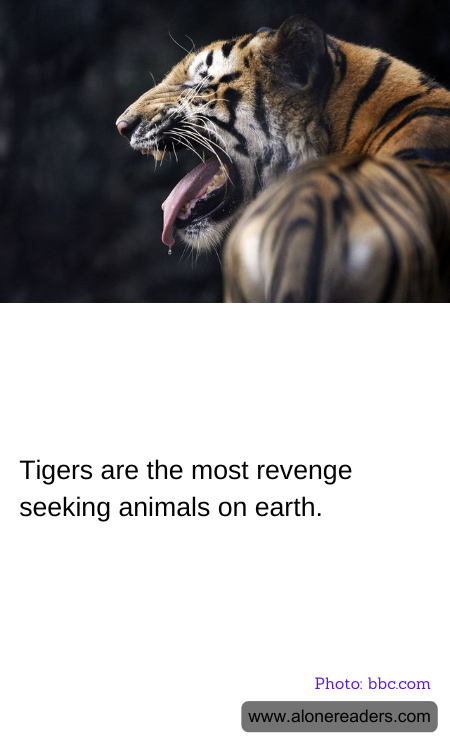
Tigers, known for their majestic appearance and powerful presence, are often regarded as symbols of strength and courage in various cultures. However, the belief that tigers are the most revenge-seeking animals on earth is more a product of folklore and popular media than scientific fact. While tigers can exhibit aggressive behavior, especially when provoked or threatened, their response is more about immediate survival than long-term revenge.
Tigers, like many wild animals, have a strong instinctual behavior to defend their territory, protect their young, and secure their food sources. These behaviors can sometimes be perceived as revenge, especially in scenarios where tigers have repeated negative encounters with humans or other animals. For instance, if a tiger's habitat is encroached upon by humans, it might attack to defend its territory. If the same humans repeatedly enter the tiger's space, the tiger might see them as a continued threat, leading to what might be perceived as vengeful behavior.
Moreover, the idea of revenge implies a level of premeditation and emotional motivation similar to what humans experience, but there is no scientific evidence to suggest that tigers or any other animals operate with this complexity regarding emotions. Animal behaviorists often caution against anthropomorphizing, which is the attribution of human traits, emotions, or intentions to non-human entities like animals. Misinterpretations can arise from anthropomorphism, leading to myths about animal behavior, such as the notion of tigers as revengeful creatures.
It's important to approach understandings of animal behavior from a biological and ecological perspective rather than a human-centric viewpoint. By doing so, we can appreciate the natural instincts and survival strategies of animals like tigers without overlaying them with human emotions and motives. Conservation efforts can also benefit from a clear understanding of animal behavior, as this knowledge helps establish more effective measures to protect these magnificent creatures and their habitats. By respecting tigers as complex, instinct-driven animals, we foster a more realistic and informed approach to both studying and conserving them.
