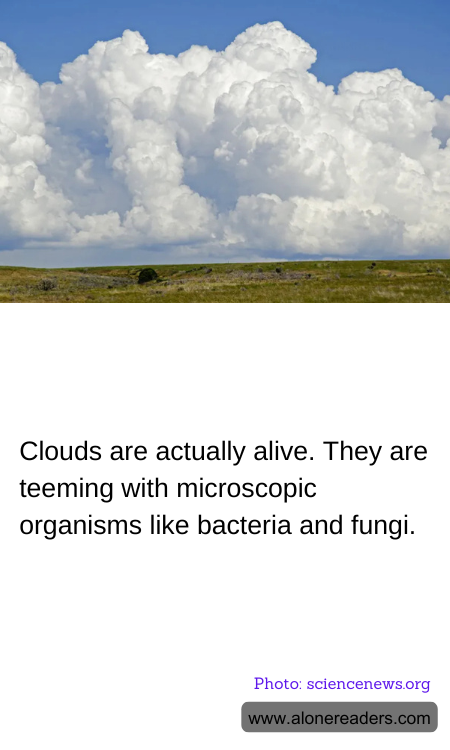
Clouds, those ethereal, fluffy masses that float above us, are not just an assembly of water droplets and ice crystals; they are bustling ecosystems teeming with life. Recent studies reveal that clouds are alive with a wide variety of microscopic organisms, including bacteria, fungi, and viruses. This burgeoning field, known as aerobiology, explores how these tiny life forms influence everything from weather patterns to climate change.
The organisms found in clouds can originate from the Earth's surface, lifted into the atmosphere by winds where they become integral to meteorological processes. Once in the clouds, these microbes can interact with chemical compounds, influencing the formation and precipitation of clouds. For instance, some bacteria are capable of catalyzing the formation of ice crystals around which cloud droplets can condense. This process, known as ice nucleation, is crucial for the formation of rain or snow. The bacteria produce proteins that facilitate the freezing process at temperatures close to freezing, which could otherwise be supercooled without forming ice.
One of the fascinating aspects of these microbial populations is their potential impact on the climate. By affecting cloud formation and precipitation, microbes could play roles in weather modification and climate regulation. Scientists speculate that understanding these dynamics might help in developing new methods for weather control, such as inducing rainfall in drought-affected areas.
However, this interaction is a double-edged sword. While these organisms can contribute beneficially to weather patterns, their transport across the globe raises concerns about the spread of diseases and the impact on air quality. The ability of microbes to travel vast distances ensconced in clouds means that they can traverse continents, potentially influencing ecosystems far from their points of origin.
The implications of microbial life in clouds extend beyond just weather and environmental science. It poses important questions for the fields of epidemiology, environmental management, and even planetary science, where scientists wonder if similar microbial exchanges could occur in the atmospheres of other planets.
Thus, the discovery that clouds are teeming with life adds a complex layer to our understanding of Earth’s atmosphere. It bridges disciplines, from microbiology and climatology to environmental science and planetary studies, increasing our understanding of the intricate connections between Earth's systems and the living organisms they host. Such knowledge not only deepens our comprehension of the natural world but also underscores the profound interconnectivity that sustains life across different spheres of our planet.
