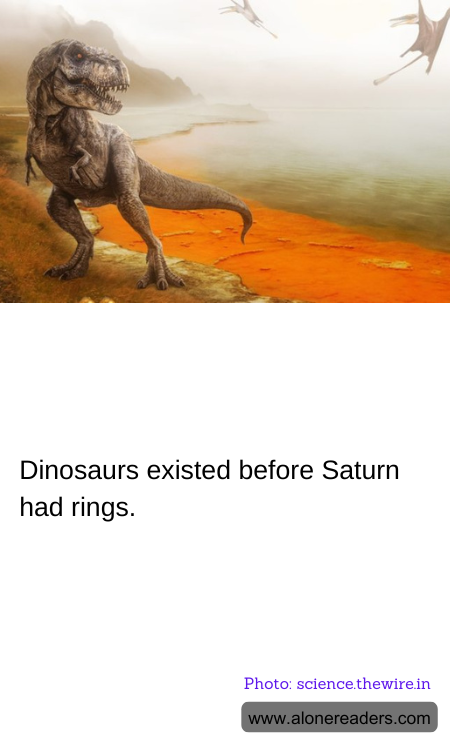
Dinosaurs, the colossal creatures that once dominated Earth, roamed our planet long before many features in our solar system took their current form. One fascinating example of such an astronomical evolution is Saturn’s rings. Recent studies suggest that while dinosaurs thrived during the Mesozoic Era, which spanned from about 252 to 66 million years ago, Saturn's iconic rings likely formed much later, possibly as recently as a few hundred million years ago. This timeline implies that these emblematic rings did not exist during the age of dinosaurs, presenting a strikingly different picture of the night sky as seen from prehistoric Earth.
The formation of Saturn’s rings is believed to be a relatively recent event in cosmic terms. Scientists theorize that the rings could have formed when objects like comets, asteroids, or even a moon broke apart under Saturn’s strong gravitational pull. This debris settled into what we now recognize as the bright, extensive rings circling the planet. The age of Saturn’s rings was estimated by observing the quantity of dusty material and the influence of Saturn’s gravity on the rings, as well as studying the interplay between ring particles and cosmic elements. These studies suggest that the icy bands are not as ancient as the planet itself, which formed around 4 billion years ago.
Understanding that dinosaurs existed before Saturn had its rings not only highlights the evolutionary epochs these magnificent creatures lived through but also underscores the dynamic and ever-changing nature of our solar system. It sheds light on the geological and astronomical transformations that have continuously shaped planetary bodies and their environments over millions of years. Moreover, it serves as a reminder of the serendipitous nature of celestial events and their timing in relation to the history of life on Earth. The realization that such iconic vistas as Saturn's rings are relatively recent features adds a layer of wonder to our understanding of the cosmos, emphasizing the transitory and continually evolving character of the universe.
