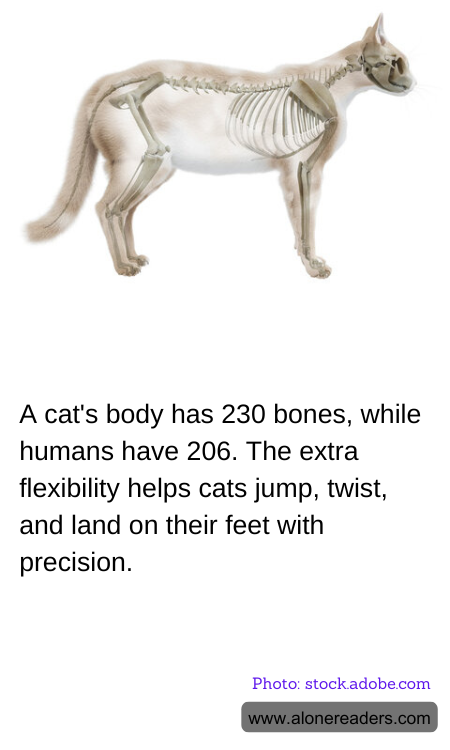
Cats are renowned for their agility and grace, traits that are closely tied to their unique skeletal structure. With a total of 230 bones, cats possess more bones than humans, who have only 206. This higher number of bones contributes significantly to a cat's flexibility and mobility. The extra bones are primarily found in the cat's spine and tail, which enable fluid and swift movements, crucial for a predator that relies on stealth and precision to capture prey.
The flexibility of a cat's spine is legendary; they can arch their back into the classic Halloween cat pose and twist their bodies midair when falling. This flexibility is largely due to the cat's vertebral discs, which are more elastic, allowing their spine to rotate more freely and the animal to contort its body into shapes that would be impossible for many other creatures, including humans. These mobile, sinuous movements are not just fascinating from a biomechanical perspective but are also essential survival skills. For instance, the ability to twist their bodies helps cats to land on their feet when they fall — a reflex known as the righting reflex.
Furthermore, the cat’s skeletal structure enhances its ability to make powerful leaps. Cats are capable of jumping up to six times their body length in a single bound, and their long, powerful hind legs work much like coiled springs to propel these jumps. Their light bone structure also assists in these gravity-defying leaps and contributes to their capability to move silently, another advantage for a stalking predator.
Additionally, a cat’s collarbones, which do not connect with other bones but are instead buried in the shoulder muscles, allow for an extraordinary range of motion. This feature enables cats to squeeze through openings that appear much too small for them, adding to their repertoire of surprising abilities.
Understanding the nuances of a cat’s skeletal system not only highlights the evolutionary adaptations that make domesticated and wild cats such formidable hunters and survivors but also deepens our appreciation for these complex and capable animals. Whether it’s their remarkable agility in the face of danger or their playful antics at home, the intricate design of a cat’s body is a key component of their charm and mystique.
