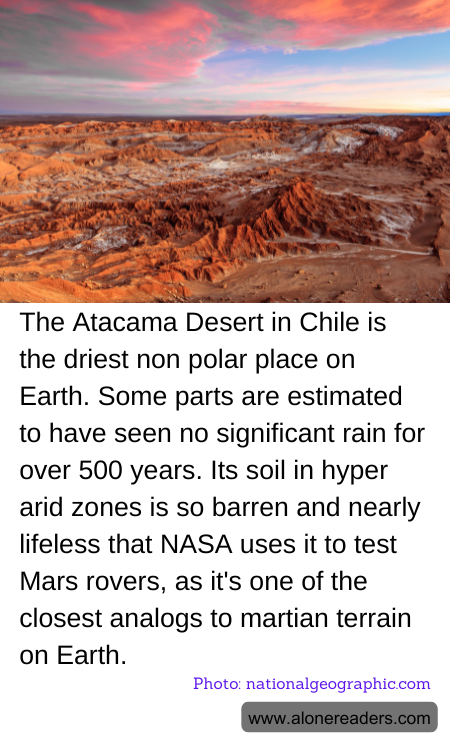
The Atacama Desert, stretching across northern Chile, holds the title of being the driest non-polar place on Earth, creating an environment that is both eerily beautiful and harshly uninhabitable. Remarkably, some regions within this desert have not received substantial rainfall for more than 500 years, showcasing an extreme level of aridity rarely found elsewhere on the planet. The landscape is dominated by vast stretches of sand and stone, towering volcanoes, and salt flats, presenting a scene that feels more extraterrestrial than terrestrial.
The soil in the Atacama's most arid zones is particularly barren, containing so little moisture and organic material that it closely mimics the conditions found on Mars. This stark similarity has made the Atacama Desert an invaluable site for scientific research, particularly for agencies like NASA. The terrain provides a unique opportunity to test and refine technology intended for space exploration, especially the rovers that are sent to explore the Martian surface. By conducting field tests in the Atacama, researchers can study how these rovers might maneuver and perform scientific tasks in a Martian-like environment, testing everything from mobility on sandy and rocky soil to the resilience of various instruments under UV radiation levels similar to those found on Mars.
Despite its inhospitable nature, the Atacama Desert is not completely devoid of life. Certain microorganisms have adapted to survive its extreme conditions, thriving in niches where faint moisture is available, such as in the fog that occasionally rolls in from the Pacific Ocean. These extremophiles are of particular interest to astrobiologists, who study them to understand how life might persist on other planets with harsh environments.
Additionally, the clear skies and minimal light pollution of the Atacama make it an ideal location for astronomical observatories. Some of the world's most powerful telescopes are stationed here, taking advantage of the dry air and high altitude to peer deep into the cosmos, further underscoring the desert's value not only to planetary science but also to the broader field of astronomy.
Thus, the Atacama Desert serves as a rare laboratory for a multitude of scientific disciplines, from studying extreme life forms and testing space technology to observing distant galaxies, making it a place of endless fascination and critical scientific importance.
