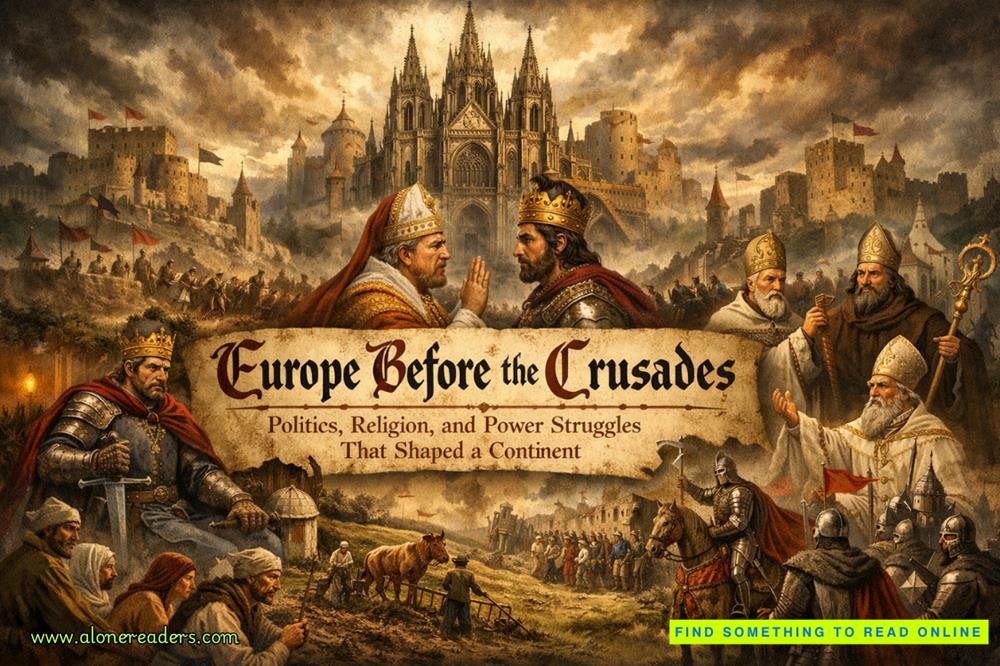
Europe on the eve of the Crusades was not a unified civilization marching in ideological harmony toward the eastern Mediterranean. It was a continent fractured by violent feudal rivalries, competing claims to spiritual authority, and deeply entrenched social hierarchies that left much of the population vulnerable, impoverished, and bound to land they did not own. The Crusades emerged not from a moment of strength and confidence, but from a period of internal instability, anxiety, and transformation in which rulers, warriors, and churchmen sought legitimacy, salvation, and control in a world they only partially governed.
The political landscape of early medieval Europe was defined by fragmentation rather than centralization. After the collapse of Roman imperial authority in the West, no durable empire succeeded in reuniting Europe under a single political structure. Instead, power became localized, personal, and hereditary. Kings ruled in theory, but real authority often rested with dukes, counts, and lords who controlled land, fortifications, and armed retainers. Loyalty was contractual rather than national, enforced through oaths rather than institutions. This decentralized order created a persistent condition of low-level warfare, where disputes over inheritance, borders, and honor regularly erupted into violence.
Feudalism structured this world not only politically, but socially and economically. Land was the primary source of wealth, and those who controlled it exercised dominance over those who worked it. Peasants, most of them serfs, lived under obligations that bound labor, rent, and obedience to their lords. Protection was promised in exchange for service, yet in practice protection was often unreliable. Raids, feuds, and private wars devastated rural communities, reinforcing a cycle of dependency and fear. For many ordinary people, violence was not an exception but a constant presence shaping daily life.
Kingship itself was insecure and contested. Royal authority depended on the cooperation of powerful nobles who could just as easily rebel as obey. Monarchs lacked standing armies, professional bureaucracies, or reliable systems of taxation. Instead, they relied on personal alliances, dynastic marriages, and the distribution of land to secure loyalty. This meant that political legitimacy was fragile, constantly challenged by rival claimants and ambitious aristocrats. Civil wars, succession crises, and territorial fragmentation were endemic features of European politics before the Crusades.
Overlaying this unstable political order was the immense and growing influence of the Christian Church. By the eleventh century, the Church had become the only institution with truly pan-European reach. Bishops and abbots administered vast estates, collected revenues, and exercised judicial authority. Monasteries functioned as centers of learning, economic production, and spiritual prestige. The Church did not merely guide souls; it governed land, shaped law, and mediated power between rulers and subjects.
Yet the Church itself was deeply entangled in the political struggles of the age. Secular rulers routinely interfered in ecclesiastical appointments, installing loyal bishops to secure influence over church wealth and legitimacy. This practice, known as lay investiture, sparked one of the most consequential conflicts of medieval Europe: the struggle between spiritual and temporal authority. At stake was not only who appointed bishops, but whether kings derived their authority from God directly or through the Church. The resulting confrontations exposed the fragile balance between crown and altar and revealed how deeply political ambition and religious ideology were intertwined.
The reform movements that swept through the Church in the eleventh century aimed to restore spiritual discipline and independence from secular control. Reformers condemned simony, clerical marriage, and moral laxity, portraying the Church as corrupted by worldly power. These efforts strengthened papal authority and redefined the pope not merely as a spiritual leader but as a supreme arbiter of Christian legitimacy. The Church increasingly claimed the right to judge kings, absolve subjects from oaths, and mobilize Christendom in defense of sacred causes.
This assertion of authority reshaped the moral universe of medieval Europe. Warfare, long considered a sinful necessity, began to be reframed as a potentially redemptive act if conducted under proper religious sanction. Concepts such as holy war and armed pilgrimage emerged from theological debates that sought to reconcile Christian ethics with the realities of a violent world. The Church did not create violence, but it increasingly sought to redirect and sanctify it, offering spiritual rewards in exchange for obedience and discipline.
At the same time, Europe’s warrior aristocracy faced its own crisis of purpose. Knights were trained for combat from childhood, yet opportunities for legitimate warfare within Europe were limited and often destructive to Christian communities. Feuds between nobles weakened kingdoms and disrupted economic life. Efforts such as the Peace and Truce of God attempted to restrain knightly violence by imposing religious prohibitions on warfare during certain days or against certain groups. These measures had limited success, highlighting the difficulty of controlling a class whose identity and status depended on fighting.
Economic conditions further compounded tensions. Population growth in parts of Europe placed pressure on land resources, while inheritance customs concentrated estates in the hands of eldest sons, leaving younger nobles landless and restless. Trade networks were expanding, but wealth remained unevenly distributed. For many lesser nobles, social advancement at home was increasingly constrained, creating incentives to seek opportunity beyond Europe’s borders.
Religious devotion during this period was intense and deeply emotional. Pilgrimage, relic veneration, and apocalyptic expectations shaped popular belief. Jerusalem held a powerful symbolic place in the Christian imagination as the site of Christ’s death and resurrection. News of threats to holy sites or Christian pilgrims resonated strongly with populations already conditioned to view history as a cosmic struggle between divine order and chaos. These beliefs did not arise in a vacuum; they were cultivated through sermons, liturgy, and storytelling that emphasized sacrifice, redemption, and divine justice.
Europe’s relationship with the wider Mediterranean world also influenced the conditions that preceded the Crusades. While often portrayed as isolated, medieval Europe was connected through trade, diplomacy, and conflict to Byzantium, the Islamic world, and North Africa. These interactions exposed Europeans to wealth, learning, and political models that contrasted sharply with their own fragmented societies. The relative sophistication of eastern cities highlighted Europe’s perceived spiritual and material shortcomings, fueling both admiration and resentment.
By the late eleventh century, all these forces converged. Fragmented political authority, an assertive and reforming Church, a restless warrior class, and a religious culture primed for sacrifice created a volatile environment. The call to crusade did not invent new motivations; it synthesized existing ambitions, fears, and ideologies into a single, compelling narrative. Participation promised spiritual salvation, social advancement, and a sense of collective purpose that had been largely absent from European life.
Understanding Europe before the Crusades requires abandoning simplistic explanations. The Crusades were not the product of blind fanaticism or sudden aggression. They were the outcome of a long process in which power struggles within Europe reshaped how violence, faith, and authority were understood. The movement toward crusading was, in many ways, a response to Europe’s internal crises rather than its external enemies.
In this context, the Crusades can be seen as both an extension and a transformation of medieval European society. They exported internal conflicts outward, offering an outlet for violence and ambition while reinforcing new forms of religious and political authority at home. The Europe that launched the Crusades was a continent searching for order, legitimacy, and meaning amid chronic instability. The decision to march eastward was not merely about reclaiming distant holy places; it was about redefining what it meant to rule, to fight, and to believe in a world where the boundaries between the sacred and the secular had become inseparably intertwined.



 The Hundred Days Offensive: How the Allies Defeated Germany in World War I
 The Second Battle of the Marne: The Turning Point of World War I in 1918
 The Spring Offensive of 1918: Germany's Final Gamble to Win World War I
 The Treaty of Brest-Litovsk: How Russia Left World War I
 The Russian Revolution and World War I: How War Brought Down the Tsar
 The Zimmermann Telegram Explained: Germany's Secret Offer to Mexico in World War I