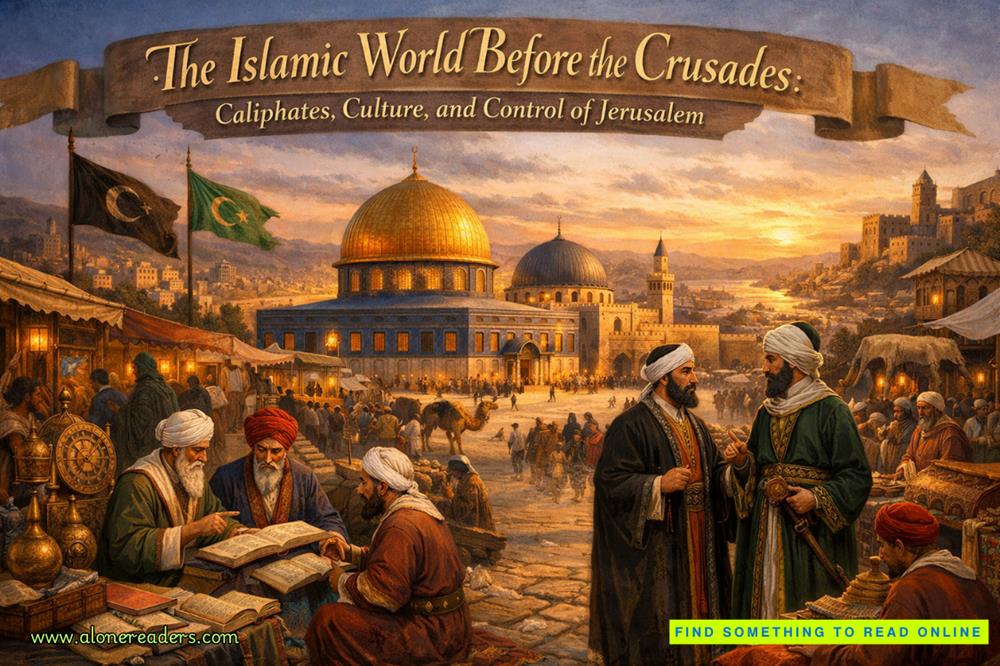
Before the clash of armies and ideologies that would later define the Crusades, the Islamic world stood as one of the most sophisticated and interconnected civilizations of the medieval era. From the seventh century onward, Muslim-ruled territories stretched across vast regions of Asia, Africa, and parts of Europe, bound together not merely by conquest but by shared administrative systems, religious principles, economic networks, and intellectual traditions. This world was neither static nor monolithic. It evolved through successive caliphates, internal rivalries, cultural synthesis, and pragmatic governance. By the time the First Crusade was proclaimed at the end of the eleventh century, Islamic civilization had already governed Jerusalem for over four centuries, shaping the city’s religious landscape, political institutions, and everyday life in ways often misunderstood or oversimplified in later Western narratives.
The rise of Islamic rule in the Near East began with astonishing speed. Following the death of the Prophet Muhammad in 632 CE, the early Muslim community expanded under the Rashidun caliphs, defeating the Byzantine and Sassanian empires in a series of decisive campaigns. These conquests were not merely military victories; they dismantled exhausted imperial structures and replaced them with a new system grounded in Islamic law, Arabic administration, and relative fiscal pragmatism. When Muslim forces entered Jerusalem in 638 CE, the city was already deeply scarred by centuries of conflict between Byzantines and Persians. The Muslim takeover, negotiated peacefully under Caliph Umar ibn al-Khattab, set a precedent that would echo for centuries. Jerusalem was integrated into the Islamic world not as a peripheral conquest but as a protected, revered city, administered with a sensitivity that acknowledged its multi-religious character.
Under early Islamic governance, Jerusalem became part of a broader provincial system centered first in Medina and later in Damascus. The Umayyad Caliphate, which ruled from 661 to 750 CE, transformed the city’s physical and symbolic landscape. The construction of the Dome of the Rock and the expansion of the Al-Aqsa Mosque complex were not acts of religious provocation but deliberate statements of continuity and authority. These monuments asserted Islam’s place within the Abrahamic tradition while anchoring Jerusalem firmly within the political geography of the caliphate. The Umayyads governed a vast empire that relied on Arabic as the language of administration, standardized taxation, and a professional bureaucracy inherited and adapted from Byzantine and Persian models. Jerusalem under Umayyad rule was stable, accessible, and economically active, benefiting from pilgrimage traffic and imperial patronage.
The transition from Umayyad to Abbasid rule in the mid-eighth century marked a profound shift in the Islamic world’s center of gravity. The Abbasids moved the capital eastward to Baghdad, emphasizing Persian administrative traditions and fostering an unprecedented flowering of intellectual life. Although Jerusalem lost some of its political prominence during this period, it remained religiously significant and administratively integrated. Abbasid governance prioritized legal uniformity through Islamic jurisprudence, while allowing considerable autonomy at the local level. Governors, judges, and tax officials managed cities like Jerusalem with an emphasis on order and revenue rather than ideological enforcement. Non-Muslim communities—Christians and Jews in particular—were recognized as protected peoples, allowed to practice their faiths, maintain institutions, and manage internal affairs in exchange for a poll tax and loyalty to the state.
Culturally, the Islamic world before the Crusades was defined by synthesis rather than isolation. Arabic served as a unifying language, but Persian, Greek, Syriac, and Hebrew intellectual traditions were actively translated, studied, and preserved. Cities across the caliphate—Baghdad, Cairo, Damascus, Cordoba—became centers of learning where philosophy, medicine, astronomy, mathematics, and theology flourished. This intellectual vitality was not confined to elites. It shaped legal systems, urban planning, education, and even commercial practices. Jerusalem, while not a major intellectual hub like Baghdad, participated in this broader cultural ecosystem. Scholars, jurists, and pilgrims passed through the city, contributing to a shared Islamic identity that transcended regional boundaries.
Economically, the Islamic world functioned as a tightly connected network of trade routes linking the Mediterranean, the Indian Ocean, Central Asia, and sub-Saharan Africa. Merchants operated under standardized contracts, credit instruments, and legal protections that facilitated long-distance commerce. Jerusalem benefited from this integration, positioned near key routes connecting Egypt, Syria, and Arabia. Markets in the city reflected the diversity of the Islamic economy, offering goods from across the known world. This economic interdependence reinforced political stability, as cities prospered through cooperation rather than constant warfare.
By the tenth century, however, the unity of the Islamic caliphate had begun to fragment. The Abbasids retained religious legitimacy but lost effective control over distant provinces. Regional dynasties emerged, ruling in the name of the caliph or openly asserting independence. In this context, Jerusalem changed hands between competing Muslim powers without losing its essential character as an Islamic city. The Fatimid Caliphate, an Ismaili Shi‘a dynasty based in Egypt, took control of Jerusalem in the late tenth century. Fatimid rule introduced a different theological orientation but largely preserved existing administrative practices. Despite sectarian differences at the imperial level, everyday governance in Jerusalem remained pragmatic, focused on taxation, security, and urban management rather than religious coercion.
The treatment of religious minorities during this period is often misunderstood. While Islamic rule was undeniably hierarchical, it was also structured and predictable. Christians and Jews were not equal citizens in a modern sense, but they enjoyed legal recognition, property rights, and communal autonomy that were rare in contemporary European societies. Churches, synagogues, and monasteries continued to function in Jerusalem, and pilgrimage routes remained open for much of the period. Periodic tensions did occur—most notably under the Fatimid caliph al-Hakim—but these episodes were exceptions rather than the norm. For centuries before the Crusades, Jerusalem was a shared city governed under Islamic sovereignty, where coexistence, though imperfect, was institutionally embedded.
Politically, the Islamic world before the Crusades was not on the brink of collapse, but it was increasingly decentralized. Military power shifted toward professional armies and regional warlords, particularly Turkish commanders employed by various dynasties. This transformation altered the balance between central authority and local control, especially in frontier regions. Jerusalem, lacking major military importance compared to cities like Damascus or Cairo, was often governed indirectly. This relative marginality contributed to its vulnerability when external forces eventually arrived, but it also meant that the city experienced fewer internal upheavals than other contested regions.
The perception of Jerusalem within the Islamic world was profoundly religious yet not exclusively so. It was revered as the site of the Prophet’s Night Journey and Ascension, making it Islam’s third holiest city. At the same time, it was understood as part of a broader sacred geography that included Mecca and Medina, cities of far greater political and spiritual centrality. Jerusalem was important, but it was not the linchpin of Islamic power. This distinction is critical to understanding why its defense did not initially provoke a unified Islamic response when the Crusaders arrived. The city’s sanctity was deeply felt, but its loss did not immediately threaten the structural integrity of the Islamic world.
On the eve of the Crusades, the Islamic Near East was characterized by cultural confidence, administrative continuity, and political fragmentation. Muslim rulers did not anticipate a mass religious invasion from Western Europe; conflicts with Byzantium, internal rivalries, and local rebellions were far more familiar concerns. The Islamic world had governed Jerusalem for centuries without attempting to erase its pluralistic character or weaponize its sanctity for constant warfare. This long period of relative stability stands in sharp contrast to the violence that would follow, not because Islamic rule was idealized, but because it was fundamentally oriented toward order, revenue, and coexistence rather than ideological annihilation.
Understanding the Islamic world before the Crusades requires moving beyond simplistic binaries of tolerance versus oppression or unity versus decay. It was a civilization of law and learning, of empire and locality, of religious devotion and administrative pragmatism. Jerusalem’s place within this world was shaped by caliphal authority, cultural synthesis, and political realism. By appreciating this context, the Crusades appear not as an inevitable clash of civilizations, but as a profound rupture in a region long accustomed to negotiated coexistence under Islamic rule.



 The Hundred Days Offensive: How the Allies Defeated Germany in World War I
 The Second Battle of the Marne: The Turning Point of World War I in 1918
 The Spring Offensive of 1918: Germany's Final Gamble to Win World War I
 The Treaty of Brest-Litovsk: How Russia Left World War I
 The Russian Revolution and World War I: How War Brought Down the Tsar
 The Zimmermann Telegram Explained: Germany's Secret Offer to Mexico in World War I