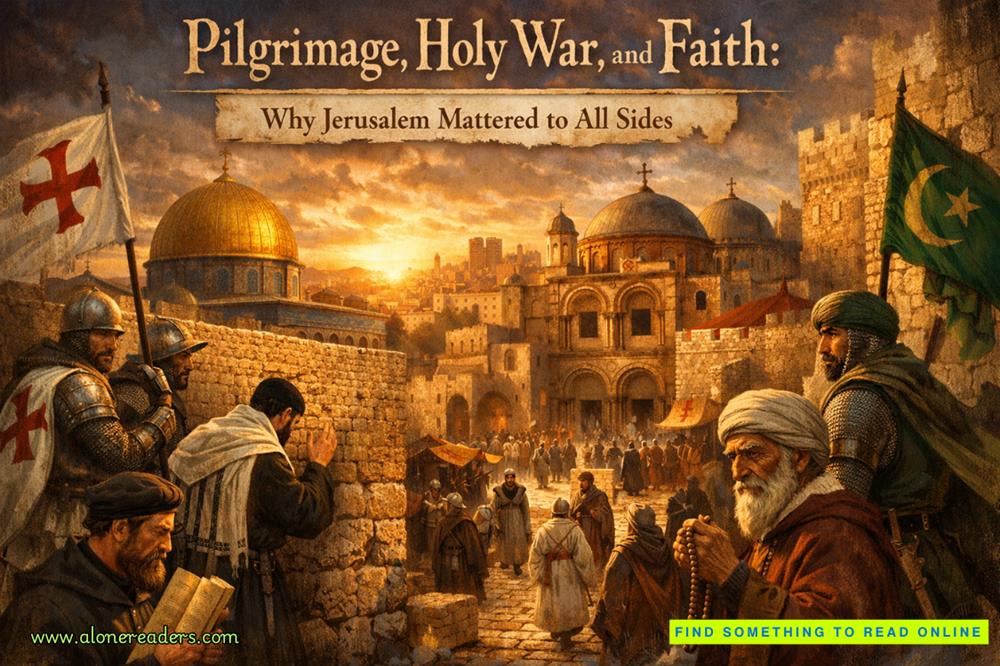
Jerusalem was not merely a city during the age of the Crusades; it was a spiritual axis upon which the medieval world turned, a place where geography dissolved into theology and stone became sacrament. For Christians, Muslims, and Jews alike, Jerusalem embodied sacred history, divine promise, and eschatological hope. Its streets were walked by prophets, its hills sanctified by revelation, and its shrines woven into the deepest structures of faith. When armies marched across continents to claim it, they were not driven solely by land or wealth, but by beliefs so powerful that they justified suffering, violence, and martyrdom. To understand why Jerusalem mattered to all sides is to understand how pilgrimage, holy war, and faith merged into a single, combustible force during the Crusades.
For medieval Christians, Jerusalem was the physical heart of salvation history. It was the city where Christ was crucified, buried, and resurrected, the site where divine redemption unfolded in human time. The Church of the Holy Sepulchre was not simply a shrine; it was believed to enclose the very threshold between death and eternal life. Pilgrimage to Jerusalem promised spiritual purification, remission of sins, and proximity to the divine that could not be replicated elsewhere. By the eleventh century, the act of pilgrimage had become an established expression of Christian devotion, often undertaken as penance or fulfillment of vows. To walk the Via Dolorosa was to reenact Christ’s suffering, to transform bodily hardship into spiritual merit. When reports spread that access to these holy places was threatened, restricted, or dishonored, the emotional and theological impact across Latin Christendom was profound.
This religious attachment was not abstract. Medieval theology emphasized sacred geography, the idea that certain places were intrinsically holy because God had acted there directly. Jerusalem, in Christian imagination, was not just where Christ had lived, but where history itself would end. Apocalyptic traditions placed the Second Coming and the Last Judgment in or near the Holy City. To control Jerusalem, therefore, was to stand at the center of God’s cosmic plan. When Pope Urban II called for the First Crusade in 1095, he framed the campaign not as territorial expansion but as an armed pilgrimage, a penitential journey sanctioned by God. The promise of indulgence transformed warfare into an act of devotion. Killing and dying became, in this context, instruments of salvation, a radical redefinition that reshaped Christian ethics and mobilized unprecedented numbers.
For Muslims, Jerusalem held an equally deep and ancient sanctity, rooted in both revelation and tradition. Known as Al-Quds, “the Holy,” the city was associated with the Prophet Muhammad’s Night Journey and Ascension, during which he was believed to have traveled from Mecca to Jerusalem and then ascended to heaven. The Haram al-Sharif, containing the Dome of the Rock and the Al-Aqsa Mosque, was revered as the third holiest site in Islam, after Mecca and Medina. Jerusalem was also the first direction of Muslim prayer before it was changed to Mecca, embedding it within the earliest layers of Islamic ritual life. Unlike later European assumptions, Muslim rule over Jerusalem prior to the Crusades had generally allowed access to Christian and Jewish holy sites, reflecting an understanding of the city as shared sacred space under Islamic guardianship.
The Crusader conquest of Jerusalem in 1099 marked a profound rupture in this order. The massacre that followed the city’s capture shocked the Muslim world not only because of its scale, but because it occurred in a city regarded as holy. Mosques were defiled, worshippers killed, and Islamic shrines repurposed. For Muslims, this was not merely a military loss but a theological violation, an affront to God and the ummah as a whole. Over time, Jerusalem became a rallying symbol in Islamic discourse, representing the need to defend sacred trust against foreign aggression. The concept of jihad, which had long encompassed personal moral struggle and communal defense, increasingly took on a military dimension focused on the recovery of holy lands. Leaders such as Nur ad-Din and later Saladin framed their campaigns not as conquest but as restoration, a return of Jerusalem to its rightful place within the Islamic world.
Saladin’s recapture of Jerusalem in 1187 illustrates how deeply faith shaped political and military action. His conduct after victory, marked by restraint and negotiated ransoms rather than massacre, was deliberately contrasted with the brutality of the Crusaders decades earlier. This was not simply strategic; it was ideological. By presenting himself as a just ruler defending Islam’s holy places, Saladin reinforced Jerusalem’s status as a moral symbol as well as a strategic prize. The city’s liberation became a proof of divine favor, strengthening religious legitimacy and unifying diverse Muslim populations behind a shared sacred cause.
For Jews, Jerusalem’s significance was older still, reaching back to the Hebrew Bible and the foundations of Jewish identity. It was the city of King David, the site of Solomon’s Temple, and the focal point of covenant between God and Israel. Even after the destruction of the Second Temple in 70 CE and centuries of diaspora, Jerusalem remained central to Jewish prayer, law, and longing. Daily prayers faced toward the city, festivals commemorated its loss, and the hope of return was embedded in religious liturgy. Jerusalem was not simply remembered; it was ritually present, sustained through memory and practice across generations.
During the Crusades, Jewish communities were often caught between competing powers, suffering persecution from both sides. The Rhineland massacres that accompanied the First Crusade revealed how crusading fervor could turn inward, redefining Jews as enemies within Christendom. In Jerusalem itself, Jewish residents were killed during the Crusader conquest, their synagogues destroyed or repurposed. For Jews, the Crusades reinforced Jerusalem’s tragic duality: it was both the city of ultimate hope and a site of repeated trauma. Yet even in devastation, its spiritual gravity endured. The Western Wall, a remnant of the ancient Temple complex, continued to anchor Jewish devotion, symbolizing endurance amid exile.
What made Jerusalem uniquely explosive during the Crusades was not simply that it was holy to multiple religions, but that each tradition understood its holiness in exclusive and absolute terms. Christian theology saw the city as redeemed through Christ; Islamic belief viewed it as sanctified through revelation and prophetic history; Jewish faith regarded it as eternally chosen by God. These claims were not easily reconciled because they were embedded in sacred narratives that defined identity itself. To lose Jerusalem was not merely to lose territory; it was to suffer a blow to cosmic order, to see one’s relationship with the divine threatened or denied.
Pilgrimage intensified these tensions by transforming belief into movement. Pilgrims did not merely think about Jerusalem; they journeyed toward it, investing physical effort, risk, and emotion into their faith. Roads filled with stories of hardship and miracle, reinforcing the idea that the city was worth suffering for. When pilgrimage routes were disrupted by war or politics, the disruption was felt as spiritual injury. Armed pilgrimage, as envisioned by Crusader ideology, fused this impulse with violence, making the journey itself an act of holy war. On the Islamic side, the defense and recovery of Jerusalem likewise became a form of collective pilgrimage in reverse, a movement to reclaim what God had sanctified.
Jerusalem’s urban landscape further magnified its symbolic power. Within a small area stood sites sacred to all three faiths, often layered physically atop one another. The Temple Mount was simultaneously the Haram al-Sharif, the location of the ancient Jewish Temples, and a place resonant in Christian tradition. This compression of sacred meaning meant that control of space carried enormous theological weight. Altering a building, changing a ritual, or raising a banner could be interpreted as a declaration of spiritual dominance. During the Crusader period, churches became mosques and mosques became churches, each transformation signaling not just political victory but divine endorsement.
The Crusades reveal how faith can mobilize societies with extraordinary intensity when belief, place, and identity converge. Jerusalem mattered because it was not negotiable within the logic of medieval religion. Compromise over sacred truth was seen as betrayal, coexistence as temporary at best. Yet the city’s history also shows moments of pragmatic tolerance, negotiated access, and shared reverence, suggesting that conflict was not inevitable but shaped by broader political and ideological currents. Jerusalem became the stage upon which the deepest convictions of an age were acted out, for good and ill.
In the end, Jerusalem’s importance during the Crusades lay in its ability to make the invisible visible. Faith, which often resides in texts and rituals, took physical form in walls, shrines, and streets. Holy war, which might otherwise remain abstract doctrine, became embodied in armies marching toward a single city. Pilgrimage, usually a personal journey, became a collective enterprise capable of reshaping continents. Jerusalem concentrated these forces, amplifying them until they defined an era. To study why it mattered to all sides is to confront the enduring power of sacred places to inspire devotion, justify violence, and shape history long after the swords have been laid down.



 The Hundred Days Offensive: How the Allies Defeated Germany in World War I
 The Second Battle of the Marne: The Turning Point of World War I in 1918
 The Spring Offensive of 1918: Germany's Final Gamble to Win World War I
 The Treaty of Brest-Litovsk: How Russia Left World War I
 The Russian Revolution and World War I: How War Brought Down the Tsar
 The Zimmermann Telegram Explained: Germany's Secret Offer to Mexico in World War I










