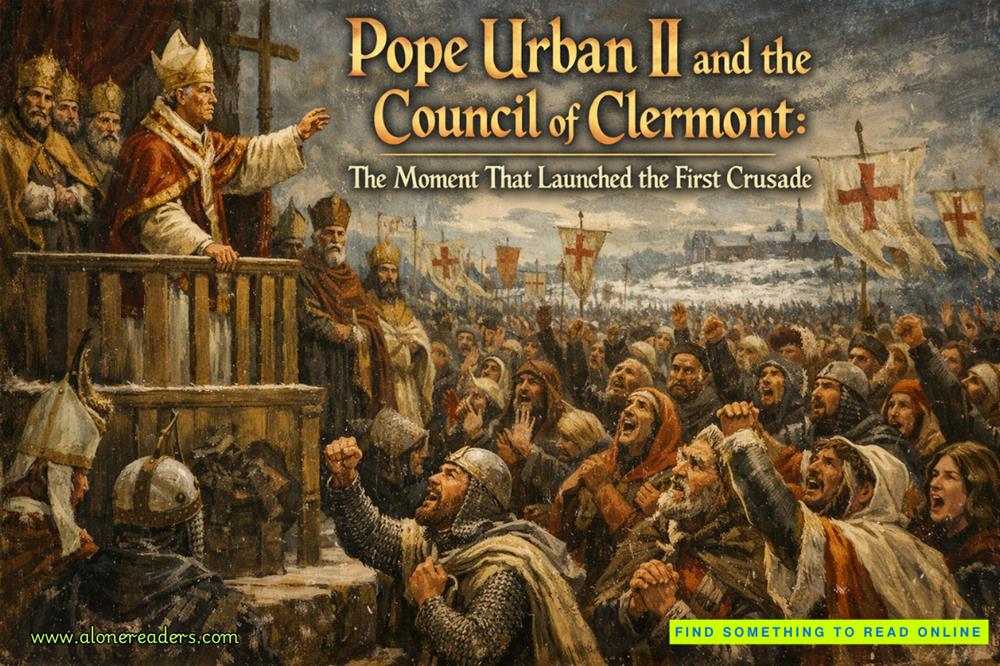
Pope Urban II’s appearance at the Council of Clermont in November 1095 stands as one of the most transformative moments in medieval history, not because of military strategy or territorial conquest, but because of the unprecedented fusion of religious authority, political ambition, and mass mobilization that it unleashed. The call for the First Crusade was not a spontaneous outburst of religious enthusiasm, nor was it a purely defensive reaction to events in the eastern Mediterranean. It was the result of carefully layered pressures within Western Christendom, shaped by decades of reform, conflict, and papal assertion, culminating in a speech that reframed violence as sacred duty and pilgrimage as warfare.
Urban II inherited a Church deeply entangled in the struggle for moral and institutional supremacy. The late eleventh century was marked by the Gregorian Reform movement, which sought to purify the clergy, assert papal independence from secular rulers, and redefine the pope as the supreme spiritual authority in Christendom. Urban was a committed reformer, trained in the intellectual and administrative traditions of the Church, and acutely aware that his legitimacy depended on demonstrating leadership not only over doctrine but over the Christian world itself. The papacy’s confrontation with emperors over investiture had fractured Europe politically, and Urban needed a cause capable of uniting feuding nobles, rebellious bishops, and rival monarchs under a single sacred banner.
The eastern situation provided both opportunity and justification. The Byzantine Empire, battered by internal instability and military defeats following the Battle of Manzikert, had lost much of Anatolia to Turkish powers. Emperor Alexios I Komnenos appealed to the West for military assistance, seeking mercenaries rather than mass migration. Urban, however, recognized something larger: a chance to project papal authority beyond Latin Christendom, heal the schism with the Eastern Church on Roman terms, and redirect Europe’s endemic violence outward. This was not merely aid to Byzantium; it was an assertion that the pope could command Christendom’s warriors as instruments of divine will.
When the Council of Clermont convened, it was officially a church synod dealing with reform issues—clerical discipline, simony, and ecclesiastical governance. Yet its enduring significance lay in the public sermon delivered outside the formal sessions. Urban’s speech, preserved in multiple later versions, was a masterclass in rhetorical adaptation, tailored to resonate with nobles, knights, peasants, and clergy alike. He depicted Eastern Christians as suffering brethren, holy sites as profaned, and Jerusalem as a sacred inheritance unjustly held. The language was vivid, emotional, and deliberately polarizing, drawing a stark moral divide between Christian and infidel, salvation and damnation.
Central to Urban’s appeal was the revolutionary promise of full remission of sins for those who took part, transforming participation into an act of penitential devotion. This innovation cannot be overstated. Warfare, traditionally seen as morally dangerous, was reframed as redemptive when conducted under papal authorization. The crusader was no longer merely a fighter but a pilgrim, bearing arms as an extension of faith. In one stroke, Urban aligned the Church’s penitential system with the military class’s appetite for honor, land, and spiritual assurance.
The response was immediate and electrifying. Cries of “Deus vult”—God wills it—reportedly erupted from the crowd, capturing the fusion of popular enthusiasm and theological justification that defined the crusading movement. What mattered was not the precise wording of Urban’s sermon but its effect: the creation of a shared narrative that transformed disparate grievances into a collective mission. Nobles saw opportunity for status and territory, knights saw sanctified violence, peasants saw deliverance from hardship, and the Church saw obedience translated into action on a continental scale.
Yet beneath the spiritual language lay hard political realities. Western Europe in the late eleventh century was plagued by endemic violence among the warrior aristocracy. Feuds, private wars, and unchecked aggression threatened social stability. The crusade offered a pressure valve, exporting violence toward an external enemy while cloaking it in moral legitimacy. By placing himself at the center of this movement, Urban positioned the papacy as the supreme arbiter of righteous violence, a role that would have profound consequences for centuries.
The Council of Clermont also marked a turning point in mass mobilization. Never before had a pope successfully summoned tens of thousands across social classes to undertake a transcontinental expedition based primarily on spiritual incentive. This was not feudal obligation or imperial conscription; it was voluntary participation driven by belief. The Church demonstrated its capacity to move populations, reshape identities, and reorder priorities across Europe, revealing a level of ideological power unmatched by any secular authority of the age.
Importantly, Urban’s call deliberately left many details vague. There was no clear chain of command, no logistical blueprint, and no unified military structure. This ambiguity allowed the crusade to become a broad, adaptable movement rather than a narrowly controlled campaign. The result was both extraordinary success and catastrophic excess. Popular crusades erupted alongside noble-led armies, and the lack of discipline would later lead to atrocities that Urban himself may not have anticipated or endorsed. Nevertheless, the papal vision had escaped containment, becoming a self-sustaining force within medieval society.
The legacy of Clermont extends far beyond the capture of Jerusalem in 1099. It institutionalized the idea that the pope could authorize holy war, that spiritual rewards could legitimize mass violence, and that Europe could be unified through shared religious purpose rather than dynastic allegiance. It reshaped relations between Christians, Jews, and Muslims, hardened religious identities, and entrenched the notion of a cosmic struggle that transcended local politics. What began as a sermon became a centuries-long paradigm.
Urban II did not live to see the fall of Jerusalem, but his achievement lay elsewhere. He transformed the papacy from a contested moral authority into the commanding voice of Western Christendom. The Council of Clermont was not merely an event; it was a redefinition of power, where words spoken by a pope mobilized armies, redrew maps, and altered the course of global history. The First Crusade was born not on the battlefield, but in the careful orchestration of belief, fear, hope, and obedience—a reminder that ideas, when wielded with precision, can be as decisive as any sword.



 The Hundred Days Offensive: How the Allies Defeated Germany in World War I
 The Second Battle of the Marne: The Turning Point of World War I in 1918
 The Spring Offensive of 1918: Germany's Final Gamble to Win World War I
 The Treaty of Brest-Litovsk: How Russia Left World War I
 The Russian Revolution and World War I: How War Brought Down the Tsar
 The Zimmermann Telegram Explained: Germany's Secret Offer to Mexico in World War I