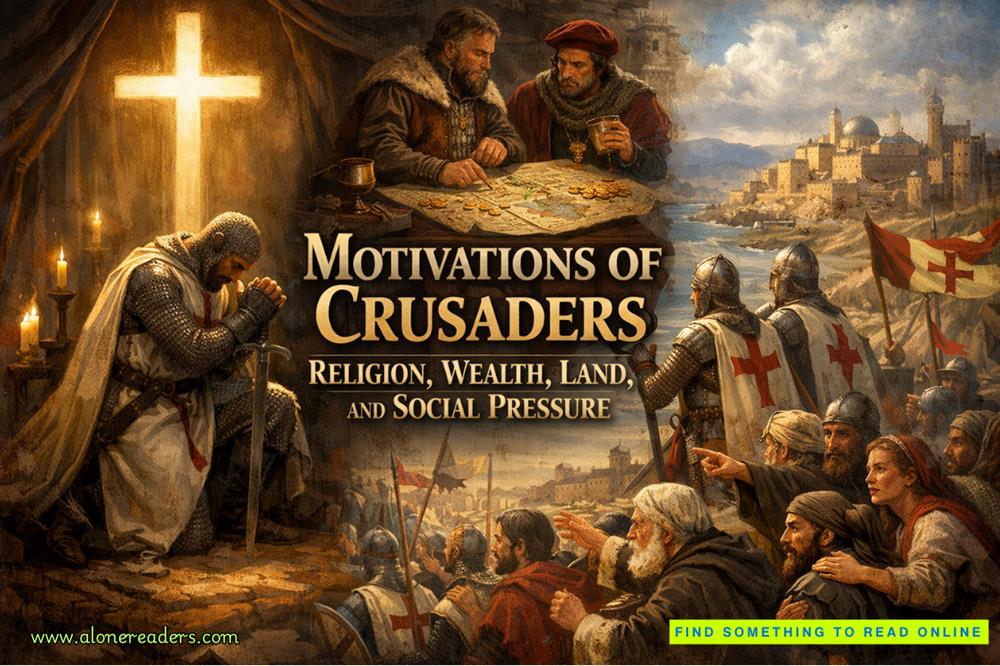
The Crusades were not driven by a single cause, nor can they be understood through a simplistic lens of blind religious fanaticism. They were complex mass movements shaped by a convergence of spiritual belief, material ambition, social obligation, and psychological pressure within medieval European society. To understand why tens of thousands of men and women left their homes, sold their lands, risked financial ruin, and marched thousands of kilometers into unknown and often lethal territories, one must examine the interlocking motivations that defined the crusading experience. Religion provided the moral framework, but wealth, land, status, and social coercion supplied powerful incentives that made crusading both desirable and, at times, unavoidable.
At the core of crusader motivation stood religious conviction, deeply embedded in the medieval worldview. Christianity in the 11th to 13th centuries was not merely a private belief system; it was the organizing principle of life, law, morality, and identity. Salvation was not abstract—it was urgent, fragile, and constantly threatened by sin. The Crusades were presented as a unique spiritual opportunity: a divinely sanctioned war in which violence, normally sinful, became an act of penitence. Crusaders were promised remission of sins, a concept that transformed warfare into a sacred pilgrimage. This was revolutionary. A knight who might otherwise fear damnation for a lifetime of bloodshed was told that by taking the cross, he could cleanse his soul through combat itself. For many, the Crusade was less about killing enemies and more about saving their own eternal souls.
This promise of salvation was amplified through intense preaching campaigns. Clergy described the Holy Land as sacred soil polluted by infidels, portraying the recovery of Jerusalem as a divine mandate. Emotional sermons emphasized Christ’s suffering, framing crusading as an act of love, sacrifice, and obedience. The language was deliberately vivid and moralized: to refuse the call was not neutrality, but cowardice or spiritual failure. In a society where fear of hell was immediate and real, such rhetoric carried enormous psychological weight. Participation became a demonstration of faith, while abstention invited suspicion of moral weakness or impiety.
Yet religious zeal alone cannot explain the scale or persistence of crusading. Material incentives played a critical, though often understated, role. Medieval Europe was a rigidly hierarchical society marked by limited economic mobility. Land was the primary source of wealth, power, and security, but it was concentrated in the hands of a narrow elite. Population growth in the 11th century intensified competition for resources, particularly among the lesser nobility. Younger sons, bound by inheritance customs that favored the eldest, faced bleak prospects. The Crusades offered a potential solution: conquest abroad in place of stagnation at home. The East was imagined as a land of opportunity—rich cities, fertile estates, and spoils waiting to be claimed.
While modern historians caution against exaggerating crusader greed, it is undeniable that expectations of wealth influenced decision-making. Chronicles and letters frequently reference booty, ransoms, and commercial privileges. Italian city-states, in particular, saw the Crusades as openings for trade expansion, naval dominance, and access to lucrative eastern markets. Even individual crusaders hoped to recover costs through plunder or land grants. The idea that faith and profit were mutually exclusive would have seemed foreign to medieval minds; material success was often interpreted as divine favor rather than moral compromise.
Land acquisition, closely tied to wealth, represented another powerful motive. The establishment of crusader states in the Levant created tangible rewards for participants willing to remain after conquest. Fiefs, titles, and lordships were distributed to successful leaders, allowing landless knights to reinvent themselves as territorial rulers. For some, this meant a dramatic elevation in status that would have been impossible in Europe. The Crusades thus functioned as a pressure valve for feudal society, exporting surplus warriors and ambition into frontier zones where new hierarchies could be built through conquest.
Social pressure within medieval communities further intensified the drive to crusade. Society was governed by honor culture, where reputation determined one’s standing as much as wealth or lineage. When nobles publicly took the cross, their peers faced an implicit challenge. Refusal could be interpreted as fear, disloyalty to Christendom, or failure to uphold knightly ideals. Crusading became a public test of masculinity, courage, and moral worth. Once participation became normalized among elites, opting out required justification that few could convincingly provide.
Family dynamics reinforced this pressure. Noble households often treated crusading as a collective endeavor, pooling resources to support one member’s journey in hopes of shared spiritual and material rewards. Wives, parents, and clergy encouraged participation, framing it as both duty and privilege. In some cases, individuals reported feeling coerced by expectations they could not escape without social cost. The Crusade was not merely a personal choice; it was a communal event that reshaped family strategies and local politics.
For the lower classes, motivations differed but were no less compelling. Peasants and townspeople lacked prospects of landownership or political power, yet they too joined crusading movements. Many were driven by apocalyptic beliefs, convinced that participation would usher in divine favor or the imminent end of history. Others were drawn by hopes of improved status, freedom from debts, or simple escape from grinding poverty. The Crusades offered a rare chance to step outside fixed social roles, even if the reality often fell tragically short of expectations.
It is also essential to recognize the role of institutional pressure exerted by the Church. Ecclesiastical authorities framed crusading as a moral obligation, backed by tangible incentives and penalties. Crusaders received legal protections: debts were deferred, property safeguarded, and families placed under Church care. Conversely, those who reneged on vows faced spiritual and social sanctions. By embedding crusading into legal and religious structures, the Church transformed enthusiasm into enforceable commitment.
Over time, these motivations evolved. Early crusaders were driven heavily by apocalyptic fervor and penitential ideals, while later expeditions increasingly reflected political calculation and dynastic ambition. Yet even as objectives shifted, the fundamental blend of faith, gain, and pressure remained constant. Individuals did not choose between religion and material interest; they experienced them as intertwined forces reinforcing one another. A crusader could sincerely seek salvation while also desiring land, honor, and wealth—without perceiving contradiction.
Understanding crusader motivation requires abandoning modern assumptions about rational choice and secular ethics. Medieval actors operated within a moral universe where divine will shaped earthly success, and where collective expectations outweighed individual preference. The Crusades were not irrational explosions of violence but structured responses to specific social, economic, and spiritual conditions. They offered meaning, opportunity, and belonging in a world defined by uncertainty and hierarchy.
In the end, the motivations of crusaders reveal less about fanaticism and more about medieval society itself. They expose a civilization grappling with faith and fear, scarcity and ambition, obligation and hope. The Crusades endured because they addressed multiple needs simultaneously, speaking to the soul, the stomach, and the social order. Any explanation that isolates one motive at the expense of others fails to capture the lived reality of those who took the cross.



 The Hundred Days Offensive: How the Allies Defeated Germany in World War I
 The Second Battle of the Marne: The Turning Point of World War I in 1918
 The Spring Offensive of 1918: Germany's Final Gamble to Win World War I
 The Treaty of Brest-Litovsk: How Russia Left World War I
 The Russian Revolution and World War I: How War Brought Down the Tsar
 The Zimmermann Telegram Explained: Germany's Secret Offer to Mexico in World War I










