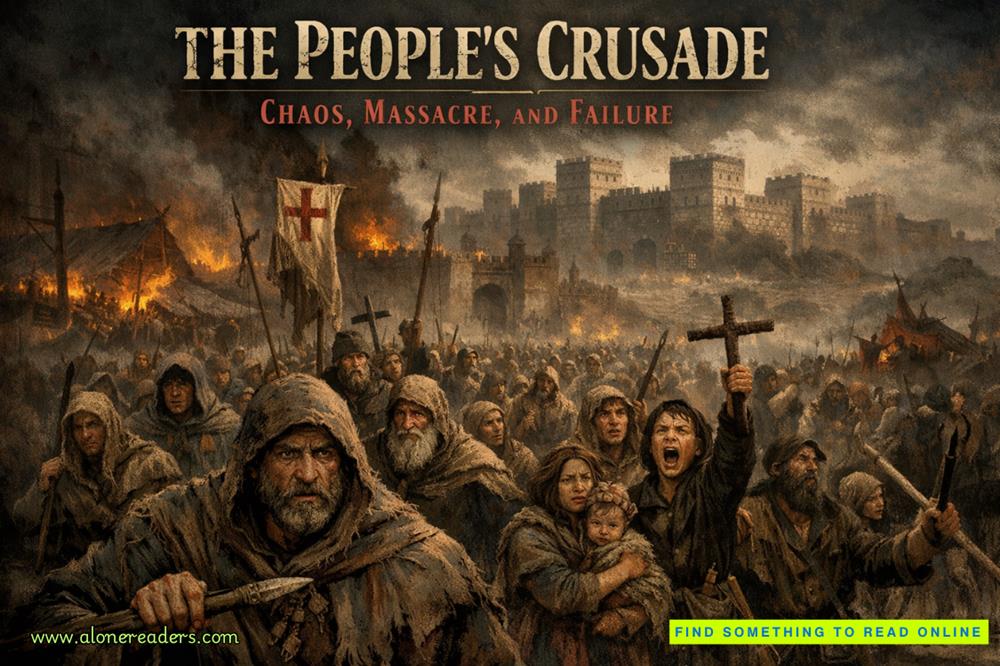
The People’s Crusade stands as one of the most tragic and revealing episodes of medieval history, not because of what it achieved, but because of what it exposed about the volatile fusion of religious fervor, mass desperation, and unchecked violence. Long before armored knights and noble banners marched eastward in what history would later define as the First Crusade, tens of thousands of ordinary people—peasants, laborers, women, children, monks, and outcasts—set out on a journey they barely understood, driven by apocalyptic belief rather than strategy or leadership. Their movement was not a campaign in any military sense; it was a collective emotional eruption, fueled by fear, poverty, millennial expectation, and the promise of divine salvation.
What distinguished the People’s Crusade from later crusading armies was not merely its lack of organization, but its complete absence of institutional restraint. These were not men sworn to feudal lords or trained under banners of command. They were people who believed that faith itself was armor, that suffering was proof of righteousness, and that violence committed in God’s name required no moral accounting. This conviction proved catastrophic almost immediately. As the crowds moved through the Rhineland and Central Europe, the line between pilgrimage and pogrom collapsed entirely. Jewish communities, long marginalized but tolerated within Christian lands, became targets of unprecedented brutality. Entire populations were massacred, forced to convert, or driven to suicide, as crusaders interpreted their suffering as a divine test rather than a crime.
The massacres were not spontaneous eruptions of mob anger alone; they were ideologically rationalized killings, justified by a belief that enemies of Christ existed not only in distant Jerusalem but everywhere. Preachers inflamed these sentiments by declaring that purifying Christendom was a prerequisite to reclaiming the Holy Land. The result was a wave of terror that spread faster than the crusade itself. Cities locked their gates. Local rulers oscillated between reluctant protection of Jewish residents and outright complicity, unwilling or unable to restrain the crowds. The People’s Crusade thus revealed how fragile medieval social order became when religious authority bypassed secular control.
As the movement advanced eastward, its internal weaknesses intensified. Starvation, disease, and desertion followed closely behind faith. With no supply chains, no discipline, and no unified leadership, the crusaders survived by looting villages and extorting towns, turning supposed allies into enemies. What began as a holy mission increasingly resembled a wandering catastrophe, spreading instability across every region it touched. Even within the crusading ranks, violence erupted—against perceived heretics, against leaders accused of weakness, and against anyone who challenged the narrative of divine inevitability.
Upon reaching Byzantine territory, the illusion of holy destiny collided with political reality. The Byzantine authorities, already wary of western crusaders, were horrified by the arrival of a massive, uncontrollable population with no command structure and no respect for authority. The emperor’s priority was containment, not cooperation. The People’s Crusade was hurriedly transported across the Bosporus, less as an act of alliance than as an attempt to remove a destabilizing force from imperial lands. Once in Anatolia, the final stage of the tragedy unfolded with brutal speed.
Facing seasoned and organized Turkish forces, the People’s Crusade stood no chance. Faith could not compensate for the absence of armor, tactics, or intelligence. Camps were poorly defended, scouts nonexistent, and leadership fragmented. When attacks came, they were swift and devastating. Entire contingents were slaughtered within hours. Others were hunted down as they fled into unfamiliar terrain. Survivors were enslaved, killed, or absorbed into local populations, their crusading dream ending not in martyrdom but in obliteration and silence.
The failure of the People’s Crusade was total—not only militarily, but morally. It achieved none of its stated goals, brought devastation to Christian and Jewish communities alike, and forced later crusading leaders to confront the dangers of mass religious mobilization without control. Yet its legacy endured. It demonstrated how ideology, when detached from responsibility, becomes a weapon against society itself. It also set a grim precedent: violence could be sanctified, chaos excused, and atrocity reframed as obedience to God.
In retrospect, the People’s Crusade was not a tragic misunderstanding, but a predictable outcome of a society primed for fear and salvation in equal measure. Europe at the turn of the millennium was burdened by famine, disease, social rigidity, and spiritual anxiety. The promise of redemption through movement—through action—was irresistible. When that promise was paired with absolute certainty and moral exemption, destruction followed naturally. The crusaders believed they were walking toward Jerusalem, but in truth, they were marching into the darkest recesses of collective fanaticism.
This episode remains essential to understanding the Crusades not as a single coherent movement, but as a spectrum ranging from disciplined campaigns to uncontrolled mass hysteria. The People’s Crusade represents the extreme end of that spectrum, where belief replaced reason and salvation justified annihilation. Its story forces an uncomfortable conclusion: that the greatest danger of holy war lies not in its enemies, but in the conviction that no limits apply when violence wears the mask of faith.



 The Hundred Days Offensive: How the Allies Defeated Germany in World War I
 The Second Battle of the Marne: The Turning Point of World War I in 1918
 The Spring Offensive of 1918: Germany's Final Gamble to Win World War I
 The Treaty of Brest-Litovsk: How Russia Left World War I
 The Russian Revolution and World War I: How War Brought Down the Tsar
 The Zimmermann Telegram Explained: Germany's Secret Offer to Mexico in World War I