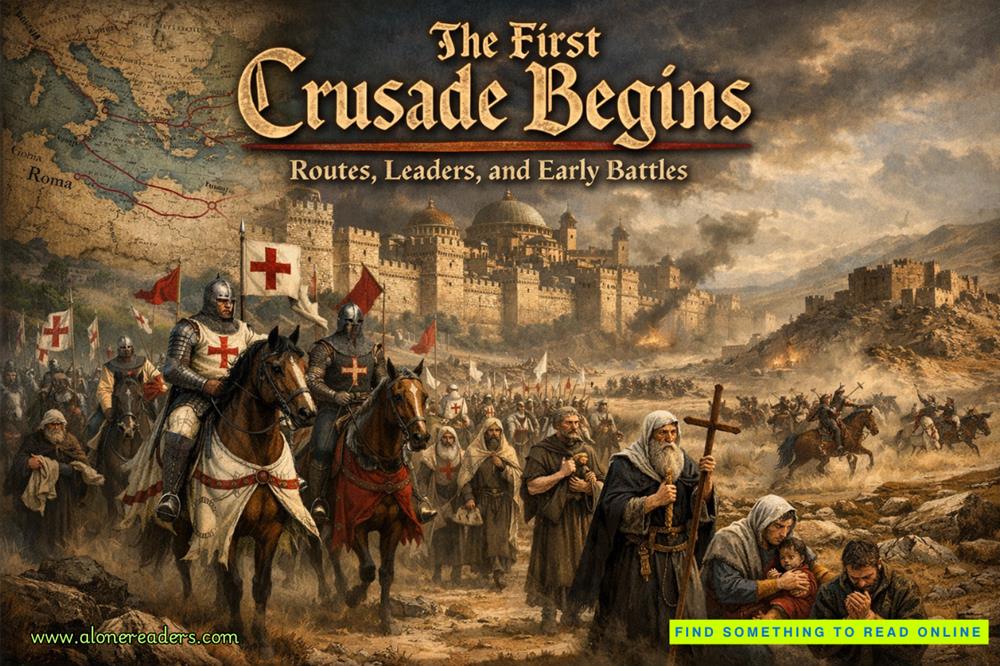
The beginning of the First Crusade was not a single, unified march of disciplined armies but a chaotic convergence of faith, fear, ambition, and desperation that erupted across Europe in the final years of the eleventh century. When Pope Urban II called for armed pilgrimage in 1095, he unleashed forces that neither he nor any contemporary ruler fully controlled. What followed in 1096 was a fragmented yet relentless movement toward the eastern Mediterranean, shaped by divergent routes, rival leaders, and brutal early encounters that defined the Crusade’s character long before Jerusalem came into view. The opening phase revealed that this was not merely a religious expedition, but a mass migration armed with belief, capable of reshaping societies along its path.
The earliest Crusaders did not wait for princes or careful planning. Almost immediately after the call to arms, thousands of peasants, artisans, minor knights, women, and even children abandoned their homes, driven by apocalyptic expectations and promises of divine reward. This movement, later known as the People’s Crusade, surged out of northern France and the Rhineland under charismatic but undisciplined figures who lacked military experience yet commanded enormous emotional loyalty. Their journey exposed one of the central truths of the First Crusade from the outset: zeal often replaced strategy, and conviction frequently overwhelmed caution.
As these popular armies moved eastward along the Rhine and Danube, they left devastation behind. Many participants interpreted their vow to fight non-Christians as immediate permission to attack Jewish communities in German cities such as Worms, Mainz, and Cologne. These massacres, carried out with shocking brutality, demonstrated how the Crusade’s ideological framework could rapidly collapse into uncontrolled violence. For contemporaries, this bloodshed was both a warning and a precedent, revealing that the Crusade would be as destructive within Christendom as beyond it. The early routes thus became corridors of terror long before the Crusaders reached Muslim-controlled lands.
The main princely armies, better organized and militarily capable, began their journeys later in 1096. Unlike the spontaneous mobs, these forces were led by experienced nobles who saw the Crusade as both a sacred duty and an opportunity to expand personal power. Among the most prominent leaders were Godfrey of Bouillon, Duke of Lower Lorraine; Raymond of Saint-Gilles, Count of Toulouse; Bohemond of Taranto, a Norman adventurer from southern Italy; and Hugh of Vermandois, brother of the French king. Each leader commanded troops loyal primarily to himself, not to any unified Crusader authority, a fact that would shape both cooperation and rivalry throughout the campaign.
The routes taken by these armies reflected geography, politics, and supply realities rather than any grand strategic design. Most contingents traveled overland through Central Europe, following Roman roads and river valleys that could sustain large groups. The Danube corridor became the primary artery, drawing armies through Hungary and the Balkans toward Constantinople. This path brought the Crusaders into direct contact with the Byzantine Empire, whose rulers viewed the approaching hosts with deep suspicion. To Byzantines, these Western warriors appeared less like allies and more like armed migrants capable of destabilizing imperial order.
Tensions with Byzantine authorities surfaced immediately. Emperor Alexios I Komnenos demanded that Crusader leaders swear oaths of loyalty and promise to return former imperial territories reconquered from Muslim control. While some leaders complied reluctantly, others saw these demands as humiliating constraints. The resulting mistrust shaped the entire eastern phase of the Crusade. From the beginning, cooperation between Byzantines and Crusaders was transactional, fragile, and marked by mutual fear. This uneasy alliance influenced route selection, provisioning, and early military engagements, ensuring that even Christian unity was riddled with fracture.
Once across the Bosporus into Asia Minor, the Crusaders encountered a radically different landscape and enemy. The Seljuk Turks, masters of mobile cavalry warfare, controlled much of Anatolia and had little interest in defending fixed positions against massive infantry armies. The first major confrontation came near Nicaea, a strategically vital city close to Constantinople. The siege of Nicaea revealed both the strengths and weaknesses of the Crusader forces. While their numbers and determination were formidable, their lack of centralized command and limited siege expertise created vulnerabilities that only Byzantine naval intervention resolved.
The fall of Nicaea in 1097 marked a critical turning point, not only militarily but psychologically. It demonstrated that Muslim-held cities could fall to Crusader arms, reinforcing the belief that divine favor guided the expedition. Yet the manner of the city’s surrender, negotiated secretly between Byzantines and defenders, angered many Crusaders who were denied the opportunity to loot. This episode deepened resentment toward Byzantine allies and reinforced a growing conviction among Western leaders that they alone deserved the rewards of conquest. From this moment, the Crusade became as much about possession as salvation.
The march across Anatolia that followed was one of the most punishing phases of the entire Crusade. Crusader armies split into columns to forage more effectively, exposing themselves to Turkish hit-and-run attacks. Heat, thirst, disease, and starvation claimed thousands of lives. Horses, essential for knights, died in vast numbers, forcing many mounted warriors to continue on foot. The Battle of Dorylaeum, fought in July 1097, highlighted the Crusaders’ ability to adapt under pressure. Initially ambushed and nearly destroyed, they regrouped, formed defensive infantry lines, and ultimately repelled Turkish forces through sheer persistence and numerical weight.
Dorylaeum established a grim pattern for early Crusader warfare. Victory was achieved not through tactical brilliance but through endurance, brutality, and willingness to absorb catastrophic losses. The battle also cemented the reputation of Norman and Frankish knights as fearsome fighters, capable of maintaining cohesion under extreme conditions. At the same time, it revealed the cost of crusading warfare: survival itself became a form of triumph, and every mile eastward was purchased with blood.
As the Crusaders pushed deeper into the Near East, leadership tensions intensified. Raymond of Toulouse pursued a vision of moral authority and spiritual legitimacy, while Bohemond sought territorial control and personal power. Godfrey of Bouillon attempted to maintain unity but lacked formal supremacy. These rival ambitions influenced route decisions, siege priorities, and alliances with local Armenian Christian communities, who often served as guides, suppliers, and intermediaries. The Crusade’s path thus bent not only around mountains and rivers but around the ambitions of its commanders.
The early battles and marches of the First Crusade transformed the expedition from a hopeful pilgrimage into a hardened war machine. Ideals of penance and redemption coexisted with looting, massacre, and political calculation. Ordinary participants, initially motivated by visions of spiritual reward, became accustomed to extreme violence as a daily necessity. This normalization of brutality was one of the Crusade’s most enduring legacies. Violence ceased to be a means and became an identity, shaping how Crusaders viewed both enemies and themselves.
By the time the armies reached northern Syria, they were no longer simply European Christians marching toward Jerusalem. They were survivors of a transcontinental ordeal, bound together by shared suffering and sharpened by continuous conflict. The routes they carved through Europe and Asia Minor became conduits for cultural exchange, economic disruption, and long-term hostility between civilizations. The leaders who emerged from the early phase were not saints or heroes in any simple sense, but warlords forged by necessity, rivalry, and belief.
The beginning of the First Crusade thus set the tone for everything that followed. Its fragmented routes reflected a fractured Christendom; its leaders embodied competing visions of faith and power; its early battles revealed a willingness to endure and inflict unprecedented suffering. Long before Jerusalem’s walls appeared on the horizon, the Crusade had already achieved something irreversible. It had proven that faith could mobilize continents, justify atrocities, and redraw the map of the medieval world, leaving consequences that would echo for centuries.



 The Hundred Days Offensive: How the Allies Defeated Germany in World War I
 The Second Battle of the Marne: The Turning Point of World War I in 1918
 The Spring Offensive of 1918: Germany's Final Gamble to Win World War I
 The Treaty of Brest-Litovsk: How Russia Left World War I
 The Russian Revolution and World War I: How War Brought Down the Tsar
 The Zimmermann Telegram Explained: Germany's Secret Offer to Mexico in World War I