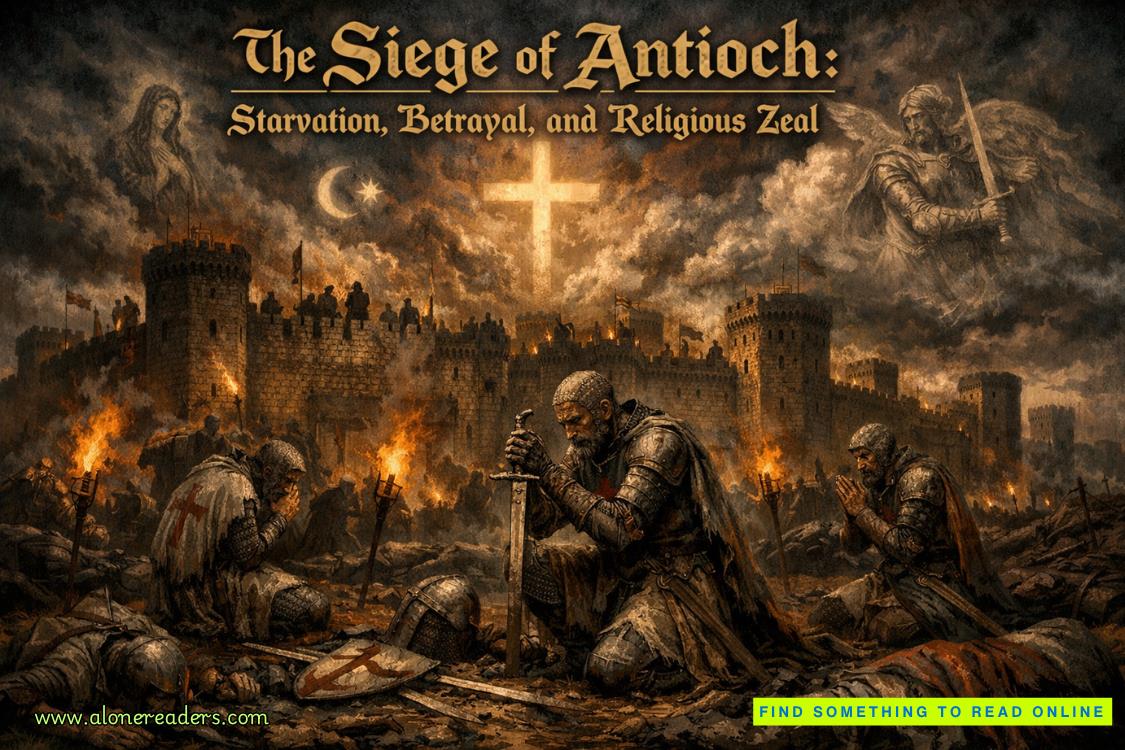
The Siege of Antioch stands as one of the most harrowing and psychologically revealing episodes of the First Crusade, a prolonged ordeal that exposed the brutal intersection of hunger, faith, ambition, and human frailty. What began as a confident march toward holy conquest deteriorated into a desperate struggle for survival, testing not only military endurance but also the moral and spiritual limits of the Crusaders themselves. Antioch was not merely a city to be captured; it was a crucible in which the Crusading ideal was stripped bare, revealing a volatile mixture of religious ecstasy, ruthless pragmatism, and existential fear.
Antioch’s strategic and symbolic value made it unavoidable. Situated at the crossroads between Anatolia and Syria, it controlled access to the eastern Mediterranean and the road to Jerusalem. Its towering walls, reinforced by more than four hundred towers and protected by mountainous terrain, rendered a swift assault impossible. The Crusaders, arriving in late 1097, were ill-prepared for a siege of such magnitude. Their forces were fragmented, their leadership divided, and their supply lines tenuous at best. What followed was not a triumph of arms but a slow descent into deprivation that reshaped the very nature of the Crusading enterprise.
As the months dragged on, starvation became the siege’s most relentless enemy. The surrounding countryside had already been stripped bare by earlier armies, and Antioch’s defenders retained control of key gates, allowing them to harass foraging parties with devastating efficiency. Horses—symbols of knightly status and military power—were slaughtered and eaten. Leather belts, boots, and saddle straps were boiled into gelatinous meals. Contemporary accounts speak of soldiers collapsing mid-march, their bodies unable to sustain even minimal exertion. Hunger erased social distinctions, reducing nobles and peasants alike to scavengers in a hostile land.
Disease flourished in the filth of the Crusader camps. Dysentery, fevers, and malnutrition spread unchecked, killing silently and indiscriminately. Morale fractured under the strain. Desertion, once unthinkable for men sworn to a holy cause, became increasingly common. Some fled under cover of darkness, others openly abandoned the siege, convinced that God had withdrawn His favor. These acts were met with public shaming and threats of eternal damnation, yet fear proved stronger than doctrine for many. The ideal of holy unity, so powerful at the Crusade’s outset, fractured under the pressure of prolonged suffering.
Inside Antioch, conditions were hardly comfortable, but the defenders possessed a decisive advantage: control. They could ration supplies, rotate troops, and exploit the Crusaders’ disorganization. Muslim forces launched frequent sorties, inflicting casualties and reinforcing the sense that the besiegers were, in truth, the trapped ones. The psychological toll of this inversion was immense. The Crusaders had come as conquerors; they now existed in a state of permanent siege anxiety, unsure whether starvation or attack would claim them first.
Leadership rivalries deepened the crisis. The Crusade lacked a unified command structure, and personal ambition frequently overrode collective necessity. Accusations of hoarding, favoritism, and cowardice circulated freely. Trust eroded as survival instincts took precedence. In this climate of desperation, betrayal became not only conceivable but inevitable. The fall of Antioch did not come through martial brilliance but through clandestine negotiation, revealing how far the Crusaders had drifted from their proclaimed ideals.
The city was ultimately betrayed from within by a disaffected guard, whose motives remain a subject of debate—greed, resentment, or simple survival. Under cover of night, a small group of Crusaders scaled the walls using a concealed access point, opening the gates to their starving comrades. The ensuing slaughter was swift and merciless. Men, women, and children were cut down as the Crusaders surged through the streets, driven by months of pent-up rage and hunger. The conquest was not celebrated as a victory of faith but endured as an explosion of accumulated despair.
Yet even this grim triumph offered no relief. Within days, Antioch itself was besieged by a massive relief army. The Crusaders, now trapped inside the city they had barely secured, faced annihilation. Supplies were scarce, defenses damaged, and morale at its lowest point. It was at this moment of utter desperation that religious zeal reached its most extreme and transformative expression. Visions, prophecies, and divine revelations proliferated, offering psychological escape from an otherwise hopeless reality.
The discovery of a sacred relic—claimed to be a holy spear associated with Christ’s crucifixion—became the emotional fulcrum of the siege’s final phase. To modern sensibilities, the episode borders on collective delusion, yet within the medieval worldview, it provided absolute validation of divine favor. Starving soldiers wept, prayed, and renewed their vows, convinced that their suffering mirrored that of biblical martyrs. The relic did not fill empty stomachs, but it restored something equally vital: purpose.
Religious zeal, inflamed by hardship, transformed the Crusader army into a force driven less by rational calculation than by apocalyptic conviction. When they marched out to confront the besieging army, they did so not as a conventional fighting force but as men convinced that victory was divinely guaranteed. Against all expectations, they prevailed. Whether through tactical surprise, enemy disunity, or sheer desperation, the outcome reinforced the belief that God actively intervened on their behalf. Faith, born of starvation and fear, had become a weapon.
The Siege of Antioch thus stands as a defining paradox of the First Crusade. It was both a military success and a moral catastrophe, a testament to endurance and a warning about fanaticism. The Crusaders emerged victorious, yet fundamentally altered. They had learned that betrayal could be sanctified, that atrocity could be justified, and that suffering could be reinterpreted as proof of righteousness. These lessons would echo throughout the remainder of the Crusade and beyond, shaping attitudes toward warfare, faith, and the enemy.
In Antioch, the Crusading movement shed any remaining illusion of chivalric purity. What remained was a hardened ideology forged in starvation, validated by selective belief, and sustained by the conviction that divine will excused human brutality. The city’s walls did not merely contain a battle; they enclosed a transformation. The Siege of Antioch was not just fought—it was endured, rationalized, and mythologized, leaving an indelible mark on medieval history and on the psychology of holy war itself.
More than nine centuries later, Antioch still compels attention because it exposes the dangerous power of belief when combined with desperation. It reminds us that religious zeal, when untethered from restraint, can justify betrayal as virtue and suffering as destiny. In the end, the siege was not simply about territory or theology, but about how far human beings will go when convinced that heaven itself demands endurance at any cost.



 The Hundred Days Offensive: How the Allies Defeated Germany in World War I
 The Second Battle of the Marne: The Turning Point of World War I in 1918
 The Spring Offensive of 1918: Germany's Final Gamble to Win World War I
 The Treaty of Brest-Litovsk: How Russia Left World War I
 The Russian Revolution and World War I: How War Brought Down the Tsar
 The Zimmermann Telegram Explained: Germany's Secret Offer to Mexico in World War I