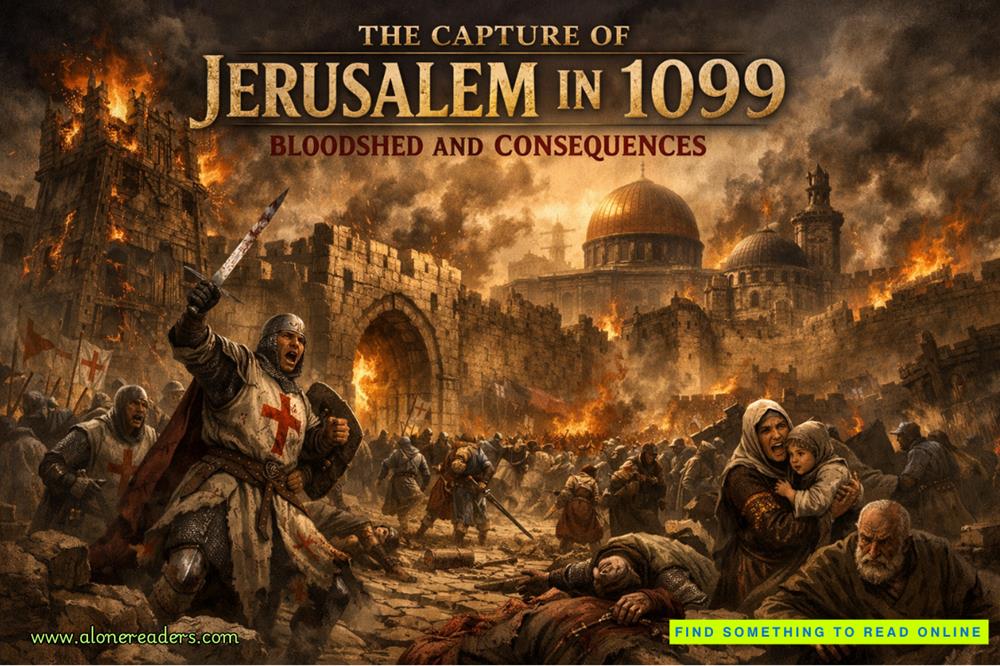
The capture of Jerusalem in July 1099 marked one of the most violent and symbolically charged moments of the medieval world, representing both the triumphant climax of the First Crusade and a descent into mass slaughter that would echo through centuries of religious memory and geopolitical conflict. After nearly three years of brutal campaigning across Anatolia and the Levant, the Crusader armies—exhausted, starving, and fractured by internal rivalries—finally reached the city they believed was the spiritual center of the Christian world. Jerusalem was not merely a strategic objective; it was imagined as a divine prize, a sacred inheritance that had to be reclaimed regardless of human cost. This fusion of military ambition and apocalyptic belief shaped every stage of the siege and its aftermath.
By the time the Crusaders arrived at Jerusalem on June 7, 1099, the city had recently changed hands. It was under the control of the Fatimid Caliphate of Egypt, having been retaken from the Seljuk Turks just a year earlier. The Fatimids, recognizing the danger posed by the approaching Crusader host, expelled most of the Christian population from the city while allowing Jewish and Muslim inhabitants to remain. This decision would later have catastrophic consequences. The defenders fortified the walls, destroyed surrounding wells, and prepared for a prolonged siege, confident that the Crusaders—short on supplies and siege equipment—would struggle to mount a successful assault.
The Crusader army itself was a shadow of its former strength. Disease, desertion, and starvation had thinned its ranks, and internal disputes among leaders such as Godfrey of Bouillon, Raymond of Toulouse, and Tancred of Hauteville threatened cohesion. Yet what the Crusaders lacked in resources, they compensated for with an intense belief that their mission was divinely ordained. Chroniclers describe visions, prophecies, and collective fasts, reinforcing the conviction that God would intervene on their behalf if they demonstrated sufficient faith and unity. This mindset transformed the siege into a spiritual trial as much as a military operation.
The initial assaults on Jerusalem’s walls failed disastrously. Lacking ladders and siege towers, the Crusaders were repelled with heavy losses. Morale plummeted as thirst became unbearable in the summer heat. The turning point came with the arrival of Genoese ships at the port of Jaffa, which provided timber and skilled engineers. These materials were transported overland and rapidly converted into siege towers and battering rams. The Crusaders reorganized their forces, assigning different sectors of the wall to rival commanders in a tense but necessary cooperation.
On July 13, 1099, the final assault began. Siege towers were rolled forward under covering fire, and after two days of relentless combat, a breach was achieved near the northern walls. Once the Crusaders gained a foothold, resistance collapsed with shocking speed. What followed was not a controlled occupation but an eruption of violence that even contemporary observers struggled to justify. Crusader chronicles, written with pride rather than remorse, describe streets running with blood, bodies piled in sacred spaces, and indiscriminate killing of Muslims and Jews alike. The Temple Mount, one of the holiest sites in Islam and Judaism, became a scene of mass slaughter.
The scale of the bloodshed has been debated by historians, but there is no serious dispute that it was extensive and systematic. Men, women, and children were killed regardless of age or status. Jewish inhabitants who sought refuge in synagogues were burned alive. Muslim defenders who surrendered were often executed. This was not merely an act of wartime brutality; it was framed by the Crusaders as a sacred cleansing of the city. To them, Jerusalem had been defiled by non-Christian rule, and its purification required violence on an unprecedented scale.
Religious symbolism saturated the aftermath. Crusaders reportedly walked barefoot through the city, weeping with joy and gratitude, visiting holy sites still stained with blood. The contradiction between spiritual exaltation and mass murder was not perceived as hypocrisy by the participants. Instead, violence was interpreted as proof of divine favor. This worldview, deeply embedded in medieval theology, left little room for mercy when enemies were defined as enemies of God.
The immediate political consequence of the conquest was the establishment of the Latin Kingdom of Jerusalem, a Crusader state governed by Western European elites. Godfrey of Bouillon refused the title of king, claiming he would not wear a crown of gold where Christ had worn a crown of thorns, instead adopting the title “Defender of the Holy Sepulchre.” Despite this gesture of humility, the new regime was militarized, exclusionary, and dependent on constant warfare to survive. The city was repopulated with Christian settlers, while Muslims and Jews were largely excluded or reduced to second-class status.
Beyond the walls of Jerusalem, the massacre had far-reaching consequences. News of the bloodshed spread rapidly across the Islamic world, transforming what had initially been perceived as a limited foreign invasion into a civilizational threat. The capture of Jerusalem crystallized Muslim resistance and reshaped Islamic political thought around the concept of jihad as a defensive obligation. Leaders who might otherwise have remained divided began to see unity as essential for survival. Over the next decades, this ideological shift would lay the groundwork for figures such as Nur ad-Din and Saladin.
The event also altered Christian-Muslim relations in ways that proved nearly impossible to reverse. For Muslims and Jews, the memory of 1099 became a symbol of betrayal, cruelty, and religious intolerance. For Western Christians, it was celebrated as a heroic victory, reinforcing a narrative of divine mission that justified further crusading expeditions. This divergence in memory ensured that Jerusalem would remain a contested symbol rather than a shared sacred space.
Economically and strategically, the conquest of Jerusalem placed enormous strain on the Crusader states. The city itself held immense religious value but limited practical resources. Supplying and defending it required constant support from Europe and control of surrounding territories. This vulnerability made the Crusader presence inherently unstable. The very violence that secured Jerusalem in 1099 also guaranteed that it would be surrounded by hostile forces determined to reclaim it.
Over time, the moral legacy of the massacre became increasingly difficult to reconcile even within Christian thought. Later medieval writers attempted to downplay or contextualize the killings, while modern historians have grappled with the challenge of explaining how religious devotion could coexist with such brutality. The capture of Jerusalem in 1099 stands as a stark reminder of how absolutist belief systems can erode moral boundaries when violence is sanctified.
In the long arc of history, the events of July 1099 did not represent an endpoint but a beginning. The city would change hands multiple times, each conquest layered with memories of previous bloodshed. Yet the first Crusader capture remained uniquely traumatic because it set the tone for centuries of conflict. Jerusalem became not only a holy city but a symbol of irreconcilable claims, each rooted in historical trauma and sacred narrative.
The capture of Jerusalem in 1099 was therefore far more than a medieval military victory. It was a moment where faith, fear, and fanaticism converged, reshaping the political and religious landscape of the Middle East and Europe alike. Its bloodshed forged myths, hardened identities, and ensured that Jerusalem would remain one of the most emotionally charged cities in human history. Understanding this event in its full complexity is essential not only for grasping the nature of the Crusades but for recognizing how the past continues to shape conflicts long after the swords have fallen silent.



 The Hundred Days Offensive: How the Allies Defeated Germany in World War I
 The Second Battle of the Marne: The Turning Point of World War I in 1918
 The Spring Offensive of 1918: Germany's Final Gamble to Win World War I
 The Treaty of Brest-Litovsk: How Russia Left World War I
 The Russian Revolution and World War I: How War Brought Down the Tsar
 The Zimmermann Telegram Explained: Germany's Secret Offer to Mexico in World War I