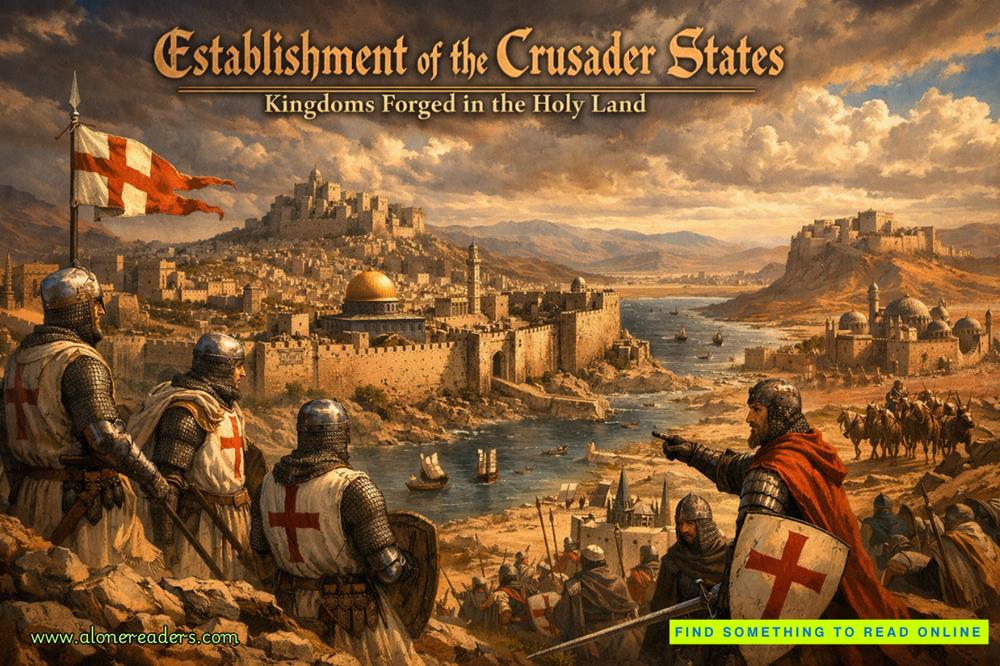
The establishment of the Crusader States in the Holy Land was one of the most consequential outcomes of the First Crusade, transforming a religious expedition into a long-term colonial and political enterprise. What began in 1096 as a penitential pilgrimage armed with violence evolved, by 1109, into a network of Latin Christian principalities carved out of predominantly Muslim lands. These states were not pre-planned imperial creations but improvised regimes born from conquest, survival, and opportunism, shaped by European feudal traditions and the harsh realities of the eastern Mediterranean world. The Crusader States represented the first sustained Western European political presence in the Middle East since antiquity, and their existence fundamentally altered relations between Christianity and Islam for nearly two centuries.
The roots of these states lay in the extraordinary military success of the First Crusade. After capturing Jerusalem in July 1099, the crusading armies found themselves in possession of vast territories without any unified strategy for governance. Many crusaders returned to Europe, believing their vows fulfilled, but others chose to remain, drawn by land, power, and religious purpose. The vacuum of authority created by the collapse of local Muslim control in key regions allowed ambitious leaders to establish personal dominions, often legitimized by conquest rather than formal authorization from the papacy or Byzantine Empire. In this sense, the Crusader States were as much feudal lordships as they were religious frontiers.
The earliest of these polities was the County of Edessa, founded in 1098. Located far inland in Upper Mesopotamia, Edessa was geographically isolated from the other Crusader holdings, making it both strategically vulnerable and politically distinctive. Its establishment owed less to direct crusading objectives than to the personal ambition of Baldwin of Boulogne, who maneuvered his way into power through alliances with local Armenian elites. Edessa functioned as a hybrid state, blending Frankish military rule with Armenian administrative structures, reflecting the adaptability required for survival in unfamiliar territory. However, its isolation and lack of strong natural defenses would later make it the first Crusader State to fall.
The Principality of Antioch emerged from one of the most brutal sieges of the First Crusade. Captured in 1098 after months of starvation, betrayal, and internal conflict, Antioch became the seat of a powerful and fiercely independent Latin principality. Its ruler, Bohemond of Taranto, rejected Byzantine claims to the city, setting a precedent for strained relations between the Crusader States and the Eastern Roman Empire. Antioch was militarized to an extreme degree, surrounded by hostile forces and dependent on constant warfare to maintain its borders. Its strategic location near Asia Minor made it both a bulwark against Muslim counterattacks and a persistent source of diplomatic tension.
The Kingdom of Jerusalem, established after the capture of the holy city in 1099, became the most symbolically significant and politically complex of the Crusader States. Unlike Edessa or Antioch, Jerusalem was not merely a strategic prize but the spiritual heart of Latin Christendom. The city’s conquest was accompanied by widespread slaughter, leaving a deep and lasting scar on Muslim and Jewish memory. The rulers of Jerusalem faced the challenge of governing a sacred city with a largely non-Christian population, requiring a careful balance between religious ideology and practical administration. Over time, the kingdom developed sophisticated legal codes, including the Assizes of Jerusalem, which attempted to codify feudal rights in an environment of perpetual war.
The County of Tripoli, founded in 1109 after a prolonged campaign along the Levantine coast, completed the network of Crusader States. Strategically positioned between Antioch and Jerusalem, Tripoli served as a vital link in trade and communication. Its establishment demonstrated the gradual transition from crusading warfare to colonial consolidation. Coastal control allowed the Crusader States to maintain supply lines from Europe, particularly through Italian maritime republics whose commercial interests became deeply entwined with the survival of the Latin East. This reliance on naval power underscored the fundamentally foreign nature of Crusader rule.
Governance within the Crusader States combined European feudal institutions with adaptations to local conditions. Land was distributed as fiefs to knights, creating a warrior aristocracy dependent on constant military readiness. Yet the demographic reality posed severe challenges. Latin Christians were always a numerical minority, ruling over Muslim, Eastern Christian, and Jewish populations. As a result, the Crusader States often practiced pragmatic tolerance, allowing local communities to retain their laws, religious practices, and economic roles in exchange for taxes and obedience. This coexistence was uneasy and conditional, shaped more by necessity than by ideological openness.
Military survival was the defining concern of the Crusader States. Surrounded by hostile powers, they developed a culture of permanent warfare. Castles and fortifications became the backbone of their defense, transforming the landscape of the Holy Land. The emergence of military orders, such as knightly brotherhoods dedicated to both monastic discipline and combat, reflected the fusion of faith and warfare that characterized Crusader society. These orders provided a professional, standing military force that compensated for the chronic shortage of manpower.
Diplomacy was equally crucial. The Crusader States navigated a complex web of alliances and rivalries, not only with Muslim rulers but also among themselves and with neighboring Christian powers. Internal divisions frequently undermined their stability. Succession crises, feudal disputes, and competing claims weakened collective defense. The lack of centralized authority meant that unity was fragile and often short-lived, especially in moments of external threat. At times, Crusader leaders even allied with Muslim factions against rival Christians, revealing the pragmatic nature of frontier politics.
Economically, the Crusader States depended on agriculture, trade, and taxation. Fertile coastal plains and inland valleys supported crops such as grain, olives, and sugar, while ports facilitated commerce between East and West. Italian merchants gained privileges in exchange for naval support, creating semi-autonomous quarters within major cities. This commercial integration linked the Crusader States to the broader Mediterranean economy, but it also made them vulnerable to shifts in trade routes and political alliances.
Culturally, the Crusader States were zones of intense interaction. Latin settlers encountered Byzantine traditions, Islamic scholarship, and Eastern Christian practices, leading to a degree of cultural exchange despite ongoing conflict. Architecture blended Western and Eastern styles, while daily life reflected a mix of customs and languages. However, this interaction did not erase fundamental divisions, and religious identity remained a powerful marker of inclusion and exclusion. The ideological narrative of holy war continued to justify violence and domination.
The establishment of the Crusader States marked a turning point in the history of the Crusades. What began as a temporary expedition evolved into a sustained effort to create Christian kingdoms in the heart of the Islamic world. These states were neither fully European nor fully Eastern, existing instead as fragile hybrids sustained by military force, religious conviction, and external support. Their creation institutionalized the conflict between Crusading Christendom and the Muslim Near East, ensuring that the struggle would continue long after the First Crusade ended.
In retrospect, the Crusader States can be understood as experiments in medieval colonialism, shaped by faith but driven by power and survival. Their foundations were laid in blood and belief, yet their endurance depended on adaptability and compromise. Though ultimately doomed by demographic weakness and resurgent Muslim powers, their establishment reshaped the political and cultural landscape of the eastern Mediterranean. The kingdoms forged in the Holy Land were not mere byproducts of crusade ideology but central actors in a prolonged and transformative historical confrontation, the echoes of which continue to influence perceptions of East and West today.



 The Hundred Days Offensive: How the Allies Defeated Germany in World War I
 The Second Battle of the Marne: The Turning Point of World War I in 1918
 The Spring Offensive of 1918: Germany's Final Gamble to Win World War I
 The Treaty of Brest-Litovsk: How Russia Left World War I
 The Russian Revolution and World War I: How War Brought Down the Tsar
 The Zimmermann Telegram Explained: Germany's Secret Offer to Mexico in World War I