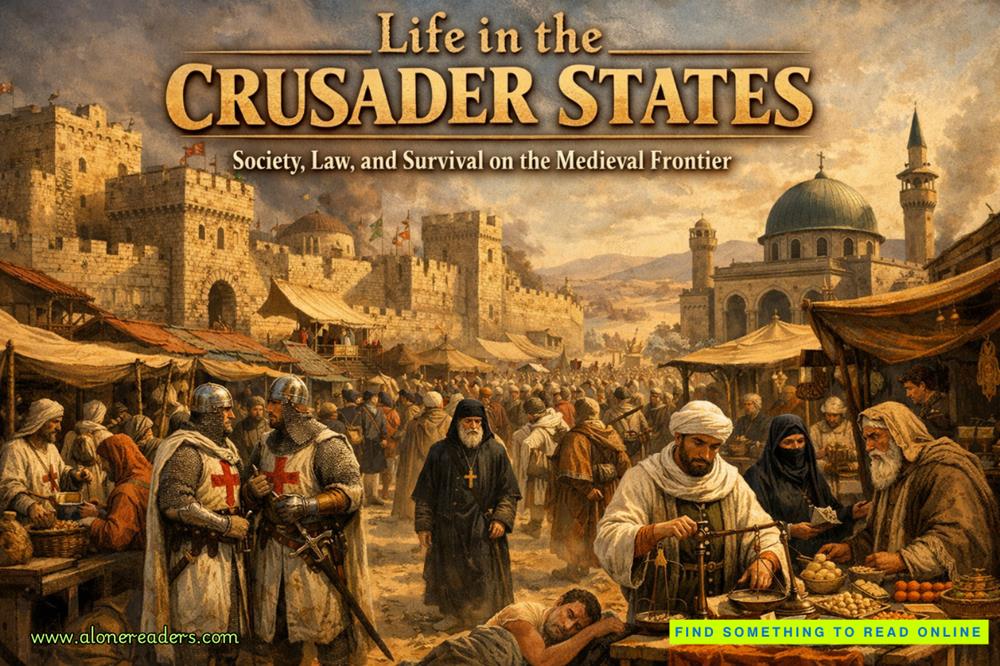
Life in the Crusader States was defined not by romantic ideals of chivalry or holy conquest, but by constant adaptation, legal improvisation, and daily struggle for survival on one of the most volatile frontiers of the medieval world. From the moment the First Crusaders carved out Latin-controlled territories in the eastern Mediterranean, they inherited lands that were culturally sophisticated, religiously diverse, and politically unstable. The resulting societies that emerged in the Kingdom of Jerusalem, the County of Tripoli, the Principality of Antioch, and the County of Edessa were unlike anything in Western Europe. They were hybrid frontier societies, shaped as much by fear and pragmatism as by faith.
The social structure of the Crusader States rested on a thin layer of Frankish elites ruling over a vastly larger indigenous population. Latin Christians—primarily French, Norman, and Flemish settlers—formed the ruling aristocracy, controlling land, fortresses, and legal authority. Beneath them lived a complex mosaic of Eastern Christians, Muslims, Jews, Armenians, Syriacs, and Greeks, many of whom had inhabited these regions for centuries before the arrival of the Crusaders. The Latin settlers were always a minority, a reality that shaped every aspect of governance, security, and daily life.
Unlike in Europe, where feudal systems evolved gradually, feudalism in the Crusader States was imposed rapidly and adapted under pressure. Land grants were tied directly to military service, and every noble estate was expected to contribute knights for defense. Yet manpower was perpetually scarce. Death from battle, disease, and climate took a relentless toll, forcing rulers to rely heavily on military orders such as the Templars and Hospitallers. These orders became not only warriors but landlords, bankers, judges, and administrators, embedding themselves deeply into civilian life.
Law in the Crusader States reflected this precarious existence. The legal system, often referred to as the Assizes, combined Western feudal traditions with local customs and emergency wartime measures. There were separate courts for nobles, burgesses, and non-Latins, reinforcing rigid social divisions while allowing a degree of autonomy for indigenous communities. Justice was swift, severe, and deeply tied to military necessity. Crimes that threatened communal security—treason, desertion, or collaboration with enemies—were punished harshly, often by mutilation or execution.
For ordinary Latin settlers, daily life oscillated between routine and crisis. Urban centers such as Jerusalem, Acre, and Tyre bustled with trade, pilgrims, and diplomacy, while rural settlements existed under constant threat of raids. Farmers often lived near fortified villages, retreating behind walls at the first sign of danger. Harvest seasons were tense affairs, conducted under armed guard. A single failed harvest could mean starvation, especially when supply lines from Europe were disrupted by war or piracy.
Indigenous populations experienced Crusader rule in complex and often contradictory ways. While conquest brought violence and displacement, many local communities continued their religious practices, languages, and economic activities with limited interference. Muslims and Eastern Christians paid taxes, worked the land, and engaged in commerce, sometimes finding Crusader administration more predictable than previous regimes. Pragmatism often outweighed ideology, particularly in matters of trade, medicine, and technical expertise, where local knowledge was indispensable.
Markets were the beating heart of Crusader urban life. Spices, textiles, glassware, sugar, and agricultural products flowed through Levantine ports, connecting Europe to the Islamic world. Italian merchant republics dominated commerce, operating semi-autonomous quarters within cities. These enclaves functioned almost as city-states, complete with their own laws and militias. Economic survival depended on cooperation with non-Christians, even as religious warfare defined the political landscape.
Health and sanitation posed constant challenges. European settlers were ill-prepared for the Levantine climate, suffering from heat exhaustion, unfamiliar diseases, and contaminated water. Epidemics could decimate entire garrisons. Hospitals run by religious orders became essential institutions, providing care not only for soldiers but also for civilians and pilgrims. Medical practices blended Western, Byzantine, and Islamic knowledge, resulting in more advanced treatment methods than those found in contemporary Europe.
Religion permeated every aspect of life, but it did not create unity. Latin Christians viewed Eastern Christian rites with suspicion, often treating them as inferior or heretical. Tensions between different Christian denominations were frequent, sometimes erupting into violence. At the same time, shared fear of external threats occasionally fostered cooperation. Survival forced uneasy coexistence, even among groups that deeply mistrusted one another.
Women in the Crusader States occupied roles that were both constrained and unexpectedly influential. Noblewomen often managed estates during their husbands’ absence or death, wielding legal authority over lands and dependents. In urban centers, women participated in trade, ran workshops, and managed households in dangerous conditions. Widowhood was common, and remarriage was often a matter of political or economic necessity rather than personal choice.
Children grew up amid violence and instability. Boys were trained early for military roles, while girls were prepared for marriages that would strengthen alliances or preserve property. Education existed primarily through religious institutions, emphasizing scripture, law, and basic literacy. Childhood was brief, shaped by the ever-present possibility of siege, flight, or loss.
Warfare was not an occasional disruption but a constant backdrop. Even during periods of truce, raids, espionage, and skirmishes continued. Fortifications dominated the landscape, from massive stone castles to modest watchtowers. Life revolved around these structures, which served as refuges, administrative centers, and symbols of authority. The sound of alarm bells was a familiar part of daily existence, signaling either imminent danger or the return of exhausted defenders.
Food security was a persistent concern. The Crusader States relied heavily on imported grain, particularly during sieges. Diets combined European staples with local ingredients, including olives, dates, chickpeas, and spices. Meat was scarce outside urban centers, and fasting regulations further restricted consumption. Hunger was a political weapon, exploited by besieging armies to force surrender.
Despite these hardships, a distinct frontier culture emerged. Frankish settlers adopted local clothing styles, architectural techniques, and agricultural practices. Languages mixed, customs blended, and new identities formed that were neither fully European nor entirely Levantine. This cultural adaptation alarmed critics in Europe, who accused settlers of moral decay, yet it was essential for survival. Rigid adherence to European norms would have meant extinction.
Ultimately, life in the Crusader States was an exercise in endurance. It demanded flexibility, compromise, and a willingness to live with constant uncertainty. These societies were not sustained by religious zeal alone, but by legal innovation, economic integration, and everyday resilience. Their legacy lies not only in castles and chronicles, but in the stark lesson that ideology cannot survive without pragmatism, especially on a frontier where survival was never guaranteed.
The Crusader States endured for nearly two centuries, not because they were strong, but because their inhabitants learned—often painfully—how to live between worlds, balancing faith and fear, power and vulnerability, ambition and necessity.



 The Hundred Days Offensive: How the Allies Defeated Germany in World War I
 The Second Battle of the Marne: The Turning Point of World War I in 1918
 The Spring Offensive of 1918: Germany's Final Gamble to Win World War I
 The Treaty of Brest-Litovsk: How Russia Left World War I
 The Russian Revolution and World War I: How War Brought Down the Tsar
 The Zimmermann Telegram Explained: Germany's Secret Offer to Mexico in World War I