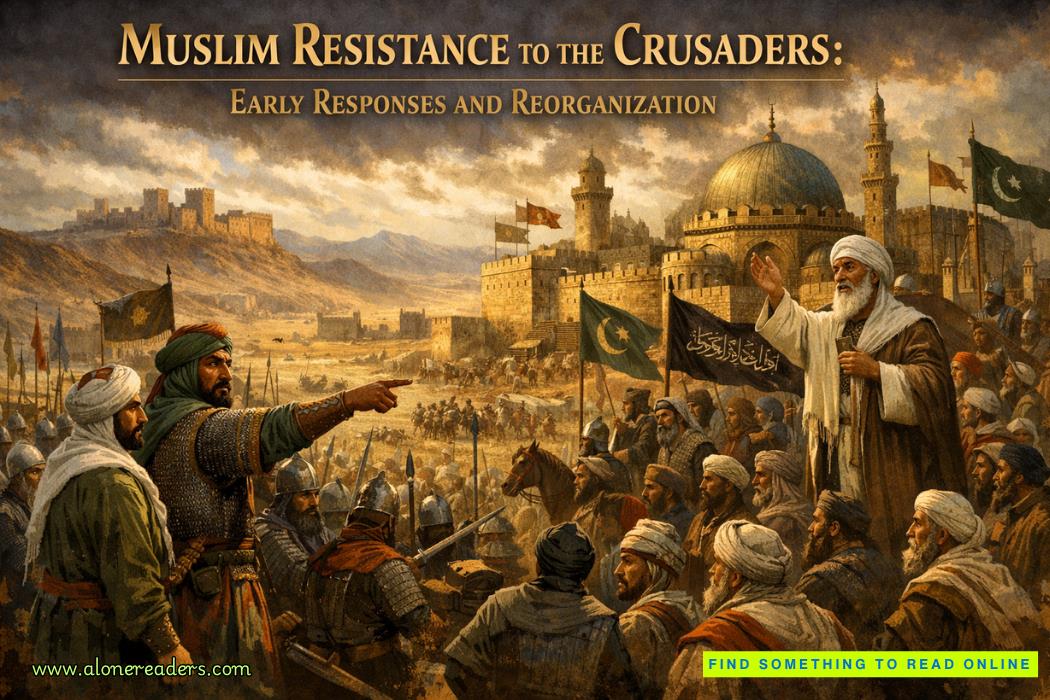
When the Crusaders first erupted into the eastern Mediterranean at the end of the eleventh century, the Islamic world did not confront them as a single civilization defending a shared homeland. Instead, the Muslim lands of the Near East were fractured by political rivalry, sectarian division, regional ambition, and decades of internal warfare. The arrival of Latin armies from Europe was initially perceived not as an existential civilizational threat but as yet another wave of foreign mercenaries or Byzantine-backed adventurers, similar to the many forces that had crossed the region before. This misjudgment would prove catastrophic, allowing the Crusaders to carve out permanent states in the heart of the Muslim world.
The early Muslim response to the Crusaders was shaped by confusion, underestimation, and political paralysis. When Jerusalem fell in 1099, the shock was immense, but it did not immediately translate into coordinated resistance. Muslim chroniclers recorded horror at the massacre, yet rulers remained consumed by local struggles. Aleppo feared Damascus more than it feared the Franks; Mosul viewed Syria as a rival sphere; Fatimid Egypt regarded the Seljuk Turks as a greater danger than the newcomers from Europe. This fragmentation allowed the Crusader states to survive and consolidate during their most vulnerable years.
At the heart of this weakness lay the collapse of centralized authority. The Abbasid Caliph in Baghdad retained religious prestige but lacked real military power. Actual control rested with Turkic warlords, atabegs, and emirs who governed semi-independent territories. Loyalty was personal, not institutional. Armies followed commanders, not causes. In such an environment, the idea of a unified Islamic resistance simply did not yet exist.
The Seljuk Empire, which had once stretched from Central Asia to Anatolia, had fractured after the death of Malik Shah. His successors fought one another relentlessly, dividing the region into competing principalities. These internal conflicts drained manpower and attention precisely when unity was most needed. The Crusaders benefited enormously from this political vacuum, exploiting rivalries and forging alliances with Muslim rulers against other Muslims.
Early encounters between Muslim forces and Crusaders reflected this disorganization. Local governors often responded defensively rather than strategically, focusing on protecting their own cities instead of confronting the broader threat. Battles were fought in isolation, without coordination or long-term planning. Even when Muslim armies achieved victories, they rarely followed them up with sustained campaigns.
Yet beneath this apparent inertia, something deeper was beginning to stir. The loss of Jerusalem, one of Islam’s holiest cities, planted a psychological wound that would not heal. Over time, this trauma became a slow-burning catalyst for ideological transformation. Scholars, poets, and preachers began to reinterpret the Crusader presence not as a temporary incursion, but as an occupation of sacred land requiring a collective response.
This marked the earliest stage of what would later become a renewed concept of jihad, not merely as personal piety or frontier raiding, but as an organized, state-sponsored struggle to reclaim Muslim territory. Importantly, this idea did not emerge overnight. It evolved gradually, shaped by both political necessity and religious discourse.
One of the first significant figures to grasp the long-term danger of the Crusader states was Imad ad-Din Zengi, atabeg of Mosul. Unlike many of his contemporaries, Zengi understood that the Franks were not passing raiders but settlers intent on permanence. His strategy marked a turning point in Muslim resistance. Rather than reacting city by city, he pursued territorial consolidation, believing that unity was a prerequisite for victory.
Zengi’s capture of Edessa in 1144 was a watershed moment. It was the first major Crusader state to fall, and its loss reverberated across both the Islamic and Christian worlds. For Muslims, it represented proof that the Crusaders were not invincible. For Europe, it triggered the Second Crusade. Symbolically, Edessa’s fall demonstrated that reorganization, not sheer numbers, was the key to resistance.
Zengi’s methods were as political as they were military. He absorbed smaller territories, suppressed rebellious emirs, and centralized authority under his command. While often ruthless, his rule created something rare in the region: stability. This stability allowed for consistent military planning and ideological messaging. Under his reign, the idea of resistance began shifting from isolated defense to coordinated recovery.
After Zengi’s assassination, his legacy was carried forward by his son Nur ad-Din, who would deepen the transformation of Muslim resistance. Nur ad-Din was not merely a warrior-ruler; he was a deliberate architect of ideological unity. He understood that defeating the Crusaders required more than armies—it required belief.
Nur ad-Din actively patronized religious institutions, madrasas, and scholars who emphasized moral reform, justice, and unity. He promoted the idea that internal corruption and division had invited foreign invasion. This narrative was powerful, because it reframed military struggle as moral renewal. Under this framework, resistance became not only a political obligation but a spiritual one.
He also strengthened judicial systems, curbed excessive taxation, and projected himself as a ruler accountable to Islamic law. This legitimacy helped him rally support across ethnic and regional lines. Turks, Arabs, Kurds, and Persians could all rally under a shared cause that transcended local identity.
Crucially, Nur ad-Din avoided reckless confrontation. Instead of launching premature offensives, he focused on strategic containment. He weakened Crusader states through pressure, diplomacy, and selective warfare, waiting until conditions favored decisive action. His patience contrasted sharply with the impulsive politics that had previously undermined Muslim efforts.
At the same time, resistance was not limited to rulers alone. Urban populations increasingly participated through funding, volunteering, and public mobilization. Mosques became centers not only of worship but of political consciousness. Sermons referenced Jerusalem with growing frequency, embedding the Crusader conflict into collective memory.
Meanwhile, Fatimid Egypt, long detached from Syrian politics, began to recognize the shifting balance of power. Its internal decay and sectarian isolation made it vulnerable, and control of Egypt would become decisive in the broader struggle. Nur ad-Din’s intervention in Egyptian affairs, though indirect, laid the groundwork for the emergence of a leader who would ultimately unify the Muslim response.
That leader was Salah ad-Din, better known as Saladin. Though his major achievements came later, his rise was a direct product of the early reorganization forged by Zengi and Nur ad-Din. Without their political consolidation, ideological groundwork, and institutional rebuilding, Saladin’s later victories would have been impossible.
What distinguishes this early phase of Muslim resistance is not immediate success, but transformation. The Islamic world shifted from fragmentation toward coherence, from reaction to strategy, from rivalry to reluctant cooperation. This was neither smooth nor complete—conflicts persisted, alliances shifted, and ambition never disappeared—but the overall direction had changed.
The Crusaders themselves sensed this evolution. Their early confidence gradually gave way to anxiety as Muslim rulers became more coordinated and aggressive. Fortifications multiplied, alliances strained, and European reinforcements were increasingly required to maintain territory that once seemed easily won.
This period also reshaped Islamic political thought. The notion that leadership carried responsibility for defending the umma gained renewed emphasis. Military failure was no longer blamed solely on fate, but on governance, injustice, and division. In this sense, the Crusades acted as a mirror, forcing Muslim societies to confront their internal weaknesses.
The resistance movement was therefore not merely external opposition but internal reconstruction. It combined military reform, ideological revival, administrative centralization, and moral rhetoric into a unified response. This synthesis explains why later Muslim campaigns were far more effective than the early, disjointed efforts of the late eleventh century.
By the mid-twelfth century, the balance had begun to tilt. The Crusader states still stood, but they were no longer expanding. They were surrounded, pressured, and increasingly isolated. The foundations of their eventual collapse were laid not by sudden victories, but by decades of patient reorganization on the Muslim side.
In retrospect, the early Muslim response to the Crusaders reveals a profound lesson of history: civilizations rarely defend themselves effectively while divided. The initial failures were not due to lack of courage or manpower, but to the absence of unity and vision. Once these elements emerged, resistance gained direction, resilience, and purpose.
The transformation from chaos to coordination did not erase suffering or guarantee immediate triumph, but it altered the trajectory of the conflict. What began as shock and humiliation evolved into determination and renewal. The Islamic world learned, adapted, and reorganized itself under pressure, turning invasion into catalyst.
This early phase of resistance stands as one of the most important chapters of the Crusades, not because of dramatic battles, but because it explains how defeat became recovery, and fragmentation became strength. It was during these formative decades that the Muslim world rediscovered the power of unity—an insight that would ultimately reshape the history of the eastern Mediterranean.



 The Hundred Days Offensive: How the Allies Defeated Germany in World War I
 The Second Battle of the Marne: The Turning Point of World War I in 1918
 The Spring Offensive of 1918: Germany's Final Gamble to Win World War I
 The Treaty of Brest-Litovsk: How Russia Left World War I
 The Russian Revolution and World War I: How War Brought Down the Tsar
 The Zimmermann Telegram Explained: Germany's Secret Offer to Mexico in World War I