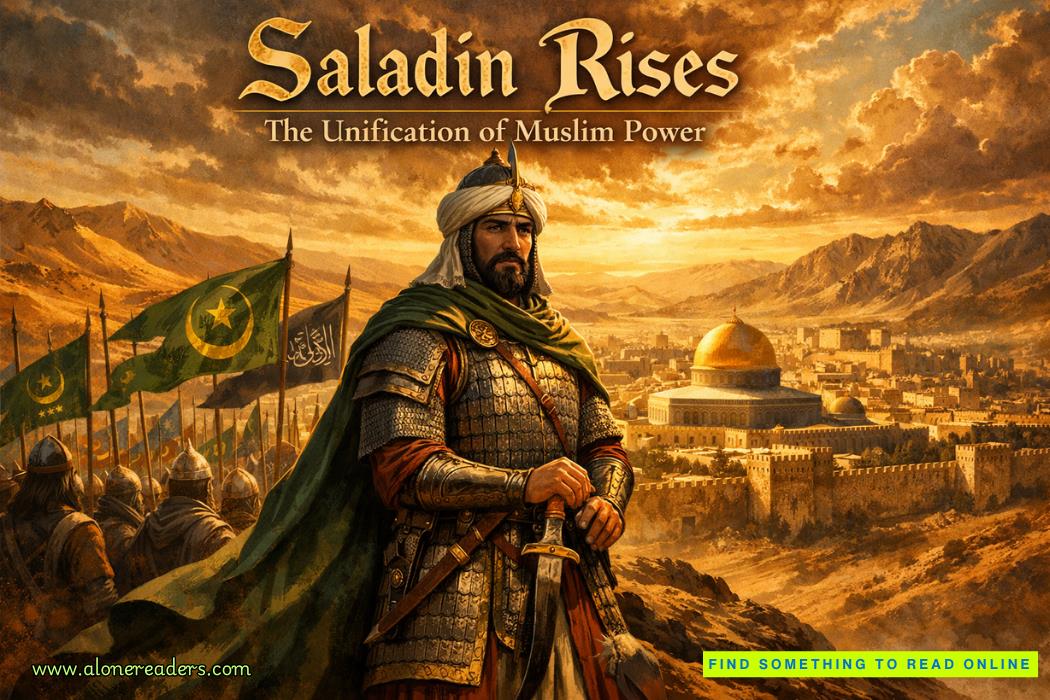
The rise of Saladin did not begin with conquest or glory, but with fragmentation. In the middle of the twelfth century, the Muslim world stood politically divided, militarily weakened, and morally exhausted. The lands stretching from Egypt to Syria were fractured into rival emirates, each ruled by ambitious leaders more concerned with personal survival than collective defense. While the Crusader states—Jerusalem, Antioch, Tripoli, and Edessa—stood as foreign dominions carved from Islamic territory, Muslim rulers frequently fought one another rather than confronting the invaders. It was from this environment of disunity that one of history’s most consequential leaders emerged, not as a conqueror first, but as a unifier.
Saladin, born Yusuf ibn Ayyub in 1137 in Tikrit, came from a Kurdish family of military administrators rather than royal blood. His early life offered no indication that he would one day dominate the political map of the Near East. He was educated in theology, law, and Arabic literature, and contemporaries often described him as reserved rather than aggressive. Yet beneath this quiet exterior lay a strategic mind shaped by discipline, religious conviction, and patience. His formative years were spent in the service of Nur ad-Din Zengi, the ruler of Syria, whose vision of jihad was not blind violence but political unity as a prerequisite for resistance.
At the time, Egypt represented both opportunity and danger. Officially ruled by the Fatimid Caliphate, Egypt followed Shi‘a Islam, standing ideologically opposed to the Sunni powers of Syria and Mesopotamia. The Fatimid state was collapsing internally, plagued by court intrigue, economic decay, and military paralysis. Nur ad-Din recognized that whoever controlled Egypt would control the balance of power in the eastern Mediterranean. When Saladin accompanied his uncle Shirkuh on military expeditions into Egypt, he entered a political arena far more complex than any battlefield.
After Shirkuh’s sudden death, Saladin was unexpectedly appointed vizier of Egypt. Many doubted him. He was young, foreign, Sunni, and lacked an independent power base. Yet it was precisely this precarious position that sharpened his political instincts. Instead of ruling through terror, he built loyalty through reform. He restored fiscal discipline, reorganized the army, and gradually replaced Fatimid officials with trusted Sunni administrators. Most crucially, he acted with patience, avoiding open confrontation until his authority was secure. In 1171, the Fatimid Caliphate was abolished peacefully, and Egypt formally returned to Sunni allegiance. This moment marked the first major step toward Muslim reunification.
Saladin’s control of Egypt transformed him from a regional administrator into a major power broker. Yet his loyalty to Nur ad-Din remained outwardly intact, even as tensions quietly grew. The Syrian ruler viewed Saladin’s expanding authority with suspicion, while Saladin understood that premature conflict would shatter the unity he sought to build. Fate intervened when Nur ad-Din died suddenly in 1174, leaving behind a child heir and a fractured realm. Power vacuums invite chaos, but Saladin moved decisively.
Rather than declaring himself ruler outright, he presented his actions as protective and restorative. He entered Damascus not as a conqueror but as a guardian of stability, marrying Nur ad-Din’s widow and asserting legitimacy through continuity. Step by step, he absorbed Syria, Aleppo, and Mosul into his growing domain. Resistance emerged from rival Muslim leaders who accused him of ambition masked as piety. Saladin responded not with annihilation but with diplomacy, negotiation, and selective force. His goal was never domination for its own sake; it was centralized authority capable of resisting the Crusader states.
This distinction defined Saladin’s leadership. Where earlier rulers focused on local power, Saladin articulated a broader vision—one Islamic polity united under a single command. He framed military struggle as both political necessity and moral duty. Mosques preached unity, scholars supported legitimacy, and popular sentiment gradually shifted. The concept of jihad under Saladin was not indiscriminate warfare, but disciplined resistance guided by law, ethics, and restraint. This ideological foundation strengthened loyalty far beyond what fear alone could achieve.
By the early 1180s, Saladin had achieved something unprecedented since the First Crusade: Egypt, Syria, Mesopotamia, and parts of Arabia were operating under coordinated leadership. Supply routes were secured, armies standardized, and intelligence networks established. The Crusader states, once benefiting from Muslim division, now found themselves strategically isolated. Saladin did not rush into war. Instead, he waited, consolidating resources while observing his enemies closely.
The turning point came with the aggressive provocations of Reynald of Châtillon, whose attacks on Muslim caravans and threats against Mecca and Medina shattered existing truces. These acts unified Muslim opinion more effectively than any sermon. For Saladin, the conflict was no longer merely political; it had become a moral imperative. The response was calculated, not impulsive. He mobilized forces from across his territories, demonstrating the tangible power of unity he had spent decades constructing.
The Battle of Hattin in 1187 was not merely a military engagement—it was the culmination of unification. Saladin’s forces, disciplined and coordinated, encircled the Crusader army through strategic terrain control and logistical superiority. When victory came, it was decisive. The Crusader Kingdom of Jerusalem lost its military backbone in a single day. Yet what followed revealed the deeper character of Saladin’s rule.
When Jerusalem fell later that year, the world expected massacre, remembering the brutality of 1099. Instead, Saladin offered terms. Civilians were ransomed, religious sites protected, and order maintained. This restraint was not weakness—it was authority. He ruled not through terror, but legitimacy, reinforcing loyalty among Muslims while earning reluctant respect even from his enemies. His actions reshaped how power itself was perceived in the medieval world.
Saladin’s unification was not flawless. Internal tensions persisted, rival ambitions simmered, and governance across such vast territories required constant negotiation. Yet his system endured beyond his lifetime precisely because it was built on institutions rather than personality alone. He established the Ayyubid dynasty, distributing authority among relatives while maintaining centralized purpose. Though later rulers would struggle to replicate his balance, the framework he created altered Middle Eastern geopolitics permanently.
Perhaps most remarkable was Saladin’s personal discipline. Despite ruling immense territories, he died with little personal wealth, having distributed much of it to soldiers, scholars, and the poor. This was not symbolic austerity—it reinforced trust. In an age defined by dynastic greed, his conduct strengthened the moral foundation of his authority. Unity, in Saladin’s vision, was not merely territorial; it was ethical.
The unification of Muslim power under Saladin transformed the Crusades from a story of fragmentation into one of resistance. Before him, the Muslim response to the Crusader presence was reactive and localized. After him, it became strategic, coordinated, and ideologically coherent. He demonstrated that victory was not born from numbers alone, but from shared purpose, disciplined leadership, and political clarity.
Saladin’s rise remains one of history’s clearest lessons in statecraft. He understood that enemies thrive when societies are divided and weaken when unity prevails. His achievement was not simply the recapture of Jerusalem, but the restoration of confidence across a civilization that had long been on the defensive. In unifying Egypt and Syria, faith and governance, diplomacy and warfare, he forged a model of leadership that transcended his era.
Long after the Crusades faded, Saladin endured as a symbol not of conquest, but of coherence. His life illustrated that true power does not emerge from chaos, but from the ability to align people, belief, and purpose toward a single vision. In an age torn by rivalries, Saladin rose by bringing others together, and in doing so, reshaped the destiny of the medieval world.



 The Hundred Days Offensive: How the Allies Defeated Germany in World War I
 The Second Battle of the Marne: The Turning Point of World War I in 1918
 The Spring Offensive of 1918: Germany's Final Gamble to Win World War I
 The Treaty of Brest-Litovsk: How Russia Left World War I
 The Russian Revolution and World War I: How War Brought Down the Tsar
 The Zimmermann Telegram Explained: Germany's Secret Offer to Mexico in World War I