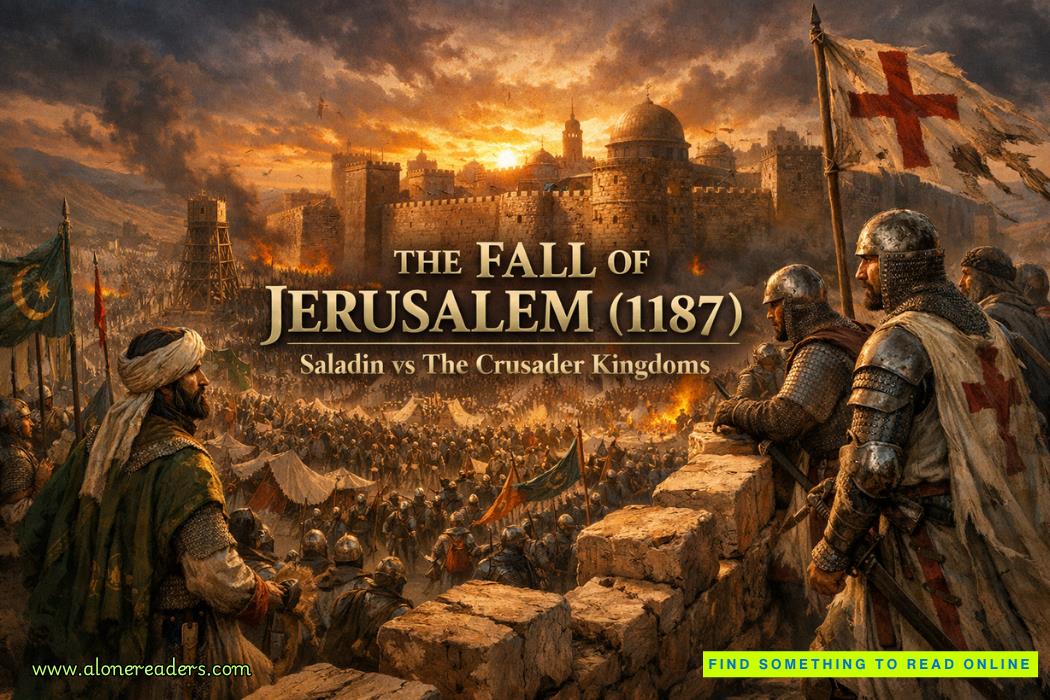
The fall of Jerusalem in 1187 stands as one of the most defining moments of medieval history, a moment when the balance of power in the Holy Land shifted decisively after nearly nine decades of Crusader rule. To the Christian world of Europe, Jerusalem was not merely a city but the spiritual heart of Christendom, a sacred symbol whose capture during the First Crusade in 1099 had been celebrated as divine victory. To the Muslim world, its loss had been a wound that festered for generations, remembered with grief, humiliation, and an enduring determination to reclaim what was seen as an inseparable part of Islamic civilization. When Jerusalem finally returned to Muslim control under Sultan Salah ad-Din Yusuf ibn Ayyub—known in the West as Saladin—it was not the result of sudden conquest but the culmination of years of political consolidation, military reform, ideological revival, and Crusader self-destruction.
By the late twelfth century, the Crusader Kingdom of Jerusalem was a fragile state masked by outward splendor. Internally, it was deeply fractured. Noble families feuded constantly, kingship was weak, and loyalty was divided between personal ambition and religious obligation. The Latin population remained small, ruling over a majority Muslim and Eastern Christian population that often felt alienated from Frankish authority. Military strength depended heavily on mercenary forces and the military orders—the Templars and Hospitallers—whose rigid ideologies sometimes clashed with pragmatic governance. While castles dotted the landscape and coastal cities flourished through Mediterranean trade, the kingdom’s survival relied on precarious truces with neighboring Muslim powers.
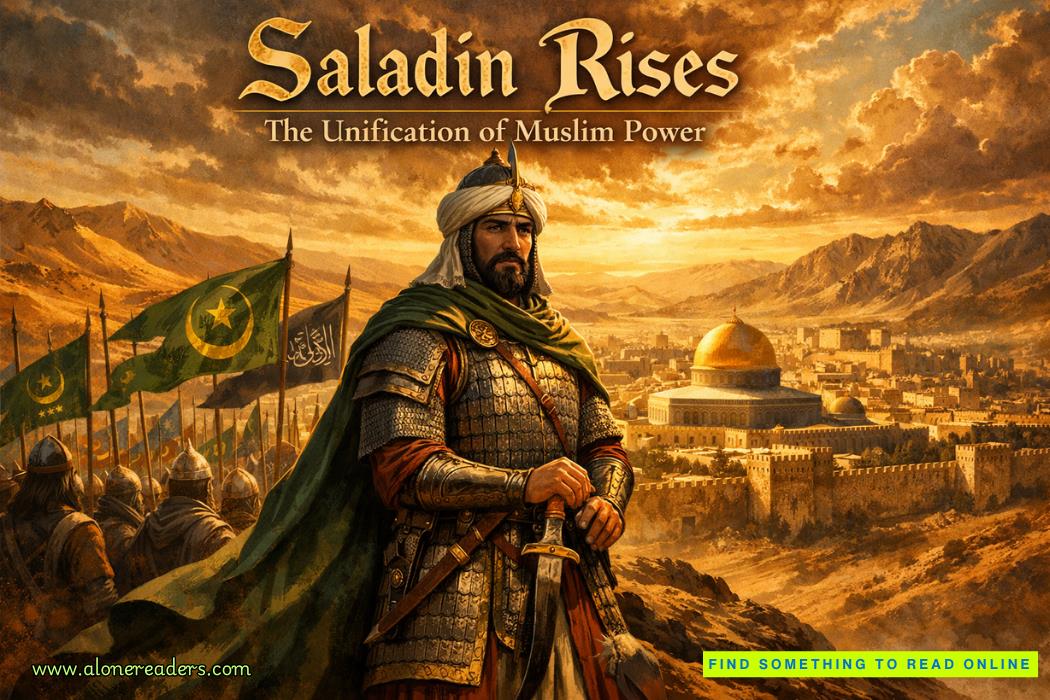
In stark contrast, the Muslim world was undergoing transformation. For decades after the First Crusade, Muslim rulers had been divided among rival dynasties, more focused on internal power struggles than on confronting the Franks. This fragmentation allowed the Crusader states to survive far longer than expected. Saladin changed that reality entirely. Rising from Kurdish origins to become vizier of Egypt and later sultan of both Egypt and Syria, he achieved what few before him had managed: the political and religious unification of the Muslim Near East. Through a combination of diplomacy, warfare, and religious legitimacy, he forged a single front capable of confronting the Crusader kingdoms as a unified force rather than scattered emirates.
Saladin’s vision was not purely territorial. He framed the struggle for Jerusalem as jihad in its classical sense, not merely holy war but moral obligation. This ideological framing revitalized Muslim morale and attracted soldiers from across the region. Unlike many Crusader leaders who pursued personal glory, Saladin cultivated an image of humility, justice, and restraint. He prayed publicly, avoided unnecessary cruelty, and emphasized discipline. This reputation would later play a crucial role in how the fall of Jerusalem was remembered, even by Christian chroniclers who considered him an enemy.
The road to Jerusalem began with catastrophe for the Crusaders at the Battle of Hattin in July 1187. This battle was not inevitable; it was the product of disastrous leadership. Guy of Lusignan, the king of Jerusalem, was politically weak and heavily influenced by aggressive nobles such as Raynald of Châtillon, whose repeated violations of Muslim caravans and threats against Mecca enraged Saladin. When Saladin besieged the city of Tiberias, Guy faced a strategic choice: remain near water at Sepphoris or march across arid land to confront the Muslim army. Against wiser counsel, he chose to march.
The result was annihilation. Dehydrated, surrounded, and harassed by Muslim cavalry, the Crusader army collapsed. The relic of the True Cross—believed to guarantee divine favor—was captured. Thousands of knights were killed or taken prisoner. Raynald of Châtillon was personally executed by Saladin, fulfilling a long-promised oath. The military backbone of the Kingdom of Jerusalem was effectively destroyed in a single day. Hattin was not merely a defeat; it was an existential collapse.
With the Crusader field army gone, the cities of the kingdom fell rapidly. Acre, Jaffa, Nablus, Caesarea, and Ascalon surrendered or were taken with minimal resistance. Refugees flooded Jerusalem, swelling its population but worsening food shortages. The city was defended by a desperate mixture of knights, townsmen, refugees, and clergy. Command fell to Balian of Ibelin, a noble who had initially received permission from Saladin to enter Jerusalem only to escort his family. Once inside, circumstances forced him to remain, and Saladin—honoring chivalric custom—allowed it.
Jerusalem in 1187 was spiritually charged and psychologically exhausted. The memory of the Crusaders’ massacre in 1099 haunted both sides. Many expected the city to fall in blood. Balian, however, understood the reality. The walls were strong but undermanned. Supplies were limited. There was no hope of relief from Europe. Yet surrender without negotiation would doom the population. He organized defenses, knighted dozens of men to create symbolic leadership, and prepared for a siege not to win—but to bargain.
Saladin encircled Jerusalem in late September. Siege engines were constructed, bombardments began, and breaches were attempted. The defenders resisted fiercely, launching counterattacks and repairing walls under fire. For several days, the outcome remained uncertain. Yet Saladin’s numerical superiority and patience slowly prevailed. When Muslim forces threatened the northern walls near the Gate of St. Stephen, the situation became critical. Jerusalem could fall by assault at any moment.
At this point, Balian sought negotiations. He reportedly warned Saladin that if the city were taken by force, the defenders would destroy holy sites and kill Muslim prisoners before dying themselves. Whether this threat was genuine or symbolic, it succeeded. Saladin faced a crucial choice: repeat the horrors of 1099 in reverse or demonstrate a new model of conquest. His decision would define his legacy.
The terms of surrender were unprecedented for the age. Jerusalem would be handed over peacefully. In exchange, Christian inhabitants could ransom themselves and leave safely. Those unable to pay would be freed through charitable funds, including money personally provided by Saladin and his brother al-Adil. Churches were respected, civilians spared, and pilgrims later allowed access. In a medieval world accustomed to massacre, the mercy shown in Jerusalem shocked contemporaries.
On October 2, 1187, Jerusalem officially returned to Muslim rule—symbolically on the anniversary of the Prophet Muhammad’s Night Journey. Saladin entered the city not as a conqueror drenched in blood but as a ruler restoring sanctity. Islamic sites were cleansed and reconsecrated. The Dome of the Rock was purified, and the call to prayer echoed again after nearly a century. Yet Christian holy places were not destroyed. The Church of the Holy Sepulchre remained intact, guarded to prevent chaos.
The fall of Jerusalem reverberated across Europe like an earthquake. News traveled slowly but hit with devastating force. Churches rang bells in mourning. Chroniclers described collective despair. The loss of the Holy City was interpreted as divine punishment for sin, corruption, and disunity. This emotional shock directly triggered the Third Crusade, one of the largest military expeditions in medieval history, drawing kings themselves into the conflict—including Richard the Lionheart, Philip II of France, and Frederick Barbarossa.
Yet even as Europe prepared vengeance, the narrative surrounding Saladin complicated the moral framework of the conflict. Christian writers, though hostile, increasingly portrayed him as a model of chivalric virtue, often favorably compared to their own leaders. His restraint contrasted sharply with the brutality that had defined earlier Crusader conquests. In an age of religious absolutism, this respect was extraordinary.
The fall of Jerusalem also marked the effective end of the Crusader dream of permanent dominion over the Holy Land. Though coastal territories would remain under Frankish control for another century, the ideological heart of the Crusader states was gone. Without Jerusalem, their purpose became ambiguous. Defense replaced expansion. Survival replaced triumph.
Politically, Saladin’s victory reshaped Middle Eastern power structures. He emerged as the dominant Sunni leader of the region, though his empire would fragment after his death. Symbolically, however, his achievement endured. Jerusalem became a unifying emblem of Islamic resistance, a memory invoked long after the Crusades themselves had faded.
The event also transformed the moral vocabulary of warfare. The contrast between the slaughter of 1099 and the mercy of 1187 created a powerful historical comparison that still influences modern interpretations. It demonstrated that conquest did not require annihilation and that authority could be asserted through restraint rather than terror. This distinction became central to Saladin’s enduring reputation across cultures.
At its core, the fall of Jerusalem in 1187 was not simply a military outcome but the collision of leadership styles, ideologies, and historical momentum. The Crusader Kingdoms collapsed not because their fortresses were weak, but because their unity was brittle and their leadership deeply flawed. Saladin triumphed not merely because he commanded larger armies, but because he understood the psychological, political, and spiritual dimensions of power.
The city changed hands, but history changed direction. Jerusalem’s fall did not end the Crusades, yet it redefined them. The era of reckless conquest gave way to prolonged struggle, negotiation, and uneasy coexistence. The myth of inevitable Christian victory shattered, replaced by the recognition that the Islamic world was not only resilient but capable of moral authority and strategic brilliance.
More than eight centuries later, the events of 1187 continue to echo. Jerusalem remains a symbol laden with faith, memory, and conflict. The story of Saladin and the Crusader Kingdoms is remembered not only as a chapter of war but as a profound lesson in how leadership, unity, and restraint can shape history far more enduringly than violence alone.



 The Hundred Days Offensive: How the Allies Defeated Germany in World War I
 The Second Battle of the Marne: The Turning Point of World War I in 1918
 The Spring Offensive of 1918: Germany's Final Gamble to Win World War I
 The Treaty of Brest-Litovsk: How Russia Left World War I
 The Russian Revolution and World War I: How War Brought Down the Tsar
 The Zimmermann Telegram Explained: Germany's Secret Offer to Mexico in World War I










