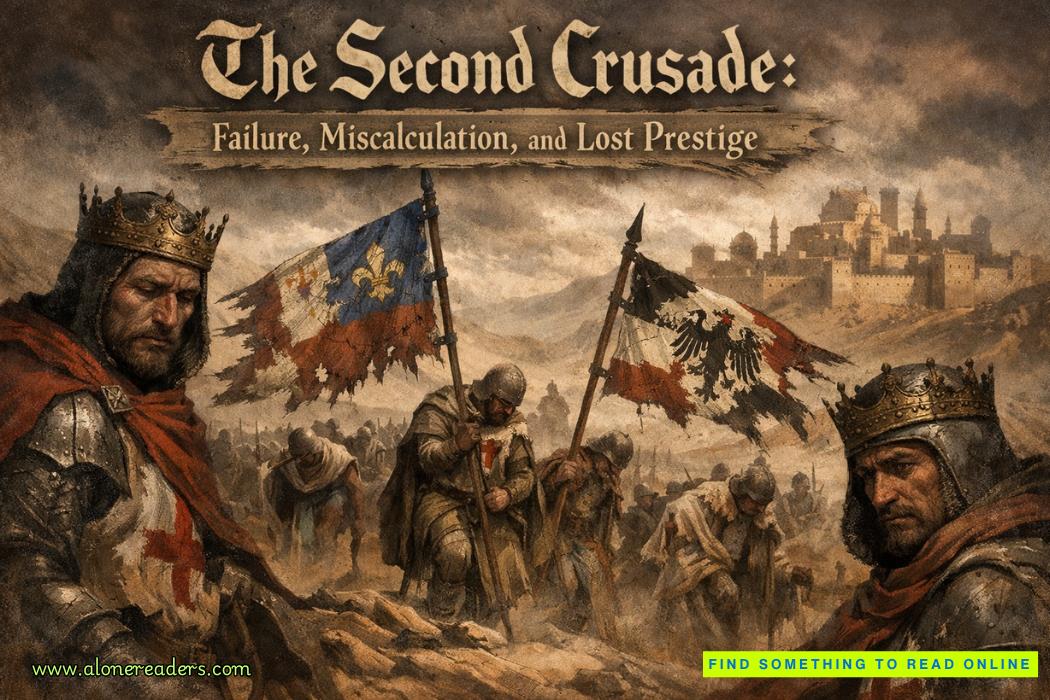
The Second Crusade stands as one of the most revealing failures in medieval history, not because it lacked devotion or manpower, but because it exposed the dangerous illusion that divine purpose alone could substitute for strategy, unity, and realism. Launched in response to the shocking fall of Edessa in 1144, the crusade was Europe’s first attempt to defend the crusader states rather than conquer new lands. What followed was not a heroic revival of the First Crusade’s success, but a slow, humiliating unraveling that permanently damaged Western credibility in the East and reshaped Muslim confidence for generations.
Unlike the spontaneous and chaotic movement of the First Crusade, the Second Crusade was meticulously planned by kings, clergy, and intellectual elites. Yet this very sophistication proved to be its undoing. Europe believed it had mastered holy war, when in reality it had only been lucky once. The crusade began not with desperation, but with overconfidence — a belief that Christian victory was inevitable if rulers merely marched under the cross.
The emotional catalyst was the fall of Edessa, the oldest and most vulnerable crusader state. Its capture by Zengi, the Muslim ruler of Mosul and Aleppo, sent tremors across Christendom. For the first time, a crusader principality had been completely erased. Panic spread through the Latin East, and desperate appeals were sent to Europe. Yet while the event shocked Western leaders, few truly understood the political transformation unfolding in the Islamic world. Muslim territories were no longer fragmented as they had been in 1096. They were slowly unifying under capable military rulers who had learned from earlier defeats.
Pope Eugene III responded with the papal bull Quantum Praedecessores, formally calling for a new crusade. This time, however, the papacy did not rely on wandering preachers. Instead, it turned to Bernard of Clairvaux, the most influential religious figure in Europe. Bernard’s preaching ignited mass enthusiasm, convincing nobles and peasants alike that God demanded immediate action. He promised divine favor, remission of sins, and assured victory. His sermons were emotionally overwhelming — yet dangerously simplistic.
What Bernard offered was faith without restraint. He framed the conflict as cosmic inevitability rather than political warfare. Anyone who doubted success was accused of doubting God Himself. This religious absolutism suppressed strategic debate and encouraged blind obedience, setting the crusade on a path where criticism became heresy and caution became betrayal.
For the first time in crusading history, reigning monarchs took the cross. Louis VII of France and Conrad III of Germany committed their royal armies, transforming the expedition into an unprecedented show of European power. On paper, it appeared unstoppable. In practice, it created rivalry, logistical chaos, and conflicting command structures. Two kings meant two armies, two strategies, and two egos — all marching toward the same disaster.
From the beginning, the journey east revealed fatal miscalculations. The German army entered Byzantine territory suspicious of imperial motives, while Emperor Manuel I Komnenos viewed the crusaders as potential threats rather than allies. Mutual distrust poisoned cooperation. Supplies were limited, guides unreliable, and discipline weak. Crusader soldiers pillaged local populations, reinforcing Byzantine hostility and undermining coordination.
When Conrad’s forces entered Anatolia, the illusion of crusader invincibility shattered completely. The Seljuk Turks, masters of mobile warfare, avoided direct confrontation and instead used ambushes, scorched-earth tactics, and relentless harassment. Heavy European knights, trained for pitched battles, found themselves helpless against swift horse archers. Entire contingents were annihilated in mountain passes. Hunger, dehydration, and panic followed.
The catastrophic defeat near Dorylaeum in 1147 marked the crusade’s first major collapse. Conrad’s army was effectively destroyed. Survivors staggered back toward Constantinople in humiliation. The German king himself fell ill and withdrew temporarily, a symbolic blow that echoed across Europe. The crusade had barely begun, yet one royal army had already ceased to exist.
Louis VII fared little better. His forces suffered similarly through Anatolia, plagued by ambushes and internal division. Discipline deteriorated rapidly. Pilgrims, knights, and nobles quarreled openly. Morale collapsed as promised miracles failed to appear. Soldiers began questioning Bernard’s assurances. Some even claimed that God had abandoned them — a dangerous thought in a movement built entirely on divine certainty.
By the time the French reached the Levant, the crusade was already spiritually wounded. Yet its greatest failure still lay ahead.
Instead of focusing on the recovery of Edessa — the original objective — crusader leaders made a stunning strategic decision. They chose to attack Damascus, one of the region’s most complex political centers. Damascus had long maintained cautious neutrality and occasionally even cooperated with the Kingdom of Jerusalem against mutual enemies. By targeting it, the crusaders transformed a potential ally into a permanent enemy.
The decision revealed how deeply Western leaders misunderstood Near Eastern politics. They believed conquest was preferable to diplomacy, and symbolism more important than stability. Damascus represented prestige, not necessity. Its capture would look glorious — even if it achieved nothing strategically.
The siege of Damascus in 1148 was brief, chaotic, and disastrous. Crusader armies approached from the west, initially positioned in fertile orchards. But internal rivalries between European kings and local crusader lords led to sudden shifts in strategy. Commanders argued over who would rule the city once captured. Accusations of betrayal spread. Unity disintegrated.
Within days, the crusaders inexplicably moved to the city’s weaker but waterless eastern side, exposing themselves to counterattacks and supply shortages. Muslim forces rapidly united in defense. Reinforcements approached. Panic set in.
After only four days, the crusader army withdrew — humiliated, confused, and defeated. Never before had such a massive Christian force achieved so little at such enormous cost.
The retreat from Damascus marked the psychological death of the Second Crusade. Trust between European and Eastern Christians collapsed. Each blamed the other for treachery. Accusations flew between French, Germans, and local barons. No coherent leadership remained.
Bernard of Clairvaux, once celebrated as God’s chosen voice, faced intense backlash. Critics accused him of false prophecy. Bernard himself struggled to explain the catastrophe, ultimately claiming that the crusaders had failed due to their sins rather than flawed leadership. This explanation satisfied few. For the first time, the moral authority of crusading ideology was openly questioned.
The consequences extended far beyond military defeat. Muslim leaders drew powerful conclusions from the failure. They had faced the full force of Christian Europe — and survived. Even more importantly, they had learned that the crusaders were divided, arrogant, and strategically inflexible. The myth of unstoppable Western knights dissolved.
In the Islamic world, confidence surged. The legacy of Zengi was carried forward by his son Nur ad-Din, who accelerated political and military unification. Muslim resistance became ideological, not merely territorial. Jihad was increasingly framed as a sacred duty in response to crusader aggression. The balance of psychological power shifted decisively.
For the crusader states themselves, the damage was existential. They had antagonized Damascus, alienated Byzantium, and gained no new territory. Their manpower was depleted. Their political cohesion weakened. Worst of all, Europe’s willingness to support them began to fade. If kings and armies could fail so completely, why sacrifice again?
The Second Crusade also reshaped European politics. Monarchs returned home burdened by debt, weakened authority, and public disappointment. Louis VII’s reign suffered lasting instability. Conrad III never recovered his prestige. The crusading ideal, once infused with triumph, became associated with loss.
Yet perhaps the most profound failure was intellectual. The crusade demonstrated that faith without strategy is not devotion — it is delusion. Europe had mistaken the success of the First Crusade as divine formula rather than historical anomaly. It failed to recognize that the political environment had changed, that enemies had adapted, and that holy war required planning, diplomacy, and humility.
In this sense, the Second Crusade was not merely a failed campaign. It was a warning — one largely ignored.
Later crusades would repeat many of the same errors: fragmented leadership, internal rivalries, inflated expectations, and disregard for local realities. But none would collapse so completely under the weight of their own assumptions.
The Second Crusade revealed something deeply uncomfortable for medieval Christendom: God did not guarantee victory. Human decision-making still mattered. Political arrogance still carried consequences. And holy symbols could not compensate for poor judgment.
Its legacy was not territory gained or cities captured, but a permanent loss of prestige, a strengthening of Muslim unity, and the slow erosion of crusader dominance in the eastern Mediterranean.
From that moment forward, the crusading movement would never again march with the same innocence, confidence, or illusion of inevitability. The cross still inspired armies — but the certainty of victory had died outside the walls of Damascus.
And in that failure, history quietly turned.



 The Hundred Days Offensive: How the Allies Defeated Germany in World War I
 The Second Battle of the Marne: The Turning Point of World War I in 1918
 The Spring Offensive of 1918: Germany's Final Gamble to Win World War I
 The Treaty of Brest-Litovsk: How Russia Left World War I
 The Russian Revolution and World War I: How War Brought Down the Tsar
 The Zimmermann Telegram Explained: Germany's Secret Offer to Mexico in World War I