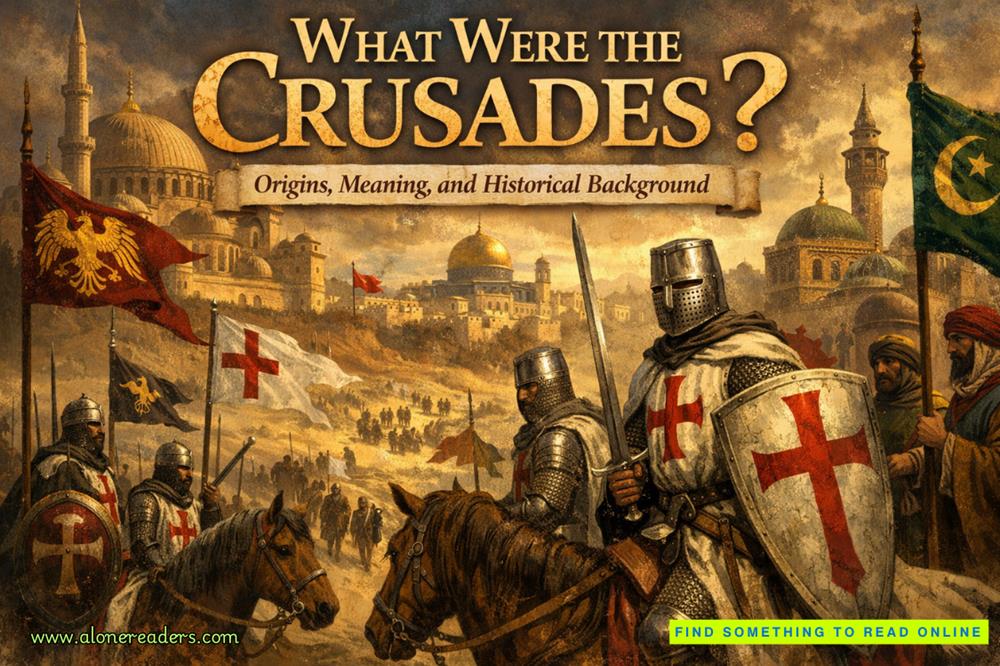
The Crusades were a series of prolonged, ideologically charged military campaigns that reshaped the medieval world, leaving a legacy that extended far beyond the battlefield. At their core, the Crusades represented a convergence of religious devotion, political ambition, economic pressure, and cultural confrontation, making them one of the most complex phenomena in European and Middle Eastern history. Far from being a single war or a unified movement, the Crusades unfolded over nearly two centuries, involving shifting alliances, evolving objectives, and deeply entrenched beliefs about faith, authority, and sacred space.
The very word Crusade derives from the Latin crux, meaning cross, reflecting the central symbolism adopted by participants who saw themselves as armed pilgrims acting under divine mandate. To take the cross was not merely to enlist in a military expedition but to enter into a sacred vow, one that promised spiritual reward in exchange for physical hardship and mortal risk. This fusion of warfare and piety marked a dramatic departure from earlier Christian attitudes toward violence, redefining the moral boundaries of war in medieval Europe.
The origins of the Crusades lie in a world under strain. By the late eleventh century, Western Europe was experiencing demographic growth, agricultural expansion, and social volatility. A surplus of younger sons among the nobility, constrained by inheritance customs, produced a restless warrior class seeking land, status, and purpose. Simultaneously, the Church was engaged in a broader reform movement aimed at asserting moral authority, disciplining violence among Christians, and strengthening papal influence across Christendom. The Crusades offered a solution to multiple pressures at once, channeling aggression outward while reinforcing religious unity under ecclesiastical leadership.
Equally important was the geopolitical context of the eastern Mediterranean. The Byzantine Empire, long a bulwark between Europe and the Islamic world, had suffered significant territorial losses following its defeat by Turkic forces in Anatolia. These losses threatened not only imperial stability but also the security of key pilgrimage routes to the Holy Land. When appeals for military assistance reached the Latin West, they were reframed within a powerful religious narrative that transformed regional defense into a universal Christian obligation.
The concept of holy war was not entirely new, but the Crusades formalized and institutionalized it in unprecedented ways. Participants were promised remission of sins, a theological incentive that elevated crusading above ordinary warfare. This promise resonated deeply in a society where salvation was a central concern and where fear of eternal punishment shaped everyday life. The Crusades thus became a spiritual enterprise as much as a military one, blending penitence with conquest and sacrifice with ambition.
Understanding the meaning of the Crusades requires examining how medieval people perceived Jerusalem and the wider Holy Land. These territories were not viewed merely as strategic locations but as sacred landscapes imbued with divine presence. Control over such spaces carried immense symbolic weight, reinforcing the belief that their recovery was both a religious duty and a cosmic necessity. This worldview intensified the emotional and ideological stakes of the conflict, making compromise difficult and violence easier to justify.
Over time, the scope of crusading expanded far beyond its initial focus. Campaigns were launched not only toward the eastern Mediterranean but also within Europe itself, targeting groups labeled as heretical, pagan, or politically inconvenient. This expansion revealed how crusading ideology could be adapted to serve a wide range of objectives, from territorial consolidation to internal repression. The Crusades thus became a flexible instrument of power, shaped as much by political calculation as by spiritual fervor.
The historical background of the Crusades also includes the perspectives of those on the receiving end of these campaigns. For Muslim societies, the Crusades were experienced as episodic invasions by foreign forces whose motivations appeared both alien and contradictory. Initial reactions varied from indifference to alarm, but over time, resistance coalesced around leaders who framed defense as a religious and communal obligation. These encounters contributed to the development of new political identities and military strategies across the region.
Culturally, the Crusades facilitated unprecedented contact between societies. Trade routes expanded, technologies and ideas circulated, and artistic and intellectual exchanges reshaped both European and Middle Eastern worlds. Yet these interactions unfolded alongside cycles of violence, displacement, and mistrust, embedding long-lasting memories of conflict. The dual legacy of exchange and enmity complicates any simplistic interpretation of the Crusades as purely destructive or transformative.
From a historical standpoint, the Crusades cannot be reduced to a single cause or outcome. They were the product of layered motivations, including faith, fear, opportunity, and ideology, all operating within a specific medieval framework of belief and power. Their significance lies not only in the territories conquered or lost but in how they altered concepts of religious authority, justified violence, and defined relationships between cultures.
In retrospect, the Crusades stand as a testament to the capacity of ideas to mobilize societies on a massive scale. They reveal how deeply held beliefs, when combined with institutional support and material incentives, can sustain prolonged conflict across generations. To study the Crusades is therefore to confront fundamental questions about the nature of faith, the exercise of power, and the enduring consequences of history shaped by conviction as much as by force.



 The Hundred Days Offensive: How the Allies Defeated Germany in World War I
 The Second Battle of the Marne: The Turning Point of World War I in 1918
 The Spring Offensive of 1918: Germany's Final Gamble to Win World War I
 The Treaty of Brest-Litovsk: How Russia Left World War I
 The Russian Revolution and World War I: How War Brought Down the Tsar
 The Zimmermann Telegram Explained: Germany's Secret Offer to Mexico in World War I