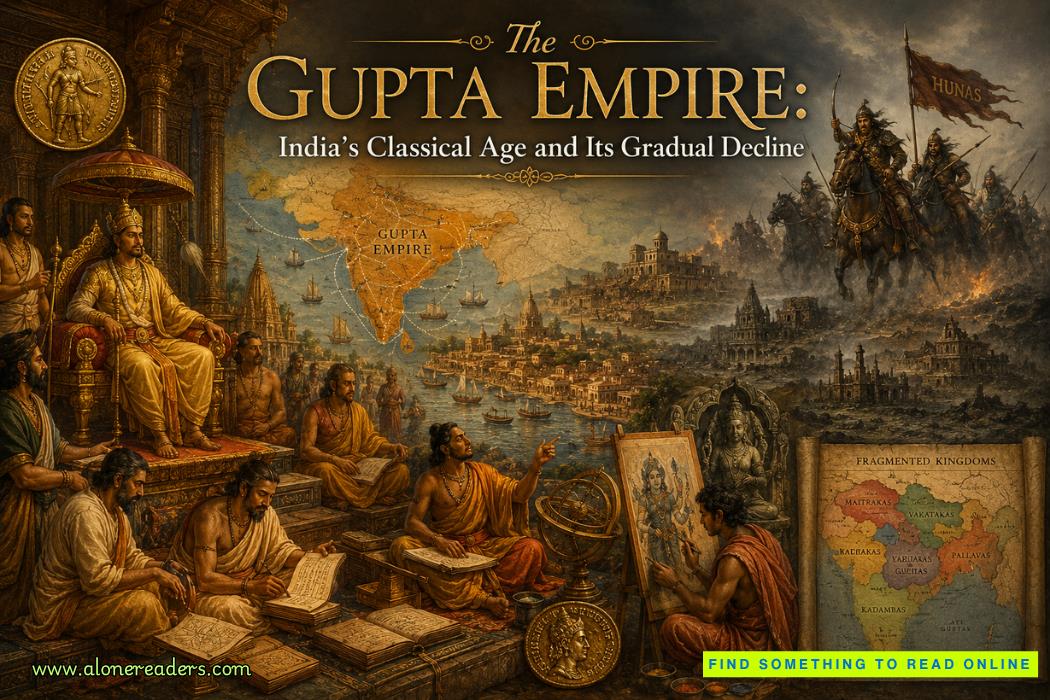
The Gupta Empire stands as one of the most celebrated chapters in the history of the Indian subcontinent, often remembered as a “Classical Age” marked by remarkable achievements in governance, science, literature, and art. Yet, like many great empires, its story is not simply one of brilliance but also of gradual weakening and eventual fragmentation. The Gupta period illustrates how power is not only built through conquest and administration, but also sustained—or lost—through adaptability, economic stability, and resilience against external threats.
The rise of the Gupta Empire began in the early fourth century, during a time when northern India was politically fragmented after the decline of earlier powers. The foundation of Gupta authority is traditionally attributed to Chandragupta I, who ascended to power around 320 CE. His reign marked a turning point, not because of sweeping conquests, but due to strategic consolidation. Through a politically advantageous marriage alliance with a powerful regional clan, Chandragupta I strengthened his legitimacy and expanded his influence. This was a subtle yet effective strategy: rather than relying solely on military might, the early Guptas built a stable base through diplomacy and alliances.
The real architect of Gupta expansion, however, was Samudragupta, Chandragupta I’s successor. His reign transformed the Gupta state into a formidable empire. Samudragupta’s campaigns across northern and central India are well known for their scale and ambition. Unlike rulers who sought only territorial annexation, he employed a flexible policy toward conquered regions. Some territories were directly annexed, while others were allowed to remain semi-autonomous under Gupta suzerainty. This approach enabled him to create a vast network of loyal states without overextending administrative resources. His military brilliance was matched by political pragmatism, a combination that ensured rapid yet sustainable expansion.
Under Samudragupta, the empire reached a level of cohesion that allowed for stability and prosperity. Trade flourished, both within the subcontinent and with distant regions. Economic growth was supported by a strong currency system, including gold coins that symbolized imperial wealth and confidence. This prosperity laid the groundwork for what would later be recognized as the Gupta Golden Age.
The peak of Gupta power came during the reign of Chandragupta II, also known as Vikramaditya. His rule is often associated with cultural flourishing and political stability. Chandragupta II expanded the empire further by defeating the Western Kshatrapas, gaining access to important trade routes and coastal regions. This not only increased the empire’s wealth but also enhanced its connectivity with international markets. Under his leadership, the Gupta Empire became a center of intellectual and artistic achievement.
The Gupta Golden Age is remembered for its extraordinary contributions to science, mathematics, literature, and art. Scholars like Aryabhata made pioneering advances in astronomy and mathematics, including concepts that would later influence global knowledge systems. The development of the decimal system and early ideas about zero are often linked to this period. Literature flourished with works of profound aesthetic and emotional depth. The playwright Kalidasa produced masterpieces that continue to be celebrated for their poetic elegance and psychological insight.
Art and architecture also reached new heights. Temples built during this period showcased refined structural techniques and intricate carvings. Sculptures displayed a remarkable sense of balance, grace, and spiritual expression. This cultural vitality was not incidental—it was nurtured by a stable political environment and royal patronage. The Gupta rulers understood that cultural prestige enhanced their legitimacy and reinforced their authority.
Yet beneath this golden surface, certain structural weaknesses were gradually emerging. The Gupta administrative system, while effective in times of stability, relied heavily on local governance and feudal-like arrangements. Regional governors and local elites were granted significant autonomy in exchange for loyalty and tribute. While this decentralized approach reduced administrative burdens, it also created potential centers of power that could later challenge imperial authority.
Another factor contributing to the empire’s vulnerability was its economic structure. Although the Gupta period saw considerable prosperity, this wealth was not evenly distributed. Over time, the increasing reliance on land grants to officials and religious institutions began to reduce the state’s direct control over revenue. These grants, often tax-exempt, weakened the central treasury. As the empire expanded, maintaining a large administrative and military apparatus became increasingly costly.
The turning point in Gupta fortunes came during the later fifth century, when the empire faced external invasions. The most significant of these threats came from the Huna tribes, who invaded from the northwest. These incursions were not merely raids but sustained assaults that disrupted trade routes, devastated agricultural regions, and strained the empire’s military resources. The Guptas initially managed to resist these invasions, but the repeated attacks exposed the limits of their defensive capabilities.
The impact of the Huna invasions went beyond immediate destruction. They accelerated internal fragmentation by weakening central authority. As the empire struggled to defend its borders, regional rulers began asserting greater independence. The delicate balance between central control and local autonomy began to collapse. What had once been a strength—the flexibility of governance—became a liability.
Compounding these challenges were internal conflicts and succession disputes. As the imperial lineage weakened, the clarity of succession diminished. Rival factions within the ruling elite competed for power, further destabilizing the political structure. An empire that once projected unity and strength now faced division and uncertainty.
Economic decline also played a crucial role in the empire’s fall. The disruption of trade routes due to invasions reduced revenue from commerce. Agricultural productivity suffered as regions were destabilized. The cumulative effect was a shrinking economic base that could no longer support the needs of a large empire. The issuance of gold coins, once a symbol of Gupta prosperity, declined significantly in the later period, reflecting reduced economic confidence.
By the mid-sixth century, the Gupta Empire had effectively disintegrated into smaller regional kingdoms. While some Gupta rulers continued to hold nominal power in certain areas, the empire as a unified political entity ceased to exist. The subcontinent once again entered a phase of regional fragmentation, setting the stage for the rise of new powers.
Despite its decline, the legacy of the Gupta Empire remains profound. Its contributions to culture, science, and governance left an enduring imprint on Indian civilization. The idea of a “Classical Age” is not merely a reflection of artistic achievement but also of a period when political stability enabled intellectual and cultural growth. The Gupta experience demonstrates that the strength of an empire lies not only in its expansion but in its ability to adapt to changing circumstances.
The story of the Gupta Empire also offers broader insights into the dynamics of historical change. Empires do not collapse overnight; their decline is often a gradual process shaped by a combination of internal weaknesses and external pressures. In the case of the Guptas, the interplay between decentralized governance, economic shifts, and foreign invasions created a complex pattern of decline. Understanding this process helps us see history not as a series of isolated events but as an interconnected narrative of cause and effect.
In many ways, the Gupta Empire represents both the possibilities and limitations of imperial power. Its rise was built on strategic alliances, military skill, and administrative innovation. Its golden age was sustained by economic prosperity and cultural patronage. Its decline, however, reveals the challenges of maintaining cohesion in a vast and diverse polity. The same factors that once enabled growth—flexibility, decentralization, and expansion—eventually contributed to fragmentation.
This duality makes the Gupta Empire a compelling subject of study. It is not simply a tale of greatness lost, but a nuanced story of transformation. The transition from unity to fragmentation did not erase the achievements of the Gupta period; rather, it redistributed them across emerging regional cultures. The intellectual and artistic traditions developed during this time continued to influence subsequent generations, shaping the cultural landscape of the subcontinent for centuries.
In examining the Gupta Empire, one is reminded that history is rarely linear. Periods of brilliance are often followed by phases of decline, and decline itself can give rise to new forms of creativity and adaptation. The Gupta legacy, therefore, is not confined to its golden age but extends into the ways it shaped the future.
At a Glance Summary Box




 The Hundred Days Offensive: How the Allies Defeated Germany in World War I
 The Second Battle of the Marne: The Turning Point of World War I in 1918
 The Spring Offensive of 1918: Germany's Final Gamble to Win World War I
 The Treaty of Brest-Litovsk: How Russia Left World War I
 The Russian Revolution and World War I: How War Brought Down the Tsar
 The Zimmermann Telegram Explained: Germany's Secret Offer to Mexico in World War I