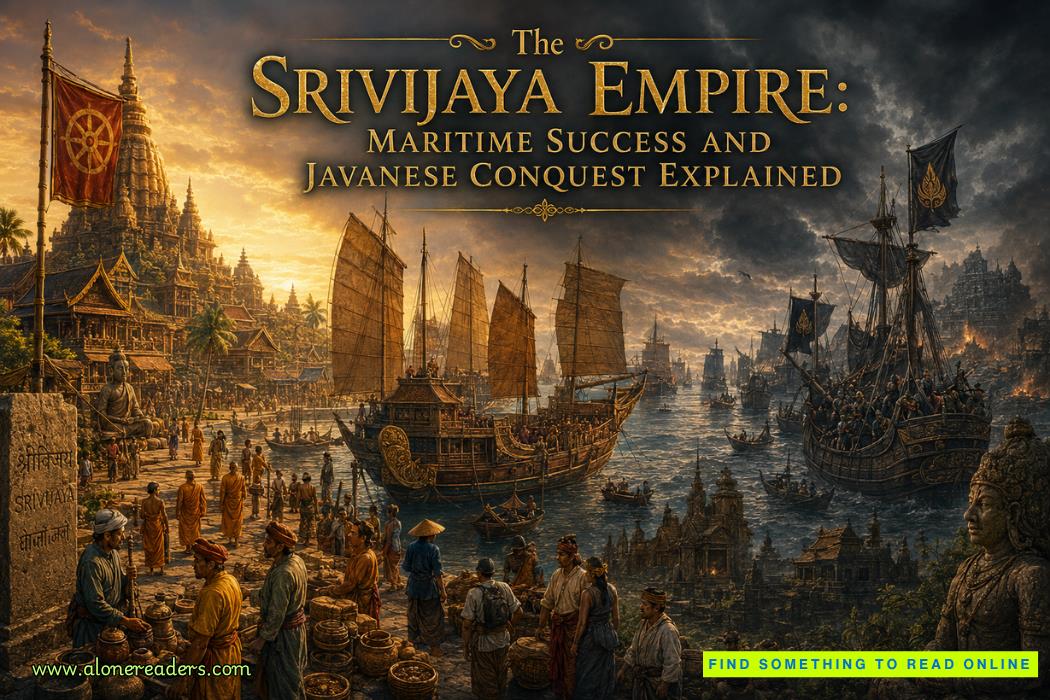
The Srivijaya Empire stands as one of the most fascinating examples of a maritime civilization that built power not through vast land conquests, but through control of water, trade, and strategic geography. Emerging from the dense riverine landscapes of Sumatra, Srivijaya did not resemble the great territorial empires of its time. Instead, it thrived as a networked thalassocracy, projecting influence across the seas of Southeast Asia. Its rise was deeply tied to commerce, diplomacy, and religion, while its fall reveals the fragile nature of trade-dependent power in a rapidly shifting geopolitical world.
At its core, Srivijaya’s success came from a simple yet transformative advantage: control over the Strait of Malacca. This narrow passage between the Malay Peninsula and Sumatra functioned as one of the most important maritime chokepoints in the world. Any ship traveling between India and China—two of the largest economic centers of the pre-modern world—had to pass through these waters. Srivijaya capitalized on this geography with remarkable efficiency. Rather than merely taxing trade, it created a system where foreign merchants were encouraged to stop, resupply, and trade within its ports.
The empire’s center, believed to be around Palembang in southern Sumatra, was not a traditional capital filled with monumental stone architecture. Instead, it was a fluid, river-based urban system, deeply integrated with maritime life. Wooden structures, floating settlements, and bustling harbors formed the heart of Srivijaya’s power. This adaptability made it resilient in its environment but also left fewer permanent traces, contributing to the historical mystery surrounding it.
What truly distinguished Srivijaya was its ability to act as an intermediary. Goods such as spices, camphor, sandalwood, gold, and ivory flowed through its ports. Chinese ceramics and Indian textiles passed in the opposite direction. Srivijaya did not produce all these goods itself; rather, it controlled their movement, ensuring that trade routes remained dependent on its cooperation. This economic strategy turned the empire into a maritime gatekeeper, accumulating wealth without needing vast agricultural territories.
Religion played a subtle yet powerful role in strengthening Srivijaya’s influence. The empire became a major center of Mahayana Buddhism, attracting monks and scholars from across Asia. Chinese pilgrim Yijing famously stayed in Srivijaya to study Buddhist texts before continuing to India. This positioned the empire not only as a commercial hub but also as a spiritual and intellectual crossroads. By aligning itself with Buddhism, Srivijaya built diplomatic bridges with other Asian powers, particularly China, where religious and political legitimacy often overlapped.
Diplomatically, Srivijaya maintained a careful balance. It sent tributary missions to the Chinese court, which were less about submission and more about strategic recognition. These missions secured trade privileges and reinforced the empire’s legitimacy in the regional order. At the same time, Srivijaya exerted influence over surrounding regions, including parts of the Malay Peninsula, western Java, and coastal Borneo. However, this control was rarely direct. Instead, it relied on a network of allied ports and subordinate rulers who benefited from the empire’s trade system.
Yet, this very structure—flexible, decentralized, and trade-focused—contained the seeds of Srivijaya’s vulnerability. Unlike land empires with fortified cities and standing armies, Srivijaya’s strength depended on maintaining continuous control over maritime routes. Any disruption to trade, whether from piracy, competition, or shifting economic patterns, could weaken its foundation.
The first major challenge came from outside Southeast Asia. In the early 11th century, the Chola Empire of southern India launched a series of naval raids against Srivijaya. These attacks targeted key ports and disrupted trade networks. While Srivijaya survived and continued to function after these invasions, the raids exposed a critical weakness: even a maritime empire could be vulnerable to another naval power. The psychological and economic impact of these attacks likely weakened Srivijaya’s dominance, opening the door for regional competitors.
Over time, new powers began to emerge within Southeast Asia itself. Among them, the Javanese kingdoms would prove to be the most decisive in shaping Srivijaya’s fate. Java, with its fertile volcanic soil, supported strong agricultural states capable of sustaining large populations and organized armies. Unlike Srivijaya, these kingdoms combined maritime capability with solid territorial foundations.
The rise of Singhasari in the 13th century marked a turning point. Under the rule of Kertanegara, Singhasari sought to expand its influence beyond Java. This ambition culminated in the Pamalayu expedition, a campaign aimed at asserting control over Sumatra and weakening Srivijaya’s remaining power. While the details of this campaign remain debated, its significance is clear: Srivijaya was no longer the uncontested authority of the seas.
Following Singhasari, the Majapahit Empire emerged as an even more formidable force. Majapahit combined political ambition, military strength, and maritime capability in a way that directly challenged Srivijaya’s legacy. By this time, Srivijaya had already begun to fragment. Its network of dependent ports and allies became increasingly autonomous, reducing the cohesion that had once defined the empire.
The Javanese conquest was not a single decisive battle but rather a gradual process of displacement and absorption. Majapahit extended its influence across maritime Southeast Asia, incorporating former Srivijayan territories into its sphere. This shift represented more than a change in political control; it marked the end of an era in which trade networks alone could sustain imperial dominance.
Another critical factor in Srivijaya’s decline was the changing nature of global trade. As trade routes evolved, some merchants began to bypass traditional ports, reducing Srivijaya’s strategic importance. Additionally, the rise of new trading centers in the region diluted its monopoly. Without exclusive control over key routes, Srivijaya’s economic model began to erode.
Environmental and geographic factors may also have played a role. Changes in river courses, silting of ports, and shifting coastlines could have affected accessibility and trade efficiency. For a maritime empire so dependent on precise geographic advantages, even minor environmental changes could have significant consequences.
By the late 13th and early 14th centuries, Srivijaya had effectively ceased to exist as a unified empire. What remained were fragments—local polities that once formed part of its vast network. These remnants were gradually absorbed into larger regional powers, particularly Majapahit.
Despite its fall, Srivijaya’s legacy endured in profound ways. It demonstrated that maritime power could rival, and even surpass, traditional land-based empires. Its model of controlling trade routes rather than territories influenced later Southeast Asian states. The cultural and religious exchanges it facilitated helped shape the region’s identity, particularly in the spread of Buddhism and the integration of Indian and Chinese influences.
Perhaps most importantly, Srivijaya serves as a reminder of the dynamic nature of power. Its rise was not built on conquest alone but on adaptation, connectivity, and strategic vision. Its fall, likewise, was not due to a single catastrophic event but to a combination of internal fragility and external pressure.
In the broader context of history, Srivijaya occupies a unique position. It was neither purely an empire of land nor merely a trading state. It existed in the space between, redefining what power could look like in a maritime world. Its story challenges conventional narratives of empire, showing that influence can flow along trade routes just as effectively as it marches across battlefields.
The Javanese conquest did not simply end Srivijaya; it transformed the political landscape of Southeast Asia. It marked the transition from a trade-centered imperial model to one that integrated both land and sea power. In this sense, Srivijaya’s decline was not just an ending but a historical pivot, shaping the trajectory of the region for centuries to come.
The rise and fall of Srivijaya ultimately reveal a timeless truth: power built on movement must constantly adapt to survive. When the currents of trade shift, even the most dominant maritime empires can find themselves drifting into obscurity.
At a Glance Summary Box



 The Hundred Days Offensive: How the Allies Defeated Germany in World War I
 The Second Battle of the Marne: The Turning Point of World War I in 1918
 The Spring Offensive of 1918: Germany's Final Gamble to Win World War I
 The Treaty of Brest-Litovsk: How Russia Left World War I
 The Russian Revolution and World War I: How War Brought Down the Tsar
 The Zimmermann Telegram Explained: Germany's Secret Offer to Mexico in World War I