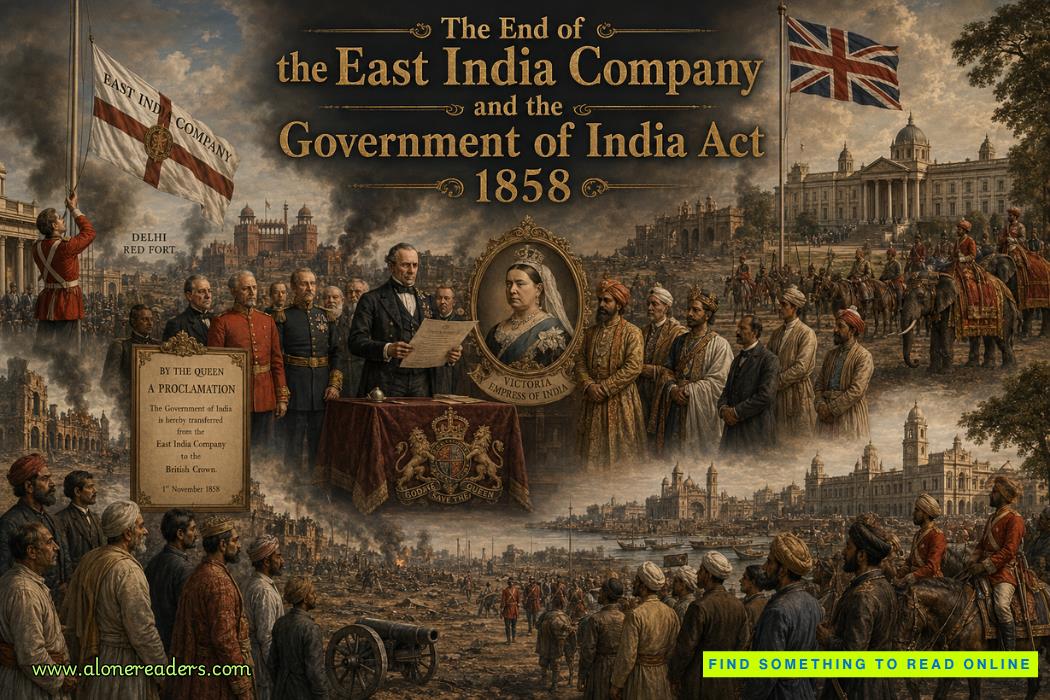
The collapse of the British East India Company's political authority marked one of the greatest constitutional transformations in the history of the British Empire. The Government of India Act of 1858 did far more than replace one administrative system with another; it fundamentally altered the relationship between Britain and India for the next ninety years. Emerging directly from the devastation of the Indian Rebellion of 1857, the Act represented Britain's admission that a private commercial corporation could no longer govern one of the world's largest and most diverse societies. It ended more than a century of Company rule and inaugurated the era of direct British Crown administration, commonly known as the British Raj. Historians continue to debate whether this transition represented meaningful reform or merely a reorganization of imperial power, but few dispute that 1858 constituted a defining turning point in the political history of modern South Asia.
The East India Company had begun as a trading enterprise following its royal charter in 1600, but military victories during the eighteenth century gradually transformed it into a territorial power. The decisive Battle of Plassey (1757) and the Battle of Buxar (1764) enabled the Company to collect revenue across Bengal while expanding its military influence into northern, central, and southern India. By the mid-nineteenth century it controlled territory inhabited by nearly 200 million people, governed through a complex bureaucracy supported by the Bengal, Madras, and Bombay Presidencies.
Despite repeated attempts by the British Parliament to regulate Company affairs through measures such as Pitt's India Act (1784) and the Charter Acts, serious problems persisted. Aggressive territorial expansion under governors-general such as Lord Wellesley and Lord Dalhousie, particularly through the controversial Doctrine of Lapse, alienated many Indian rulers. Economic restructuring disrupted traditional industries and intensified rural hardship, while missionary activity and social reforms convinced many Indians that British officials intended to undermine established religious and cultural practices. Growing dissatisfaction spread among soldiers of the Bengal Army, whose grievances concerning pay, overseas service, promotion, and religious sensitivities culminated in the cartridge controversy involving the new Pattern 1853 Enfield rifle.
When rebellion erupted at Meerut on 10 May 1857, the Company found itself confronting an unprecedented crisis. Within weeks, Delhi had become the symbolic centre of resistance under the elderly Mughal emperor Bahadur Shah II, while uprisings spread across northern and central India, including Kanpur, Lucknow, Jhansi, Bareilly, and Gwalior. Although many regions remained loyal or neutral, the rebellion exposed profound weaknesses in Company governance. The Company's military forces, heavily dependent upon Indian sepoys, fractured dramatically. Communications broke down, administrative structures collapsed in contested regions, and local populations questioned the Company's legitimacy.
Throughout the conflict, British political opinion increasingly concluded that the rebellion reflected not merely military mutiny but systemic administrative failure. Newspapers in Britain criticized Company leadership, while parliamentary debates questioned whether a profit-oriented corporation could responsibly administer such an enormous empire. Even though Company armies, reinforced by British regiments, Sikh soldiers, Gurkhas, and loyal princely states, eventually suppressed the rebellion by 1858, confidence in the existing constitutional arrangement had evaporated.
Prime Minister Lord Palmerston initially introduced legislation to abolish Company rule in early 1858, arguing that ultimate political responsibility should belong directly to the British government. Although Palmerston's administration fell before the measure passed, his successor, Edward Smith-Stanley, the Earl of Derby, successfully guided revised legislation through Parliament. The resulting Government of India Act, receiving royal assent on 2 August 1858, formally dissolved the Company's governing authority while preserving many practical administrative structures.
The legislation fundamentally reorganized imperial governance. The office of the President of the Board of Control, which had previously supervised Company affairs, disappeared. In its place emerged the powerful new office of the Secretary of State for India, a cabinet minister directly responsible to Parliament. Assisted by a fifteen-member Council of India, largely composed of experienced former Company administrators, the Secretary exercised extensive authority over legislation, finance, military affairs, diplomacy, and communications. This arrangement centralized imperial decision-making within the British government while maintaining considerable bureaucratic continuity.
Equally significant was the replacement of the Governor-General by the dual office of Governor-General and Viceroy of India. Although the title "Governor-General" continued constitutionally, the designation Viceroy symbolized the representative of the British monarch rather than a commercial corporation. Lord Canning, who had already served as Governor-General during the rebellion, became the first Viceroy under the new constitutional framework. His role involved balancing London's directives with the practical realities of governing an immense and diverse subcontinent recovering from civil conflict.
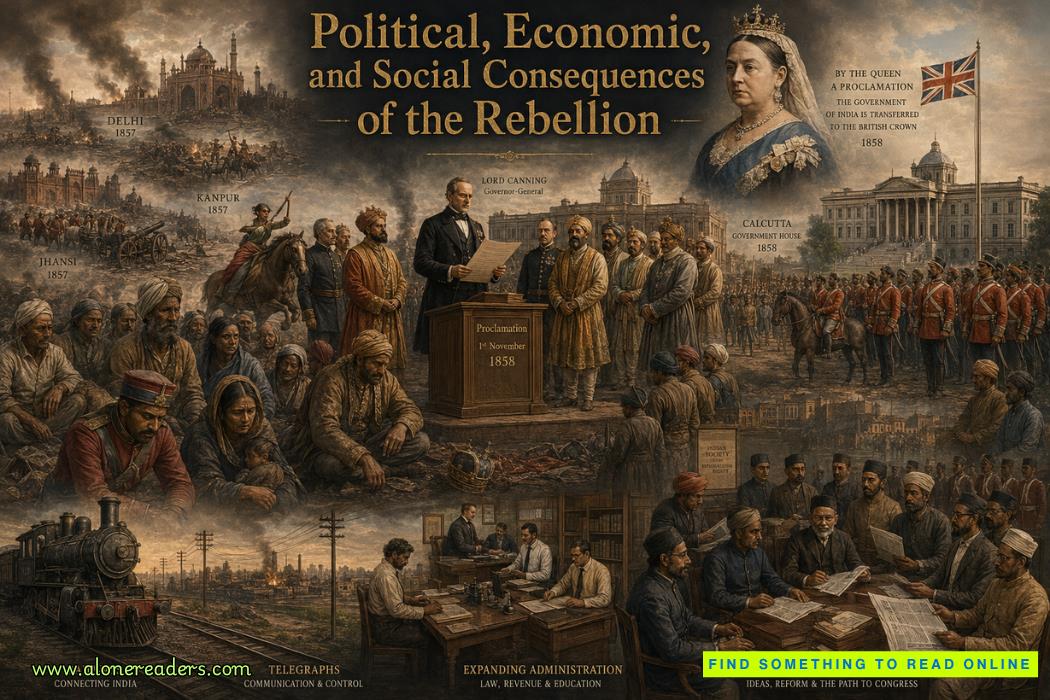
Perhaps the most symbolic moment in this constitutional transformation occurred on 1 November 1858, when Queen Victoria's Proclamation was formally announced throughout India. Read publicly at major cities including Allahabad, the proclamation sought to reassure Indian subjects following the upheaval of the rebellion. It promised equal treatment under the law regardless of religion, declared that the British government would refrain from imposing Christianity, guaranteed recognition of treaties with princely states, and effectively abandoned the Doctrine of Lapse, thereby reducing fears of future annexations. The proclamation also promised that government appointments would be open to qualified Indians "without distinction of race or creed," although in practice significant racial barriers remained.
The principal figures shaping these developments reflected differing priorities. Lord Canning, sometimes criticized in Britain for excessive moderation during the rebellion, believed that reconciliation offered greater long-term stability than indiscriminate punishment. His efforts to temper retribution earned him the nickname "Clemency Canning," although many contemporaries considered his policies controversial. Queen Victoria, while personally distant from Indian administration, became an increasingly important imperial symbol whose image emphasized paternal responsibility rather than corporate exploitation. On the Indian side, the final exile of Bahadur Shah II to Rangoon represented not merely the fall of an elderly monarch but the definitive end of the Mughal dynasty as a political institution. Indian princes who had remained loyal, including rulers in Hyderabad, Patiala, and Gwalior, emerged with strengthened positions under Crown rule because British policy now emphasized cooperation with princely allies rather than systematic annexation.
Historians continue to debate whether the Government of India Act represented genuine reform or primarily cosmetic constitutional change. One interpretation argues that transferring authority to the Crown introduced greater accountability because elected ministers, rather than Company directors, answered directly to Parliament. Administrative professionalism expanded, communication improved with the growing use of telegraphs and railways, and financial oversight became more systematic. Another perspective emphasizes continuity rather than transformation. Many senior Company officials retained influential positions, economic priorities remained fundamentally imperial, and political power continued to exclude the overwhelming majority of Indians. From this viewpoint, 1858 changed the machinery of empire without altering its underlying objectives.
The consequences nevertheless proved profound. Militarily, the British reorganized the Indian Army to reduce the likelihood of future large-scale rebellion. The proportion of European troops increased substantially, artillery remained largely under British control, and recruitment shifted toward communities that officials classified as "martial races," particularly Sikhs, Gurkhas, Pathans, and Punjabi Muslims. Administratively, the government cultivated closer relationships with princely states, recognizing that loyal indigenous rulers had played a decisive role in suppressing the rebellion. Simultaneously, British officials became increasingly cautious regarding social reform, fearing that rapid intervention in religious and cultural practices might provoke renewed unrest.
The Act also accelerated the development of a more centralized imperial bureaucracy. The Indian Civil Service evolved into one of the most prestigious administrative institutions in the empire, although competitive examinations held in Britain effectively limited Indian participation for decades. Expanding railway networks, telegraph systems, irrigation projects, and legal codification strengthened administrative integration while simultaneously facilitating economic extraction and military mobility.
Ironically, the constitutional settlement designed to stabilize imperial rule eventually contributed to the growth of Indian nationalism. Queen Victoria's promises of equality, justice, and merit-based opportunity established moral principles that educated Indians increasingly invoked when demanding political reform. As Western education expanded and a new professional middle class emerged, Indians pointed to the disparity between official promises and administrative realities. By the late nineteenth century, organizations such as the Indian National Congress, founded in 1885, would draw upon grievances rooted partly in the constitutional order established after 1858.
The legacy of the Government of India Act therefore extends far beyond the immediate aftermath of the rebellion. It formally concluded the extraordinary experiment in which a private trading corporation governed a vast empire, replacing commercial sovereignty with direct imperial rule under the British Crown. At the same time, it reshaped relations between Britain, Indian princes, and emerging Indian political elites. Although intended to secure imperial stability, the new system generated expectations of justice, representation, and constitutional governance that later nationalist movements would transform into demands for self-government and eventual independence.
The end of the East India Company was therefore not merely the dissolution of a corporation but the conclusion of an entire phase of imperial expansion. The Government of India Act 1858 emerged directly from the lessons—both real and perceived—of the Indian Rebellion of 1857, redefining Britain's methods of governing India while leaving many underlying tensions unresolved. It marked the beginning of the British Raj, a new constitutional order that endured until 1947, and it remains one of the most consequential legislative acts in the intertwined histories of Britain and India. Understanding this transformation is essential to understanding not only why the rebellion changed the structure of empire but also how that new imperial order ultimately produced the political forces that challenged and eventually dismantled it.




 The Hundred Days Offensive: How the Allies Defeated Germany in World War I
 The Second Battle of the Marne: The Turning Point of World War I in 1918
 The Spring Offensive of 1918: Germany's Final Gamble to Win World War I
 The Treaty of Brest-Litovsk: How Russia Left World War I
 The Russian Revolution and World War I: How War Brought Down the Tsar
 The Zimmermann Telegram Explained: Germany's Secret Offer to Mexico in World War I