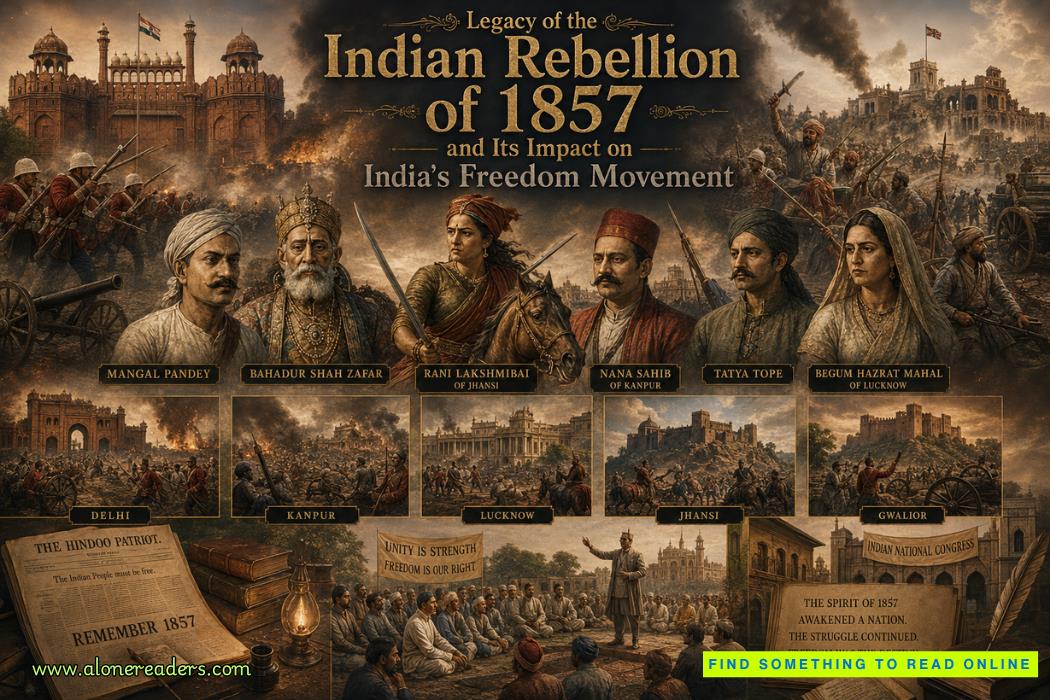
The Indian Rebellion of 1857 occupies a unique place in the history of modern South Asia. Although the uprising ultimately failed to overthrow British rule, its consequences extended far beyond the military campaigns fought across northern and central India. The rebellion transformed the political relationship between Britain and India, reshaped imperial governance, and became one of the most enduring symbols of resistance against colonial domination. More importantly, its memory profoundly influenced generations of Indian nationalists who later led the struggle for independence. Historians continue to debate whether 1857 should be remembered primarily as a military mutiny, a series of regional revolts, a civil war, or India's First War of Independence. Regardless of interpretation, its legacy became inseparable from the evolution of Indian nationalism during the late nineteenth and early twentieth centuries.
Before 1857, resistance against the British East India Company had generally been local, fragmented, and driven by regional grievances. Peasant uprisings, tribal revolts, and the opposition of displaced rulers occurred throughout the first half of the nineteenth century, but none united such diverse sections of Indian society. The rebellion brought together discontented sepoys, dispossessed princes, landlords, peasants, artisans, and religious leaders who, despite differing objectives, found common cause in resisting Company rule. The annexation policies associated with Lord Dalhousie's Doctrine of Lapse, growing economic exploitation, military grievances surrounding the Enfield rifle cartridges, and fears regarding religious interference created conditions in which widespread resistance became possible.
Although British military superiority eventually suppressed the rebellion by 1859, the conflict fundamentally altered British perceptions of India. The Government of India Act of 1858 abolished Company rule and transferred authority directly to the British Crown. Queen Victoria's Proclamation, issued on 1 November 1858, promised religious tolerance, protection of princely states, and equal treatment before the law. While many of these promises remained imperfectly fulfilled, the proclamation represented Britain's recognition that aggressive annexation and disregard for Indian political traditions had contributed significantly to the uprising. Consequently, British administrators adopted a more cautious approach toward Indian rulers, landlords, and religious institutions.
The immediate political consequences of the rebellion also shaped the future nationalist movement. The British reorganized the Indian Army to prevent another large-scale uprising by reducing the proportion of Indian soldiers, increasing the number of European troops, and recruiting heavily from communities considered politically loyal, particularly Sikhs, Gurkhas, and certain Punjabi groups. This so-called "martial races" policy reflected lessons drawn from the rebellion while simultaneously reinforcing regional and ethnic divisions within colonial military organization.
The rebellion's suppression was accompanied by severe reprisals. Entire villages suspected of aiding rebels were destroyed, thousands were executed, and many prominent leaders were killed or exiled. Bahadur Shah Zafar, the last Mughal emperor, was deported to Rangoon, where he died in 1862. Rani Lakshmibai of Jhansi fell during the fighting near Gwalior in 1858, becoming one of India's greatest symbols of courage and sacrifice. Tatya Tope continued a remarkable guerrilla campaign before his capture and execution in 1859, while Begum Hazrat Mahal sought refuge in Nepal after resisting British reconquest of Lucknow. Their military defeat did not diminish their symbolic importance; instead, their lives gradually became foundational legends within India's national memory.
One of the rebellion's greatest legacies lay not in its immediate achievements but in the historical lessons it offered future generations. Indian intellectuals who emerged during the late nineteenth century recognized that the rebellion had demonstrated both the possibility of widespread resistance and the dangers of inadequate coordination. Unlike the leaders of 1857, later nationalists increasingly emphasized political organization, communication, public opinion, and constitutional methods before mass confrontation. The establishment of the Indian National Congress in 1885 reflected this changing strategy. While early Congress leaders generally pursued moderate constitutional reforms rather than armed rebellion, they remained deeply aware of the historical significance of 1857.
The memory of the rebellion evolved considerably over time. British officials initially portrayed the conflict as a "Sepoy Mutiny," emphasizing military indiscipline and isolated violence rather than widespread political resistance. This interpretation justified continued imperial rule by suggesting that the uprising lacked genuine national purpose. Many British historians of the nineteenth century similarly argued that the rebellion represented a collection of local disturbances without coherent leadership or shared political objectives.
Indian nationalist historians challenged this interpretation. During the early twentieth century, Vinayak Damodar Savarkar famously described the uprising as India's First War of Independence, arguing that it represented a united national struggle against foreign domination. Although many modern historians consider this interpretation somewhat idealized, it significantly influenced nationalist thought. Contemporary scholarship often adopts a more nuanced position, recognizing that while the rebellion did not constitute a fully developed nationalist revolution in the modern sense, it nevertheless represented an unprecedented convergence of political, military, social, and cultural resistance across large parts of India.
The rebellion also profoundly influenced the language and symbolism of Indian nationalism. Stories of Mangal Pandey's defiance, Rani Lakshmibai's battlefield leadership, Tatya Tope's persistence, Kunwar Singh's remarkable campaigns despite advanced age, and Begum Hazrat Mahal's determined resistance became central components of patriotic literature, theatre, poetry, and public commemorations. These figures transcended regional identities and increasingly came to represent national ideals of sacrifice, courage, and resistance.
Religious cooperation during parts of the rebellion also acquired lasting significance. Although local tensions certainly existed, many rebel leaders consciously emphasized Hindu-Muslim unity. Soldiers often fought together under the symbolic authority of Bahadur Shah Zafar, while proclamations appealed to both religious communities to defend their shared political and cultural traditions. Later nationalist leaders, particularly during the early decades of the twentieth century, frequently invoked this aspect of 1857 as evidence that India's struggle against colonialism could transcend religious divisions.
The rebellion also shaped British colonial policy in ways that unintentionally strengthened Indian nationalism. Increased racial segregation after 1857, growing distrust between rulers and subjects, and the exclusion of Indians from higher administrative positions fostered resentment among the emerging educated middle class. Western education, introduced partly to produce loyal administrators, instead produced intellectuals who increasingly criticized colonial rule using liberal political ideas originating in Britain itself. Figures such as Dadabhai Naoroji, Surendranath Banerjee, Bal Gangadhar Tilak, Lala Lajpat Rai, and later Mahatma Gandhi, Jawaharlal Nehru, and Subhas Chandra Bose inherited a political landscape permanently shaped by the consequences of 1857.
Revolutionary organizations of the early twentieth century drew particularly strong inspiration from the rebellion. Groups such as the Anushilan Samiti, the Ghadar Movement, and the Hindustan Socialist Republican Association celebrated the martyrs of 1857 as pioneers of armed resistance. Revolutionary literature frequently portrayed the uprising as unfinished business requiring completion through renewed struggle. Even during the Indian National Army campaigns of the Second World War, Subhas Chandra Bose consciously invoked the memory of 1857, presenting his movement as a continuation of the earlier fight against British rule.
Historiographical debates surrounding the rebellion remain vigorous. Some scholars emphasize the absence of centralized leadership, noting that many participants sought the restoration of traditional rulers rather than the creation of a modern nation-state. Others argue that nationalism should not be measured solely by twentieth-century standards. They contend that 1857 represented an important transitional stage in which regional identities gradually merged into broader political consciousness. Increasingly, historians view the rebellion as a complex coalition of local grievances united by opposition to colonial authority rather than a single ideologically coherent revolution.
Its legacy also extends beyond political history. The rebellion profoundly influenced literature, visual art, folklore, and public memory throughout India. Statues, memorials, museums, and annual commemorations continue to honor its heroes. School textbooks, historical novels, films, and television dramas have repeatedly revisited its events, ensuring that each generation encounters the rebellion not merely as a military conflict but as a defining episode in India's long journey toward independence. Even where interpretations differ, the emotional resonance of 1857 remains remarkably powerful.
Perhaps the rebellion's greatest historical contribution was psychological. It demonstrated that British authority, despite its military strength, was neither inevitable nor unquestionable. Although the uprising failed militarily, it shattered the illusion of unquestioned colonial invincibility. The British themselves acknowledged this reality through sweeping administrative reforms designed to prevent another similar crisis. For Indians, the rebellion established a historical tradition of organized resistance that later political leaders could reinterpret according to changing circumstances.
The legacy of the Indian Rebellion of 1857 therefore cannot be measured simply by battlefield victories or political outcomes. Its enduring significance lies in the ideas, memories, and symbols it bequeathed to subsequent generations. It transformed imperial governance, inspired nationalist thought, shaped historical identity, and provided an enduring narrative of sacrifice and resistance. While India's independence ultimately emerged through a combination of constitutional politics, mass civil disobedience, revolutionary activism, and global geopolitical change, the memory of 1857 remained an essential foundation upon which those later struggles were built. In that sense, the rebellion occupies a permanent place not merely as a failed insurrection but as the beginning of a historical tradition that eventually culminated in India's independence nearly ninety years later.



 The Hundred Days Offensive: How the Allies Defeated Germany in World War I
 The Second Battle of the Marne: The Turning Point of World War I in 1918
 The Spring Offensive of 1918: Germany's Final Gamble to Win World War I
 The Treaty of Brest-Litovsk: How Russia Left World War I
 The Russian Revolution and World War I: How War Brought Down the Tsar
 The Zimmermann Telegram Explained: Germany's Secret Offer to Mexico in World War I