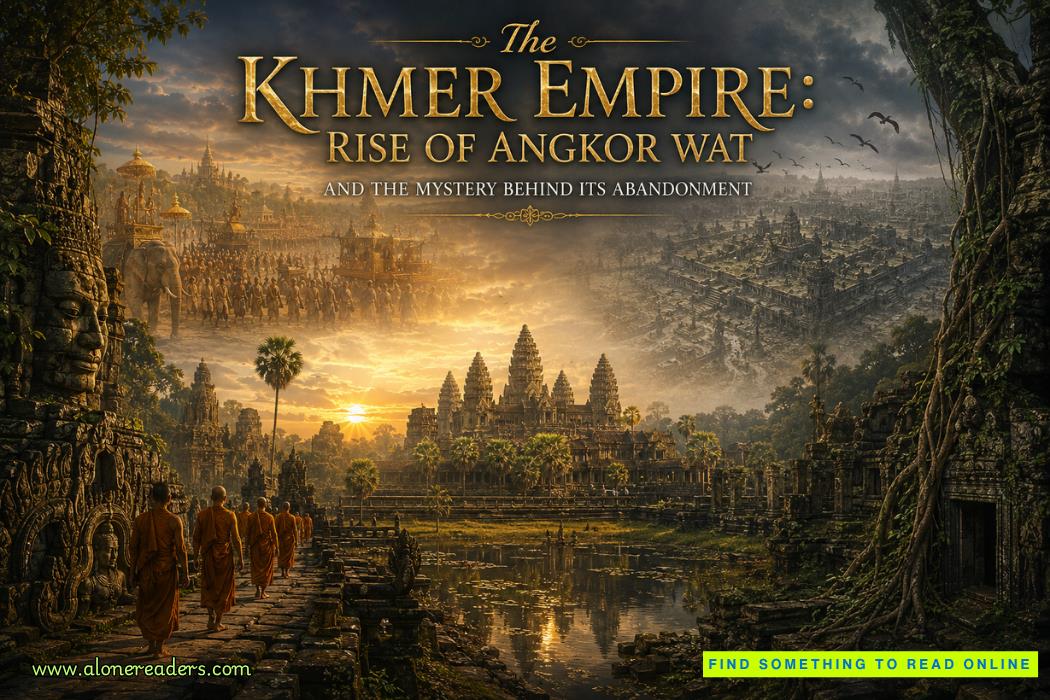
The Khmer Empire stands as one of Southeast Asia’s most remarkable yet enigmatic civilizations, a vast and sophisticated power that once dominated much of mainland Southeast Asia. Its crowning achievement, Angkor Wat, remains the largest religious monument in the world—a testament to architectural brilliance, spiritual devotion, and imperial ambition. Yet, despite its grandeur, the empire’s eventual decline and the mysterious abandonment of Angkor continue to puzzle historians. The story of the Khmer Empire is not merely one of rise and fall, but of human ingenuity intertwined with environmental fragility, political complexity, and shifting belief systems.
The origins of the Khmer Empire can be traced to the early ninth century, when King Jayavarman II declared himself a devaraja, or “god-king,” in 802 CE. This was more than a ceremonial act—it established a powerful ideological framework that legitimized centralized authority. By associating the king with divine power, Jayavarman II laid the foundation for a unified political structure in a region previously fragmented into smaller principalities. This moment is often considered the symbolic birth of the empire.
From its earliest days, the Khmer Empire demonstrated a unique capacity for territorial expansion and administrative cohesion. Successive rulers extended their influence across present-day Cambodia, Thailand, Laos, and Vietnam. But unlike many empires built solely on military conquest, the Khmer strength also lay in its mastery of landscape engineering. The region around Angkor was transformed into a highly sophisticated urban and agricultural system, supported by an intricate network of canals, reservoirs, and embankments. These hydraulic systems allowed the empire to sustain large populations and maintain agricultural surplus, even during seasonal fluctuations.
It was under King Suryavarman II in the early twelfth century that the empire reached one of its most iconic milestones—the construction of Angkor Wat. Originally dedicated to the Hindu god Vishnu, the temple was not merely a place of worship but a cosmic representation of the universe. Its design reflects Mount Meru, the mythical center of the universe in Hindu cosmology, with its central towers rising like sacred peaks. Every detail, from the bas-reliefs depicting epic narratives to the precise alignment with celestial bodies, reveals a civilization deeply invested in symbolism and cosmic order.
Angkor Wat also functioned as a political statement. Its sheer scale and precision signaled the absolute authority and divine legitimacy of the king. Unlike earlier temples, which were often built on elevated ground, Angkor Wat was constructed on flat terrain surrounded by a massive moat. This not only enhanced its visual grandeur but also symbolized the cosmic ocean. The temple’s westward orientation, unusual for Khmer temples, has led some scholars to associate it with funerary rituals, possibly serving as a mausoleum for Suryavarman II.
The period following Angkor Wat’s construction marked a golden age of cultural and architectural achievement. Monumental structures such as Bayon, Ta Prohm, and Preah Khan emerged, each reflecting a blend of religious influences. This era also witnessed a significant religious transition. While earlier rulers adhered to Hinduism, later kings, particularly Jayavarman VII, embraced Mahayana Buddhism. This shift was not merely theological but deeply political. Jayavarman VII’s reign emphasized compassion, public welfare, and infrastructure development. He built hospitals, rest houses, and roads, transforming the empire into a more socially integrated state.
Yet, beneath this prosperity, subtle cracks were beginning to form. The very hydraulic systems that sustained the empire also required constant maintenance and coordination. Over time, these systems became increasingly complex and fragile. Evidence suggests that prolonged droughts followed by intense monsoon rains in the fourteenth and fifteenth centuries disrupted the delicate balance of water management. Sedimentation clogged canals, reservoirs overflowed or dried up, and agricultural productivity declined. The empire’s reliance on large-scale infrastructure became a double-edged sword.
At the same time, external pressures began to mount. The rise of the Ayutthaya Kingdom in present-day Thailand introduced a formidable rival. Frequent conflicts weakened the Khmer military and drained resources. Historical accounts suggest that Angkor was sacked multiple times, culminating in a significant invasion in 1431. While this event is often cited as the turning point, it was likely the culmination of long-term decline rather than a singular cause.
Internal dynamics also played a critical role. The shift from Hinduism to Buddhism altered the ideological foundation of kingship. The concept of the god-king diminished, potentially weakening centralized authority. Additionally, the growing influence of Theravada Buddhism, which emphasized personal spiritual practice over state-sponsored ritual, may have reduced the resources allocated to monumental construction and state projects. This ideological transformation subtly reshaped the social fabric of the empire.
Another often overlooked factor is the changing trade networks of the region. As maritime trade routes gained prominence, coastal cities became more economically significant than inland capitals like Angkor. The empire’s focus on inland agriculture and temple construction may have left it less adaptable to these shifts. Gradually, political and economic power began to move southward, closer to emerging trade hubs.
The abandonment of Angkor was not a sudden collapse but a gradual transformation. Archaeological evidence indicates that the region was not entirely deserted. Instead, there was a slow decline in population and administrative importance. The royal court eventually relocated, possibly to Phnom Penh, marking a shift in the political center. Angkor Wat itself was never completely abandoned; it remained a site of Buddhist worship, preserving its spiritual significance even as its political role faded.
What makes the story of the Khmer Empire particularly compelling is the interplay of multiple factors—environmental, political, religious, and economic. There is no single explanation for its decline, which is why it continues to fascinate historians. The empire’s fall serves as a reminder that even the most advanced civilizations are vulnerable to systemic complexity and external change.
Today, Angkor Wat stands not as a relic of failure but as a symbol of enduring human creativity. Its intricate carvings, towering spires, and harmonious proportions continue to inspire awe. Modern technology, including satellite imaging and lidar scanning, has revealed that Angkor was once one of the largest pre-industrial urban centers in the world. These discoveries have reshaped our understanding of the empire, highlighting its sophistication and scale.
In many ways, the Khmer Empire’s story resonates with contemporary concerns. Issues such as climate variability, infrastructure management, and resource sustainability echo across centuries. The empire’s reliance on a complex water system, once its greatest strength, ultimately contributed to its vulnerability. This duality underscores a timeless lesson: progress without adaptability can lead to decline.
For historians and writers alike, the Khmer Empire offers a rich narrative tapestry. It is a story of ambition and belief, of monumental achievement and quiet unraveling. The rise of Angkor Wat represents the zenith of human imagination, while its gradual abandonment invites reflection on the impermanence of power. Together, they form a narrative that is both grand and intimate, echoing across time as a testament to the fragile brilliance of civilization.
At a Glance – Summary Box



 The Hundred Days Offensive: How the Allies Defeated Germany in World War I
 The Second Battle of the Marne: The Turning Point of World War I in 1918
 The Spring Offensive of 1918: Germany's Final Gamble to Win World War I
 The Treaty of Brest-Litovsk: How Russia Left World War I
 The Russian Revolution and World War I: How War Brought Down the Tsar
 The Zimmermann Telegram Explained: Germany's Secret Offer to Mexico in World War I










