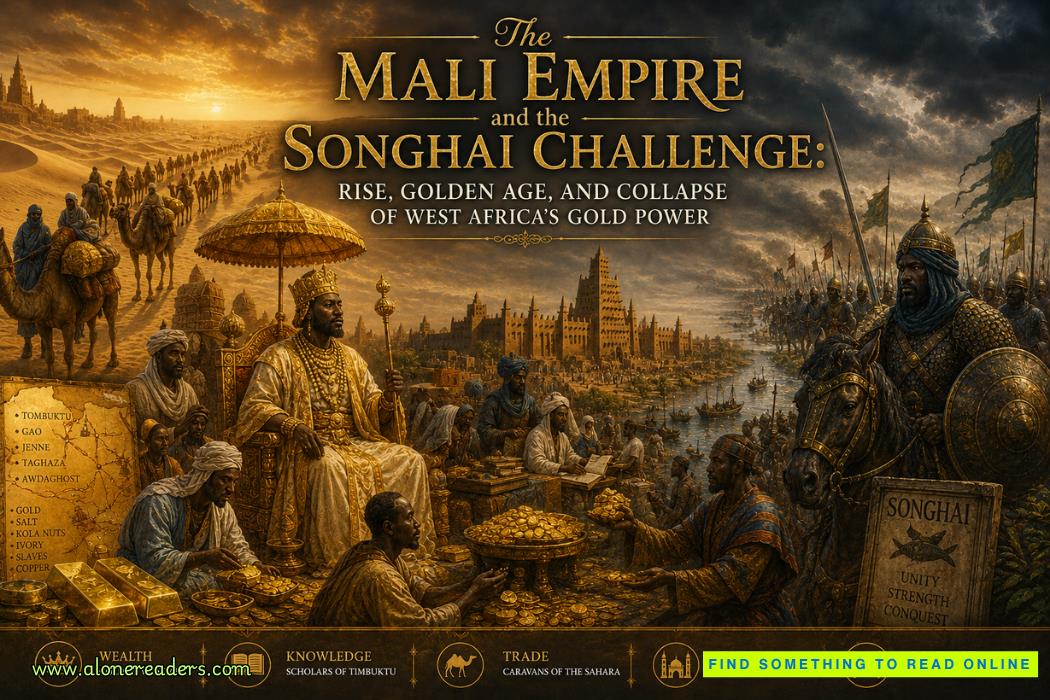
The story of the Mali Empire is not merely one of wealth and power; it is a narrative shaped by control of resources, mastery of trade routes, and the fragile balance of political authority. Emerging from the ruins of earlier West African states, Mali rose to become one of the most prosperous empires of the medieval world, famed for its immense gold reserves and vibrant intellectual centers. Yet, like many great powers, its decline was neither sudden nor accidental. It unfolded gradually under the pressure of internal weaknesses and the growing ambition of a formidable rival—the Songhai Empire.
The origins of Mali can be traced to the early 13th century, when a Mandinka leader named Sundiata Keita unified fragmented clans after defeating the Sosso kingdom at the Battle of Kirina. This victory was more than a military triumph; it marked the beginning of a centralized state built on strategic geography and economic foresight. Mali’s location allowed it to dominate the trans-Saharan trade routes, which connected West Africa to North Africa and beyond. These routes carried salt, gold, ivory, and enslaved people, making them the lifeblood of regional and international commerce.
What distinguished Mali from its predecessors was not simply access to gold but its ability to regulate and tax its flow. Gold fields such as Bambuk and Bure were among the richest in the world, and Mali’s rulers enforced strict control over gold nuggets while allowing gold dust to circulate as currency. This dual system ensured both economic stability and royal dominance. It is often said that during its height, Mali supplied nearly half of the Old World’s gold, a staggering indicator of its influence.
The empire reached its zenith under Mansa Musa, whose reign in the early 14th century became legendary. His pilgrimage to Mecca in 1324 is one of the most documented events in African medieval history. Traveling with a vast entourage, Musa distributed so much gold along his journey that he inadvertently caused inflation in regions such as Cairo. This journey was not merely an act of religious devotion but a calculated display of wealth and power, placing Mali firmly on the global map.
Musa’s legacy extended far beyond wealth. He invested heavily in architecture, education, and religious institutions. Cities like Timbuktu and Gao flourished as centers of learning, attracting scholars, poets, and traders from across the Islamic world. The construction of mosques and madrasas transformed Timbuktu into a hub of intellectual life, where manuscripts were produced and preserved in vast numbers. Knowledge became as valuable as gold, reinforcing Mali’s cultural prestige.
However, beneath this golden surface lay vulnerabilities that would later contribute to the empire’s decline. The administrative structure of Mali relied heavily on the strength and authority of its ruler. While strong leaders like Sundiata and Musa maintained cohesion, weaker successors struggled to manage distant provinces and ambitious governors. Over time, regional leaders began asserting autonomy, weakening central control.
Trade dynamics also began to shift. While Mali initially dominated trans-Saharan commerce, new trade routes and emerging powers started to challenge its monopoly. The city of Gao, once under Mali’s influence, began to rise independently under the Songhai people. Unlike Mali, which relied on inherited structures, Songhai developed a more militarized and expansionist approach.
The rise of the Songhai Empire marked a turning point in West African history. Under leaders like Sunni Ali in the 15th century, Songhai transformed from a regional power into a formidable empire. Sunni Ali combined military innovation with strategic governance, capturing key cities such as Timbuktu and Djenné. These conquests were not only territorial but symbolic, as they represented the transfer of economic and intellectual centers from Mali to Songhai.
The contrast between Mali and Songhai is striking. Mali’s strength lay in its wealth and trade networks, while Songhai emphasized military discipline and administrative reform. As Mali’s internal cohesion weakened, Songhai exploited these vulnerabilities with calculated precision. The loss of key cities deprived Mali of both revenue and prestige, accelerating its decline.
Another critical factor in Mali’s fall was the gradual erosion of its economic base. Gold production declined, and the empire struggled to adapt to changing trade patterns. Coastal trade routes began to emerge, reducing reliance on trans-Saharan networks. European traders, arriving along the West African coast, introduced new dynamics that Mali was ill-equipped to navigate.
Internal conflicts further destabilized the empire. Succession disputes became more frequent, leading to fragmentation and civil strife. Provinces that once contributed to Mali’s strength began to drift away, forming independent states or aligning with rival powers. The unity that had once defined Mali became its greatest weakness when it unraveled.
By the late 15th century, Mali was no longer the dominant force it had once been. The Songhai Empire, under Askia Muhammad, solidified its control over former Malian territories and established a new era of prosperity and governance. Askia introduced administrative reforms, standardized taxation, and strengthened Islamic institutions, creating a more structured and resilient state.
Despite its decline, Mali’s legacy endured. Its contributions to trade, culture, and scholarship left a lasting imprint on West African history. The manuscripts of Timbuktu, the architectural achievements of its cities, and the stories of its rulers continue to inspire historical inquiry and cultural pride. Mali demonstrated that wealth alone is not enough to sustain an empire; adaptability and strong governance are equally essential.
The fall of Mali serves as a powerful reminder of the cyclical nature of history. Empires rise through innovation and unity but often fall due to complacency and internal division. The challenge posed by Songhai was not merely an external threat but a reflection of Mali’s inability to evolve in a changing world.
In examining the trajectory of the Mali Empire, one can see a pattern that resonates across civilizations. The concentration of wealth, the reliance on charismatic leadership, and the neglect of institutional resilience all contributed to its downfall. At the same time, the rise of Songhai illustrates how new powers can emerge by learning from the strengths and weaknesses of their predecessors.
Ultimately, the story of Mali is not just about gold or conquest; it is about the delicate balance between prosperity and sustainability. It is a narrative that underscores the importance of foresight in governance and the dangers of stagnation. As the sands of the Sahara continue to shift, they carry with them the echoes of caravans, scholars, and kings who once shaped the destiny of an empire that dazzled the world.
At a Glance Summary Box




 The Hundred Days Offensive: How the Allies Defeated Germany in World War I
 The Second Battle of the Marne: The Turning Point of World War I in 1918
 The Spring Offensive of 1918: Germany's Final Gamble to Win World War I
 The Treaty of Brest-Litovsk: How Russia Left World War I
 The Russian Revolution and World War I: How War Brought Down the Tsar
 The Zimmermann Telegram Explained: Germany's Secret Offer to Mexico in World War I










