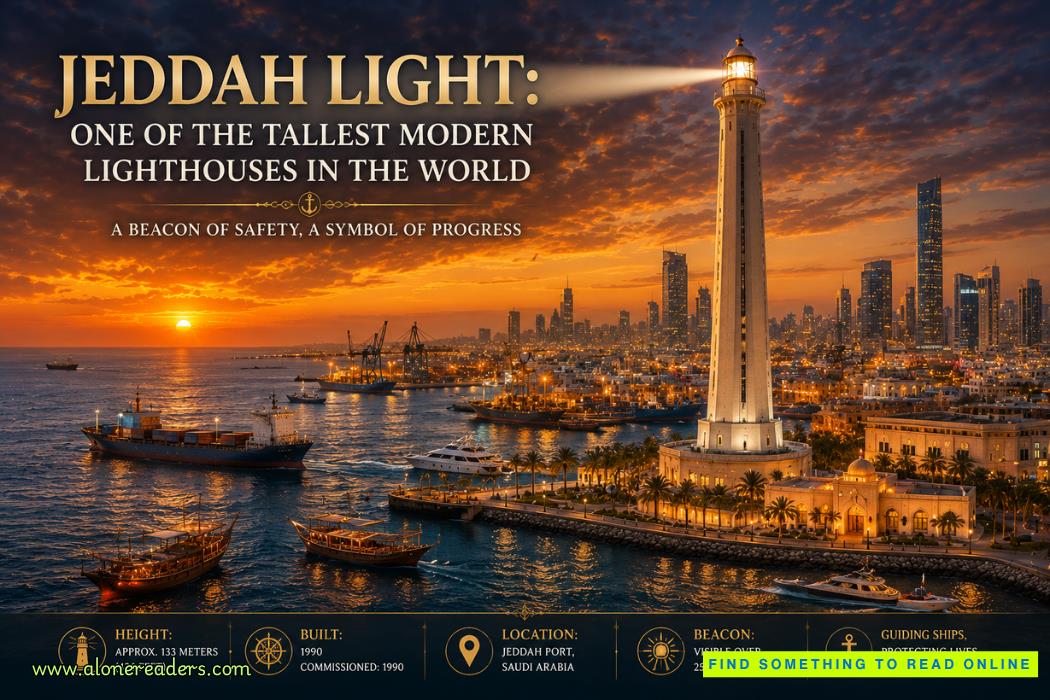
Throughout history, humanity has built lighthouses to protect sailors from unseen dangers and to guide ships safely toward distant ports. While many historic lighthouses are remembered for their ancient stone towers and dramatic legends, the modern era has produced remarkable navigational structures that demonstrate the advances of engineering and maritime technology. Among these extraordinary achievements stands Jeddah Light, a towering beacon on the coast of Saudi Arabia that is widely recognized as one of the tallest modern lighthouses ever constructed. Rising above the shores of the Red Sea, this impressive structure symbolizes both the Kingdom's expanding maritime importance and the continuing evolution of lighthouse engineering in the age of satellite navigation.
Located near the entrance to Jeddah Islamic Port, Jeddah Light occupies one of the busiest maritime corridors in the Middle East. The Red Sea has served as a critical trading route for thousands of years, connecting Africa, the Arabian Peninsula, the Mediterranean, and Asia. Long before modern shipping lanes existed, merchants carrying spices, silk, incense, coffee, and precious metals relied upon these waters. As maritime commerce continued to expand during the twentieth century, the need for an advanced navigational beacon capable of serving one of Saudi Arabia's principal ports became increasingly evident.
The construction of Jeddah Light reflected the country's growing investment in maritime infrastructure during the latter part of the twentieth century. As Jeddah developed into Saudi Arabia's primary commercial gateway on the Red Sea, shipping traffic increased dramatically. Massive cargo vessels, container ships, oil tankers, passenger ferries, naval vessels, and fishing boats all required reliable navigational guidance while entering and departing the harbor. Traditional navigation alone was no longer sufficient for safely managing such heavy maritime traffic, particularly during poor weather or nighttime operations. Jeddah Light was therefore designed not merely as a landmark but as a highly functional component of one of the region's busiest ports.
One of the most remarkable aspects of the lighthouse is its extraordinary height. Standing at approximately 133 meters (436 feet), Jeddah Light ranks among the tallest operational lighthouses in the world. Unlike many historic masonry towers built centuries earlier, its immense height became possible through modern reinforced concrete construction techniques. The structure towers over surrounding port facilities, allowing its powerful beacon to remain visible across vast stretches of the Red Sea.
The architectural design of Jeddah Light differs significantly from the classic cylindrical stone towers commonly associated with historic European lighthouses. Instead, it features a sleek, tapering concrete shaft with geometric lines that reflect contemporary engineering principles rather than decorative architectural traditions. The lighthouse demonstrates how modern functionality can produce a distinctive visual identity. Every aspect of its design prioritizes structural stability, resistance to harsh environmental conditions, and operational efficiency.
Building such an exceptionally tall lighthouse on the Red Sea coastline presented considerable engineering challenges. Engineers needed to account for high temperatures, strong coastal winds, salt-laden air, intense sunlight, and long-term corrosion. Reinforced concrete provided the necessary durability to withstand these demanding environmental conditions while maintaining structural integrity over decades of continuous exposure. The tower's foundation also required careful planning to support its tremendous vertical load while resisting coastal soil movement and environmental stresses.
Unlike many historic lighthouses that depended on oil lamps, candles, or Fresnel lenses illuminated by kerosene, Jeddah Light employs sophisticated modern lighting systems. Its powerful beacon produces an intense light capable of being seen from great distances under favorable weather conditions. Combined with electronic navigation aids, radar systems, and modern maritime communication networks, the lighthouse serves as an integrated component of contemporary vessel traffic management rather than functioning as an isolated navigational marker.
Its importance extends well beyond simply marking the shoreline. Jeddah Islamic Port is one of the busiest commercial ports on the Red Sea and serves as a major logistics hub connecting Europe, Asia, and Africa. Thousands of vessels transit these waters annually, transporting millions of tons of cargo that support both regional economies and global trade. The lighthouse provides critical visual guidance that complements modern electronic navigation, particularly during harbor approaches where precise positioning remains essential despite advances in satellite technology.
The strategic location of Jeddah further enhances the lighthouse's significance. Ships traveling through the Red Sea often pass between the Suez Canal in the north and the Bab el-Mandeb Strait in the south, making this corridor one of the world's most important maritime routes. Any navigational aid serving this region contributes to the safety and efficiency of international shipping. Jeddah Light therefore represents not only Saudi Arabia's maritime infrastructure but also an important element within the broader network of global commercial navigation.
Although satellite positioning systems such as GPS have transformed modern navigation, physical lighthouses remain indispensable. Electronic systems can occasionally experience interference, equipment failure, or communication disruptions. Visual navigation aids provide an independent reference point that enhances maritime safety under numerous operating conditions. Professional mariners continue to regard prominent lighthouses as valuable confirmation points during coastal navigation, particularly when entering busy harbors.
Jeddah Light also reflects Saudi Arabia's broader modernization efforts. During recent decades, the Kingdom has invested heavily in expanding ports, transportation infrastructure, industrial development, and international trade. The lighthouse stands as one visible symbol of these ambitions, combining advanced engineering with practical maritime necessity. Its elegant silhouette has become an instantly recognizable feature of Jeddah's coastline and a notable landmark for arriving vessels.
Despite its operational importance, Jeddah Light has also attracted attention from architects, engineers, photographers, and lighthouse enthusiasts around the world. Its exceptional height alone distinguishes it from nearly every traditional lighthouse ever built. While historic towers often evoke romantic images of isolated keepers battling storms, Jeddah Light represents the modern evolution of lighthouse design, where automation, structural engineering, and integrated navigation systems define contemporary maritime safety.
Visitors to Jeddah frequently admire the lighthouse from surrounding coastal areas, particularly along the city's scenic Corniche. Although public access to the interior is generally restricted because of its location within an active port environment and its operational role, the tower remains a striking visual landmark against the Red Sea skyline. During sunrise and sunset, the brilliant white structure contrasts beautifully with the deep blue waters and the warm colors of the Arabian sky, making it a favorite subject for photographers.
The surrounding city offers additional attractions that enhance the lighthouse's tourism appeal. Historic Al-Balad, modern waterfront developments, luxury hotels, bustling markets, and cultural landmarks attract millions of visitors each year. For many travelers interested in maritime history or modern engineering, seeing one of the world's tallest operational lighthouses becomes an unexpected highlight of their visit to Jeddah.
From an engineering perspective, Jeddah Light demonstrates how lighthouse construction has evolved alongside advances in materials science, structural analysis, and navigation technology. Where earlier builders relied upon thick stone walls and simple lantern rooms, modern engineers employ reinforced concrete, advanced lighting equipment, automated monitoring systems, corrosion-resistant materials, and sophisticated maintenance techniques. The result is a structure capable of performing reliably while requiring significantly less human intervention than traditional lighthouse operations.
Perhaps the greatest significance of Jeddah Light lies in the balance it achieves between tradition and innovation. For centuries, lighthouses have symbolized safety, hope, and guidance for those at sea. Although technology has transformed nearly every aspect of maritime navigation, these enduring symbols continue to serve an essential purpose. Jeddah Light preserves the timeless mission of the lighthouse while embracing the capabilities of the modern world.
Today, Jeddah Light stands not merely as an exceptionally tall tower but as a powerful reminder that even in an era dominated by satellites, digital mapping, and automated navigation, the reassuring presence of a visible beacon still holds immense practical and symbolic value. Rising high above the Red Sea, it continues to guide countless vessels safely toward one of the Middle East's most important ports, embodying the enduring partnership between human ingenuity, engineering excellence, and the timeless relationship between civilization and the sea.




 Château de Vincennes: France’s Forgotten Royal Fortress and Medieval Stronghold
 Château de Carcassonne: Europe’s Greatest Medieval Citadel and Fortress
 Château de Chenonceau: The Castle Built by Remarkable Women
 Château de Chambord: France’s Magnificent Renaissance Castle and Architectural Wonder
 Tehri Dam: India's Tallest Dam and the Debate Behind It
 Bhakra Nangal Dam: India's Temple of Modern Development










