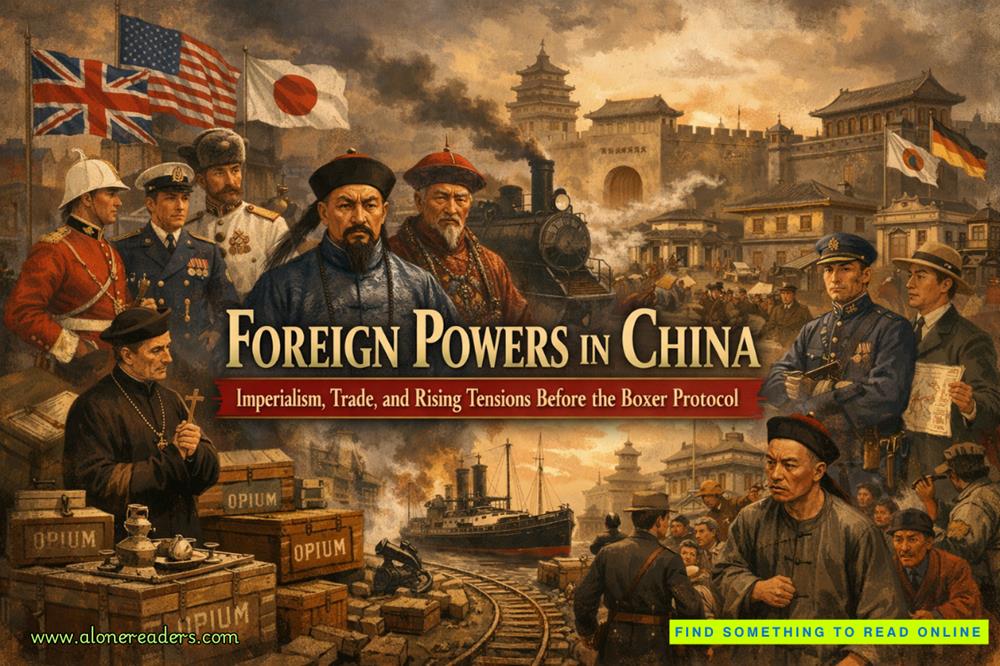
Foreign involvement in China during the nineteenth century was not a single event or policy, but a slow, coercive transformation of sovereignty driven by imperial ambition, commercial hunger, and technological imbalance. What began as regulated trade under tightly controlled Qing dynasty systems evolved into a foreign-dominated order in which China’s political autonomy, economic stability, and cultural cohesion were steadily eroded. By the time the Boxer Protocol was imposed in 1901, foreign powers had already embedded themselves deeply into China’s ports, railways, courts, and fiscal institutions, creating a landscape of domination that made violent backlash almost inevitable.
For centuries, China had viewed itself as the cultural and political center of the civilized world, operating under a tributary system that framed foreign relations as hierarchical rather than equal. European powers, however, arrived with a radically different worldview rooted in industrial capitalism, naval supremacy, and legal extraterritoriality. British merchants, followed by other Western nations, were frustrated by Qing restrictions on trade, particularly the confinement of foreign commerce to Canton and the insistence on silver payments. These tensions were not merely economic; they reflected incompatible assumptions about sovereignty, diplomacy, and power.
The Opium Wars marked a decisive rupture. Britain’s insistence on exporting opium to China, despite its devastating social consequences, revealed the brutal logic of imperial trade. When Qing authorities attempted to suppress the opium trade, military force was deployed to protect commercial interests. The resulting treaties dismantled China’s control over tariffs, opened multiple treaty ports, and granted foreign nationals immunity from Chinese law. Extraterritoriality became a legal symbol of humiliation, embedding the idea that Chinese courts were unfit to judge foreigners on their own soil.
As other powers followed Britain’s example, China became the site of intense imperial competition. France expanded its influence from Indochina into southern China, Russia pushed southward through Manchuria, Germany seized coastal concessions after manufactured diplomatic incidents, and Japan emerged as a modern imperial power following its victory in the Sino-Japanese War. Each power justified its presence through a combination of trade agreements, missionary protection, and strategic necessity, yet collectively they created a system that reduced China to a semi-colonial state without formal colonization.
Foreign economic penetration transformed China’s internal markets. Treaty ports became hubs of global commerce, dominated by foreign banks, shipping companies, and industrial firms. Railways, often financed and controlled by foreign capital, cut through the countryside not to integrate China’s economy on Chinese terms, but to extract resources efficiently. Customs revenue, once a pillar of Qing fiscal authority, increasingly flowed into foreign-managed institutions designed to guarantee debt repayment. The Qing state found itself in the paradoxical position of funding its own subordination.
Missionary activity added another layer of tension. Christian missionaries enjoyed special protections under treaty law, allowing them to operate far beyond treaty ports. While some provided education and medical care, others became deeply entangled in local disputes, often invoking foreign diplomatic pressure to resolve conflicts. To many rural communities, missionaries symbolized not spiritual salvation but foreign intrusion backed by gunboats. Rumors, misunderstandings, and cultural clashes flourished in an environment where legal inequality undermined trust and justice.
These pressures coincided with internal crises. Population growth, environmental stress, and administrative corruption strained Qing governance. Natural disasters and economic dislocation intensified popular suffering, while the visible prosperity of foreign enclaves sharpened perceptions of injustice. Chinese elites were divided between reformers who sought selective Westernization and conservatives who viewed foreign influence as an existential threat. This ideological fragmentation weakened coordinated responses to imperial encroachment and deepened public frustration.
By the late nineteenth century, China had effectively been carved into spheres of influence, informal zones where foreign powers exercised dominant economic and strategic control. Though not colonies in the formal sense, these regions operated under foreign priorities, with rail concessions, mining rights, and military presence shaping local governance. The Qing court’s attempts to balance competing powers through diplomacy often backfired, reinforcing the perception that the dynasty could neither resist nor reform effectively.
Popular resistance increasingly took the form of secret societies and local militias, blending martial traditions, spiritual beliefs, and anti-foreign sentiment. Among these movements, the Boxers emerged as a potent expression of rural anger. They targeted not only foreigners but also Chinese Christians and officials seen as collaborators. Their violence was born from systemic humiliation, not irrational fanaticism, reflecting decades of accumulated grievances rather than sudden extremism.
Foreign powers interpreted the Boxer movement primarily as a threat to order and commerce, not as a symptom of deeper structural injustice. Military intervention was swift and overwhelming, culminating in the occupation of Beijing and the imposition of the Boxer Protocol. Yet the roots of that conflict lay far earlier, in the unequal treaties, economic domination, and cultural arrogance that had defined foreign involvement in China for generations.
The Boxer Protocol formalized many of the realities already in place. Massive indemnities crippled China’s finances, foreign troops gained permanent stationing rights, and Qing authority was further constrained. What made the agreement especially devastating was not only its material cost, but its psychological impact. It confirmed, in legal terms, that China’s sovereignty was conditional and externally supervised. The imperial system that had governed China for millennia was irreversibly destabilized.
In retrospect, foreign powers often justified their actions as part of a civilizing mission or a necessary response to instability. Yet this narrative obscures the asymmetry of power and choice. China did not invite imperial restructuring; it was compelled into it through force and coercion. The resulting tensions were not misunderstandings but predictable outcomes of a system that privileged foreign profit over local legitimacy.
The legacy of this era extends far beyond the Boxer Protocol. Modern Chinese nationalism, suspicion of foreign intervention, and emphasis on sovereignty are deeply rooted in the memory of imperial humiliation. The late Qing experience serves as a case study in how economic imperialism, when combined with legal inequality and cultural disregard, can ignite resistance that reshapes global history.
Foreign powers in China did not merely trade or negotiate; they redefined the political and social order in ways that the Qing state could not absorb without breaking. The Boxer Protocol was not the beginning of this story, but its stark conclusion, a moment when rising tensions finally crystallized into an imposed settlement that symbolized the end of imperial China and the painful birth of modern Chinese resistance.



 The Hundred Days Offensive: How the Allies Defeated Germany in World War I
 The Second Battle of the Marne: The Turning Point of World War I in 1918
 The Spring Offensive of 1918: Germany's Final Gamble to Win World War I
 The Treaty of Brest-Litovsk: How Russia Left World War I
 The Russian Revolution and World War I: How War Brought Down the Tsar
 The Zimmermann Telegram Explained: Germany's Secret Offer to Mexico in World War I