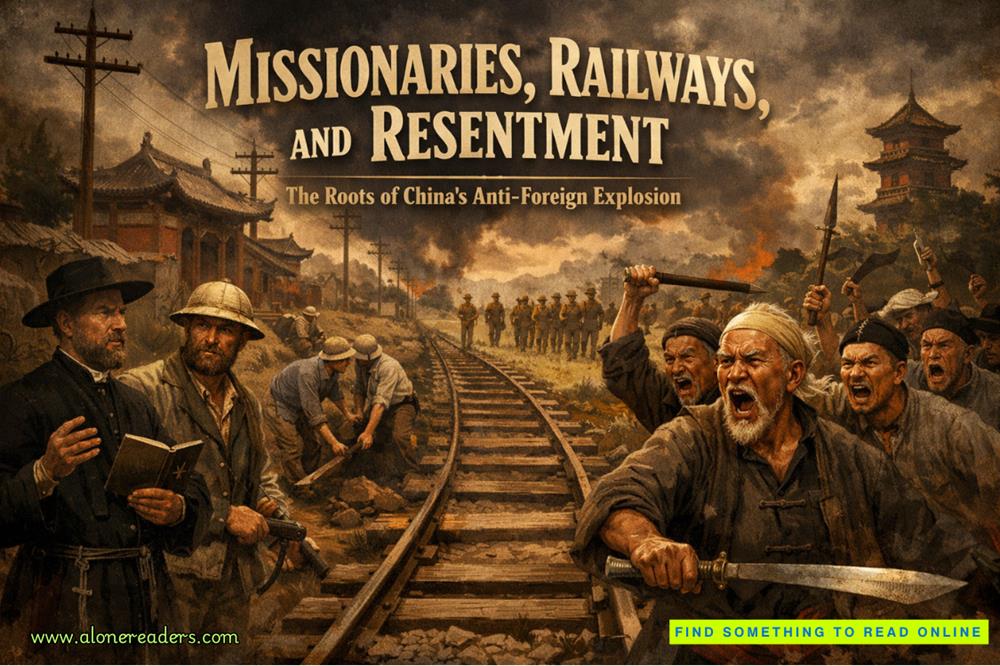
In the final decades of the nineteenth century, China found itself caught in a storm of transformation not of its own choosing. Foreign missionaries arrived preaching salvation, railways tore through ancestral lands, and imperial powers claimed legal privileges that placed them beyond Chinese law. To many Western observers, these changes represented progress, modernization, and moral reform. To millions of ordinary Chinese, however, they felt like an assault on sovereignty, culture, and survival. The explosive rise of anti-foreign sentiment in Qing China was not the product of blind xenophobia but the cumulative result of deep structural humiliations, cultural dislocation, and economic trauma imposed by foreign intrusion.
Christian missionaries stood at the forefront of this transformation. Backed by unequal treaties and protected by foreign gunboats, missionaries enjoyed unprecedented freedom to travel, preach, and establish churches deep within the Chinese interior. For centuries, China had tightly regulated foreign contact, viewing cultural autonomy as essential to social harmony. Suddenly, missionaries operated above local authority, immune from magistrates who could neither regulate nor expel them. This created a perception that foreign religion was not merely a belief system but a political weapon, undermining Confucian norms and eroding the authority of the state.
Missionaries challenged foundational elements of Chinese society. Confucianism emphasized filial piety, ancestor worship, and ritual obligation as the glue of moral order. Christianity, by contrast, condemned ancestor rituals as idolatry and demanded exclusive spiritual loyalty. Converts were often encouraged to abandon communal obligations, refuse participation in village rites, and seek protection from foreign consulates when disputes arose. This fractured local communities. Converts were seen not just as religious dissidents but as traitors shielded by foreign power, disrupting centuries-old systems of mediation and social balance.
Rumors flourished in this atmosphere of fear and mistrust. Missionaries were accused of kidnapping children, harvesting organs, poisoning wells, and using orphanages for sinister purposes. While many of these accusations were unfounded, they reflected genuine anxiety rather than irrational hysteria. Missionary institutions often operated behind walls, using unfamiliar medical practices and foreign languages. In a society already traumatized by famine, rebellion, and imperial defeat, secrecy bred terror. The foreign presence became a canvas onto which social fears were projected, magnifying resentment with each misunderstanding.
Railways intensified this resentment dramatically. To Western engineers, railways symbolized efficiency, trade, and modern infrastructure. To rural Chinese communities, they represented a violent rupture of sacred geography. Rail lines cut through farmland, gravesites, and geomantic landscapes believed to influence cosmic balance. In traditional belief, disturbing burial grounds risked angering ancestors and destabilizing fortune for entire lineages. When railways were imposed without consultation or compensation, villagers interpreted them as acts of spiritual and economic aggression.
The economic consequences were equally severe. Railways displaced boatmen, porters, cart drivers, innkeepers, and laborers whose livelihoods depended on traditional transport networks. Entire local economies collapsed as foreign-controlled rail companies monopolized movement and trade. Compensation, when offered, was often minimal or siphoned off by corrupt intermediaries. Modernization arrived not as opportunity but as dispossession, benefiting foreign investors and treaty-port elites while impoverishing rural populations.
Foreign legal privilege further poisoned relations. Under extraterritoriality, Western nationals accused of crimes in China were tried in their own consular courts rather than Chinese ones. This created a two-tier system of justice that openly declared Chinese law inferior. When disputes erupted between missionaries and villagers, outcomes overwhelmingly favored foreigners. Chinese officials were powerless to enforce rulings, undermining their legitimacy and fueling the perception that the Qing state had become a hollow shell under foreign domination.
This erosion of authority was especially dangerous in a society where imperial legitimacy rested on the ability to maintain order. Local magistrates, already stretched thin, found themselves blamed for problems they could not solve. Peasants suffering from floods, droughts, and rising taxes increasingly saw the state as complicit in their misery. Foreign presence became inseparable from domestic failure, merging anti-imperial anger with anti-foreign rage.
By the late nineteenth century, China was staggering under cumulative humiliation. Military defeats in the Opium Wars, the loss of tributary states, and the carving up of spheres of influence by European powers reinforced the sense that China was being dismantled piece by piece. Newspapers and popular pamphlets spread the idea that foreigners intended to partition China entirely. Railways and churches, once isolated irritants, now appeared as visible markers of national dismemberment.
In this volatile environment, popular movements emerged that fused spiritual belief with political resistance. Martial brotherhoods promised invulnerability to bullets through ritual and discipline. These groups drew on traditional cosmology, folk religion, and anti-dynastic millenarianism. Their appeal lay not in military realism but in psychological empowerment. For peasants stripped of agency, belief in supernatural protection offered a way to reclaim dignity in the face of overwhelming force.
Anti-foreign sentiment thus became deeply emotional as well as ideological. Foreigners were no longer perceived as individual traders or teachers but as symbols of systemic oppression. Missionaries represented cultural annihilation. Railways embodied economic theft. Extraterritoriality stood for legal humiliation. Together, they formed a coherent narrative of invasion that resonated across class and region.
Importantly, this resentment was not uniformly anti-modern. Many Chinese reformers recognized the need for technological and institutional change. What they rejected was the coercive, unequal, and extractive nature of foreign modernization, imposed without respect for sovereignty or social stability. Railways might have been welcomed had they been built under Chinese control. Christianity might have spread peacefully without legal privilege. Instead, both arrived hand-in-hand with gunboats and treaties signed under duress.
As violence erupted, foreign powers interpreted Chinese resistance as barbarism and fanaticism, reinforcing racist assumptions about civilizational hierarchy. Military reprisals were brutal and disproportionate, further validating Chinese fears of annihilation. Each act of suppression planted the seeds for future resentment, ensuring that the cycle of hostility would not end with a single uprising.
The explosion of anti-foreign sentiment in late Qing China was therefore not an accident of superstition or ignorance. It was the predictable outcome of forced globalization without consent, modernization without equity, and cultural exchange without mutual respect. Missionaries, railways, and imperial law functioned as instruments of domination rather than partnership. In resisting them, ordinary Chinese were not rejecting the future; they were fighting for the right to define it on their own terms.
By the time international agreements imposed punitive settlements on China, resentment had already crystallized into collective memory. The scars left by foreign intrusion would shape Chinese nationalism for generations, informing attitudes toward sovereignty, modernization, and external influence well into the twentieth century. What exploded at the turn of the century was not merely anger, but a profound reckoning with the cost of being modernized at gunpoint.



 The Hundred Days Offensive: How the Allies Defeated Germany in World War I
 The Second Battle of the Marne: The Turning Point of World War I in 1918
 The Spring Offensive of 1918: Germany's Final Gamble to Win World War I
 The Treaty of Brest-Litovsk: How Russia Left World War I
 The Russian Revolution and World War I: How War Brought Down the Tsar
 The Zimmermann Telegram Explained: Germany's Secret Offer to Mexico in World War I