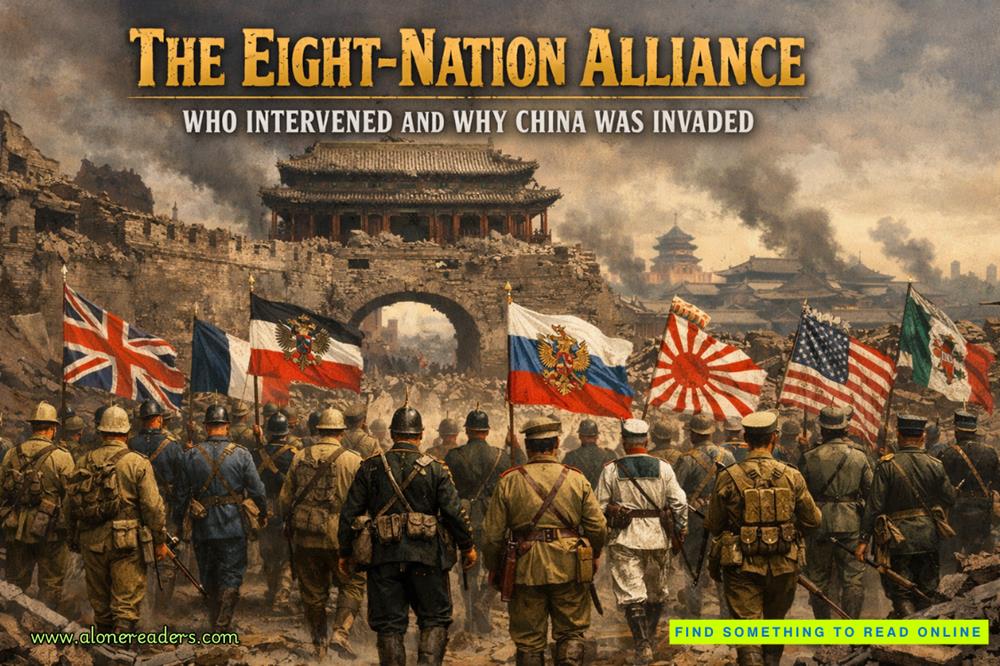
The Eight-Nation Alliance was not a spontaneous coalition formed in response to chaos but a calculated convergence of imperial ambition, commercial anxiety, strategic rivalry, and racialized ideology at the turn of the twentieth century. When foreign armies marched into northern China in 1900, they did so under the pretext of restoring order during the Boxer Uprising, yet the deeper motivations ran far beyond the protection of diplomats or missionaries. The intervention represented a defining moment when China’s weakening sovereignty collided with the peak of global imperialism, producing an invasion that reshaped East Asia’s political future and permanently altered China’s relationship with the West.
At the heart of the crisis was the Boxer Movement, a popular, violently anti-foreign uprising rooted in rural northern China. The Boxers emerged from decades of social dislocation, economic hardship, and humiliation inflicted by foreign powers through unequal treaties, missionary privilege, and extraterritorial rights. Drought, famine, and unemployment intensified resentment, while foreign railways, telegraphs, and Christian missions were perceived as symbols of cultural invasion. The Boxers believed spiritual rituals could make them invulnerable to bullets, but their real power came from mass anger directed at a world that had systematically stripped China of control over its own destiny.
The Qing dynasty found itself trapped between internal revolt and external pressure. Court politics were deeply divided, with conservative factions seeing the Boxers as a potential tool to expel foreigners, while reformist officials feared catastrophic retaliation. When violence escalated and foreign legations in Beijing were besieged, the situation crossed a threshold that imperial powers had been waiting for. The uprising became the justification for direct military intervention on an unprecedented multinational scale.
Britain entered the alliance primarily to defend its vast commercial interests. As the dominant foreign trading power in China, Britain relied heavily on treaty ports, shipping routes, and financial institutions that were now under threat. British officials feared that if they failed to act decisively, rival powers—particularly Russia and Germany—would expand their influence at Britain’s expense. Intervention was therefore as much about maintaining imperial balance as it was about restoring order. Protecting missionaries and merchants provided moral cover for a broader strategic objective: preserving Britain’s economic primacy in China.
France’s participation was closely tied to its colonial ambitions in Indochina and its role as a protector of Catholic missions. French missionaries had long operated deep within Chinese territory, often provoking local hostility. The Boxer violence against Christians allowed France to frame its intervention as a humanitarian necessity while reinforcing its imperial authority in Southeast Asia. By joining the alliance, France aimed to ensure that any post-conflict settlement would recognize its regional interests and not leave China exclusively under Anglo-German or Russian influence.
Germany’s involvement was driven by a combination of prestige politics and raw imperial aggression. The killing of the German minister in Beijing became a rallying point for Berlin, with the Kaiser openly calling for brutal retribution. Germany saw China as a late-entry opportunity into global empire-building and used the crisis to justify military expansion and territorial concessions. German troops arrived with a mandate not merely to stabilize but to dominate, reflecting a worldview in which colonial violence was both acceptable and necessary to assert national greatness.
Russia’s motives were the most strategically calculated of all alliance members. While publicly supporting the collective mission, Russia used the chaos to advance its own territorial ambitions in Manchuria. Russian forces moved beyond protecting legations and effectively occupied vast areas of northeastern China. Control of railways, ports, and buffer zones against Japan were central to Russian policy, and the alliance provided ideal diplomatic camouflage. What was presented as cooperative intervention concealed unilateral expansion that would later ignite further conflict in East Asia.
Japan’s participation marked a pivotal moment in its emergence as a modern imperial power. Unlike Western nations, Japan sought recognition as an equal rather than an outsider. By contributing disciplined, effective troops, Japan demonstrated military competence and political reliability on the world stage. Its involvement was motivated by security concerns, fear of Russian encroachment, and a desire to assert leadership in regional affairs. The Boxer crisis allowed Japan to step out of the shadow of Western imperialism and establish itself as a decisive force in Asian geopolitics.
The United States joined the alliance under the banner of protecting citizens and upholding the Open Door Policy. American policymakers were less interested in territorial conquest than in preserving equal commercial access to China’s markets. Intervention was seen as necessary to prevent China’s partition among rival empires, which would have excluded American trade. The U.S. role blended moral rhetoric with economic pragmatism, portraying the intervention as stabilizing rather than exploitative, even as American troops participated fully in military operations.
Italy and Austria-Hungary, though minor players, joined the alliance to assert relevance in global politics. Participation offered diplomatic prestige, military experience, and a seat at the negotiating table when China’s fate was decided. Their involvement underscored how even secondary powers saw China as an arena for imperial assertion, where presence itself carried strategic value.
As alliance forces advanced, military operations quickly escalated into widespread destruction. Looting, executions, and punitive expeditions became routine, justified by the language of civilization versus barbarism. Entire villages were razed, and civilians were punished indiscriminately. The intervention revealed the brutal reality beneath imperial rhetoric, exposing how “restoring order” often meant systematic violence against a population already crippled by poverty and political decay.
The fall of Beijing and the lifting of the siege marked only the beginning of foreign dominance. Negotiations culminated in the Boxer Protocol, an agreement that imposed crushing indemnities, permanent foreign military presence, and severe restrictions on China’s sovereignty. The Qing government was forced to accept collective punishment for the uprising, even though the alliance’s actions had far exceeded any defensive necessity. The protocol institutionalized China’s subordination, transforming temporary intervention into long-term control.
The alliance’s intervention also reshaped global perceptions of China. The image of a defeated, humiliated empire reinforced racist narratives of Asian weakness while masking the internal resilience and reformist energy that would soon emerge. Ironically, the invasion accelerated China’s modernization efforts, as reformers recognized that survival required fundamental political and military transformation. The same intervention meant to preserve imperial dominance inadvertently sowed the seeds of its eventual collapse.
From a broader historical perspective, the Eight-Nation Alliance was less a response to rebellion than a manifestation of imperial consensus. Each power pursued distinct goals, yet all agreed on one principle: China must not be allowed to determine its own future. The uprising was a symptom of deeper structural injustice, but the intervention treated it as a crime rather than a warning. By suppressing resistance through force, the alliance ensured short-term stability at the cost of long-term legitimacy.
The legacy of the alliance continues to shape historical memory. In China, it is remembered not as a peacekeeping effort but as a national trauma, a moment when foreign armies occupied the capital and dictated terms at gunpoint. The intervention became a symbol of humiliation that later generations would vow never to repeat. In the West, it was often portrayed as a necessary act of civilization, a narrative that obscured the exploitative foundations of imperial power.
Ultimately, the Eight-Nation Alliance intervened not because China was collapsing, but because it was vulnerable. The convergence of internal unrest and external ambition created a perfect opportunity for imperial enforcement. What followed was not merely a military campaign but a decisive episode in the global history of domination, resistance, and awakening. The alliance’s march into China stands as a stark reminder that international cooperation, when driven by unequal power and self-interest, can become a collective instrument of oppression rather than stability.



 The Hundred Days Offensive: How the Allies Defeated Germany in World War I
 The Second Battle of the Marne: The Turning Point of World War I in 1918
 The Spring Offensive of 1918: Germany's Final Gamble to Win World War I
 The Treaty of Brest-Litovsk: How Russia Left World War I
 The Russian Revolution and World War I: How War Brought Down the Tsar
 The Zimmermann Telegram Explained: Germany's Secret Offer to Mexico in World War I










