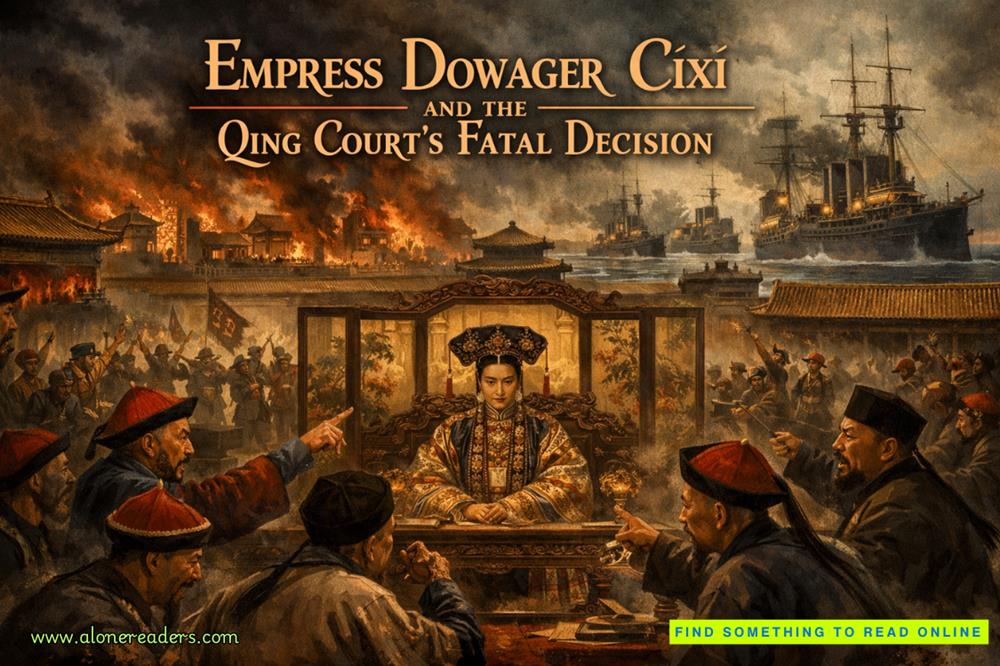
In the final years of the Qing dynasty, few decisions carried consequences as catastrophic as the one made in the summer of 1900, when the imperial court under Empress Dowager Cixi chose confrontation over restraint. This moment did not emerge from sudden madness or blind xenophobia, as it is often simplistically portrayed, but from a complex intersection of imperial fear, court factionalism, collapsing authority, and profound misunderstanding of global power. The Qing court’s fatal decision to side with the Boxers against the foreign powers was not merely a diplomatic error; it was a strategic gamble made under existential panic, one that accelerated the dynasty’s decline and reshaped China’s relationship with the modern world.
By the late nineteenth century, the Qing state was already hollowed out from within. Decades of internal rebellions, most notably the Taiping War, had drained the treasury and shattered confidence in imperial governance. Repeated humiliations at the hands of foreign powers—from the Opium Wars to the Sino-Japanese War—had exposed the Qing military’s obsolescence. Reformist officials increasingly argued that survival depended on structural modernization, constitutional reform, and controlled engagement with the West. Yet these arguments collided head-on with the worldview of Empress Dowager Cixi, who ruled not as a passive reactionary but as a deeply pragmatic autocrat shaped by palace politics rather than international strategy.
Cixi’s authority rested on her mastery of court balance. She had risen from concubinage to supreme power by understanding when to compromise and when to crush opposition. However, her political instincts were forged in the closed ecosystem of the Forbidden City, where threats were personal, conspiratorial, and immediate. Foreign imperialism, by contrast, was diffuse, abstract, and technologically driven—an enemy that could not be neutralized through intrigue alone. This mismatch between her strengths and the nature of the crisis proved fatal.
The Boxer movement emerged in northern China as a response to genuine social dislocation. Natural disasters, economic collapse, and aggressive missionary activity created fertile ground for popular violence. The Boxers framed their struggle in spiritual terms, promising invulnerability through ritual and martial discipline. To many Qing officials, they appeared dangerous, irrational, and uncontrollable. Yet to others within the court, especially conservative Manchu elites, the Boxers represented something the dynasty had lost: raw popular loyalty directed against foreign intrusion.
Cixi initially shared the skepticism of the moderates. Early court edicts condemned Boxer violence and authorized local suppression. But as foreign legations increasingly dictated demands, deployed troops, and treated the Qing government as irrelevant, the political calculus shifted. The presence of armed foreign forces near Beijing was interpreted not merely as protection of nationals but as preparation for regime change. Rumors circulated that foreign powers intended to depose the Qing and install a pliant ruler or partition China outright. Whether accurate or not, these fears resonated deeply with Cixi’s lived experience of coups, purges, and palace conspiracies.
At this critical juncture, the Qing court fractured. Reformist officials urged negotiation and restraint, warning that the dynasty could not win a war against multiple industrialized powers. Hardliners countered that submission would mean certain annihilation. The foreign presence, they argued, was already intolerable; resistance, even if risky, preserved imperial dignity and might rally the populace. Cixi’s decision was not driven by ideological nationalism alone, but by a belief that passivity guaranteed extinction, while resistance offered at least a chance of survival.
The declaration of war against the foreign powers was therefore less an act of confidence than one of desperation. The Qing court underestimated the scale of international retaliation and overestimated both the Boxers’ military value and the loyalty of provincial armies. Crucially, many regional commanders quietly refused to participate, recognizing the hopelessness of the cause. This fragmentation exposed the Qing state as an empire in name only, lacking centralized command or strategic coherence.
As foreign troops advanced and Beijing fell, the illusions sustaining the court collapsed with brutal speed. The Boxers were annihilated, the capital was occupied, and the imperial family fled west in humiliation. Cixi’s gamble had failed in the most public and irreversible manner possible, transforming political fear into national catastrophe. The resulting settlement, later formalized in the Boxer Protocol, imposed massive indemnities, foreign military presence, and legal concessions that crippled the Qing state financially and symbolically.
Yet it would be historically dishonest to cast Cixi solely as a villain blinded by ignorance. Her decision reflected the structural impossibility of Qing survival under existing conditions. Reform required time, unity, and trust in institutions the dynasty no longer possessed. Resistance, however irrational in hindsight, aligned with the political logic of a court accustomed to internal threats rather than global systems. The tragedy lay not in one woman’s choice, but in an empire that had waited too long to choose at all.
In the aftermath, Cixi reversed course with startling pragmatism. She endorsed reforms that mirrored those she had previously crushed, including administrative modernization, military restructuring, and educational overhaul. These measures, however, arrived too late. The dynasty’s moral authority was shattered, its sovereignty compromised, and its elites divided beyond repair. The Boxer catastrophe had exposed the Qing court’s fatal weakness: an inability to reconcile imperial tradition with modern statecraft before external pressure made reconciliation impossible.
The legacy of Cixi’s decision continues to shape historical memory. She is alternately condemned as a reactionary despot or reinterpreted as a ruler trapped by circumstance. What remains indisputable is that the Qing court’s alignment with the Boxers marked the point of no return, converting long-term decline into terminal collapse. It demonstrated how fear, when elevated to strategy, can destroy even the most enduring political systems.
In this sense, the fatal decision of 1900 was not simply about war or diplomacy. It was about the limits of imperial power in a world no longer governed by ritual hierarchy. The Qing court had ruled for centuries by mastering symbolism, lineage, and controlled violence. Against gunboats, global finance, and international law, those tools proved tragically insufficient. Empress Dowager Cixi’s choice crystallized this reality, turning a crisis of legitimacy into a lesson written in defeat, occupation, and the end of dynastic China.



 The Hundred Days Offensive: How the Allies Defeated Germany in World War I
 The Second Battle of the Marne: The Turning Point of World War I in 1918
 The Spring Offensive of 1918: Germany's Final Gamble to Win World War I
 The Treaty of Brest-Litovsk: How Russia Left World War I
 The Russian Revolution and World War I: How War Brought Down the Tsar
 The Zimmermann Telegram Explained: Germany's Secret Offer to Mexico in World War I










