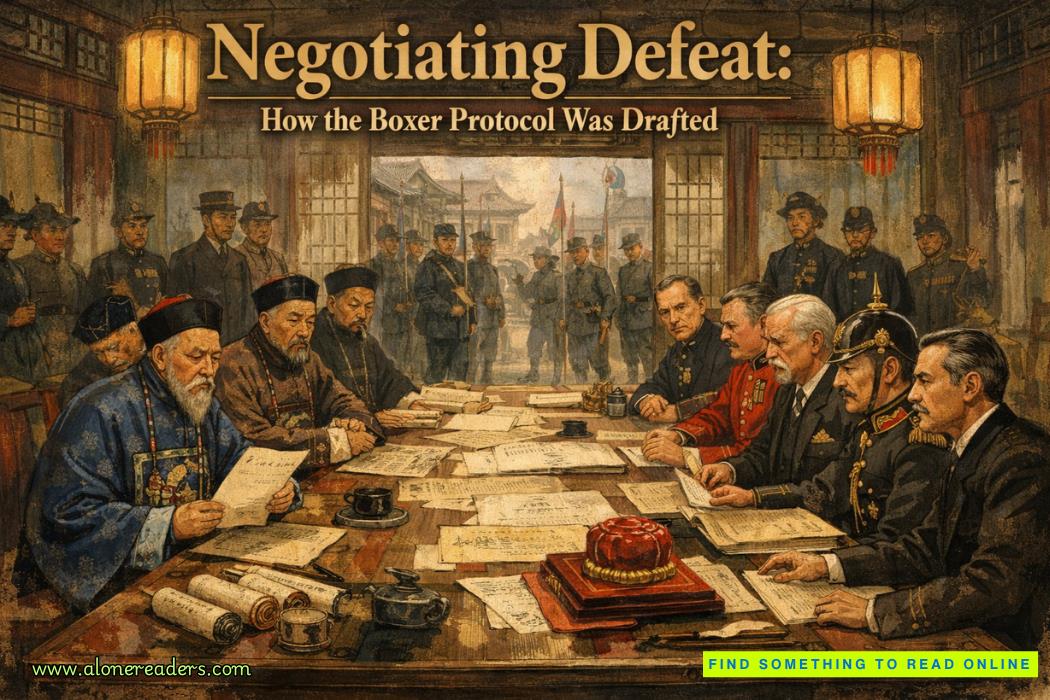
The Boxer Protocol was not born from balanced diplomacy or mutual negotiation. It emerged from a moment of profound national collapse, when the Qing Empire stood militarily defeated, politically isolated, and physically occupied by foreign armies. In the aftermath of the Boxer Rebellion of 1900, Beijing was no longer the sovereign capital of an independent empire but a city patrolled by foreign troops, its imperial authority reduced to symbolic gestures. What followed was not simply the signing of a treaty, but the slow, methodical construction of defeat on paper, where every clause reflected power, punishment, and humiliation rather than reconciliation.
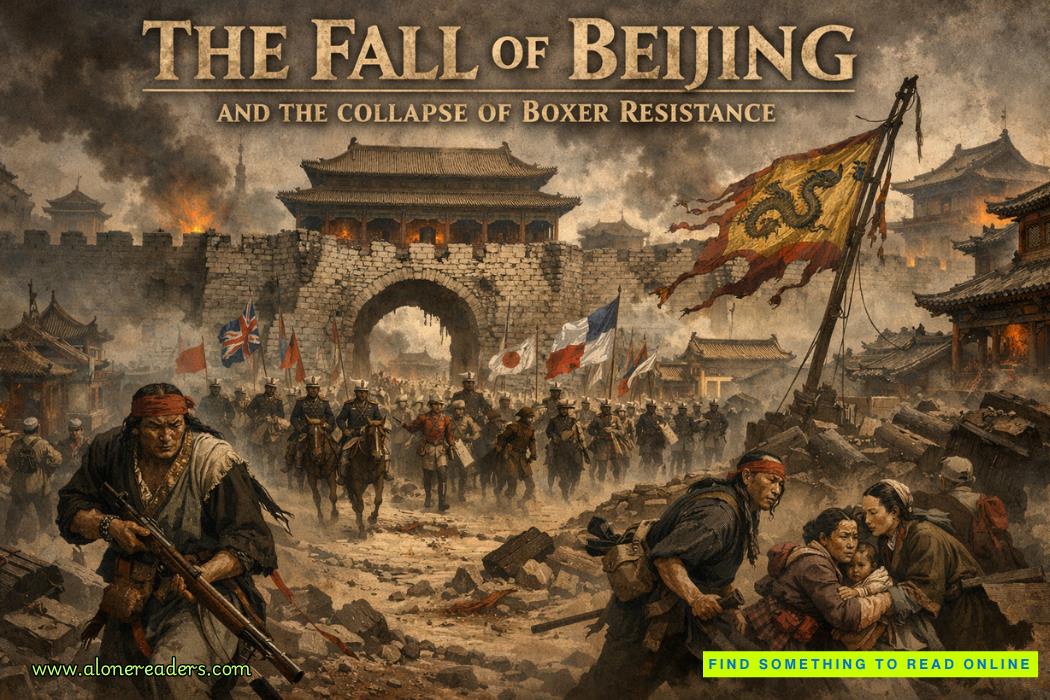
When the Eight-Nation Alliance marched into Beijing in August 1900, the Qing court fled westward to Xi’an, leaving behind a vacuum of authority. The capital’s occupation instantly reshaped diplomacy. Foreign legations were no longer petitioners at the gates of the Forbidden City; they were victors dictating conditions from within it. From this moment onward, negotiations would take place under the shadow of bayonets, making the very concept of sovereignty painfully abstract. The drafting of the Boxer Protocol was therefore less about negotiation and more about formalizing submission.
The foreign powers involved—Britain, France, Germany, Russia, Japan, the United States, Italy, Austria-Hungary, Belgium, Spain, and the Netherlands—did not approach China as a single unified bloc. Each arrived with separate ambitions, grievances, and expectations. Germany demanded retribution for the murder of its minister, Baron von Ketteler. Russia sought to consolidate its military presence in Manchuria. Japan wanted recognition as a major imperial power equal to Europe. Britain prioritized protection of trade routes and treaty ports. The United States, while less interested in territorial gain, focused on stability and preservation of the Open Door Policy. These competing interests turned the drafting process into a complex imperial bargaining arena—one in which China itself had almost no leverage.
Before formal talks even began, the Qing court was required to demonstrate submission. The Empress Dowager Cixi, who had previously supported the Boxers, reversed her stance completely. Imperial edicts denounced the rebels as criminals. Chinese officials associated with the uprising were arrested, exiled, or executed. This reversal was not merely political pragmatism; it was a symbolic performance designed to convince foreign powers that the dynasty was willing to sacrifice its own legitimacy in exchange for survival. The court understood that without visible contrition, negotiations would not even begin.
The foreign ministers and military commanders established a provisional diplomatic framework in occupied Beijing. Rather than meeting Qing negotiators as equals, they summoned them. This distinction mattered enormously. Qing envoys did not propose terms; they responded to them. Early drafts of the settlement were prepared almost entirely by foreign representatives, who then presented the conditions collectively. The Chinese role was reduced to clarification, protest, and pleading for mitigation—usually unsuccessfully.
One of the earliest and most emotionally charged demands concerned punishment. The alliance insisted that China formally acknowledge responsibility for the violence against foreigners and Christians. This was unprecedented in its scale. The protocol would require the execution or exile of high-ranking officials, public memorials honoring foreign victims, and official apologies delivered through humiliating rituals. Most painful of all was the requirement that a Qing prince travel to Germany to personally express regret to the Kaiser—a symbolic act designed to invert centuries of Sino-centric diplomacy in which China had once demanded tribute from others.
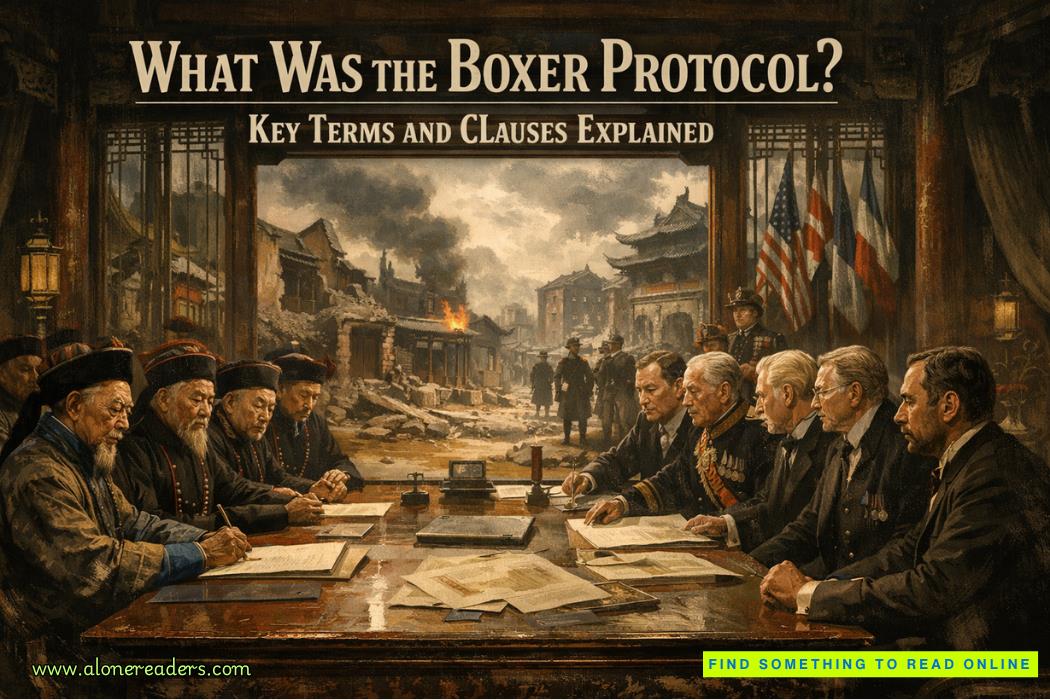
As negotiations progressed, financial punishment became the central pillar of the draft. The allies calculated indemnities not merely to compensate losses, but to cripple China’s fiscal independence for decades. After extensive internal debate among the powers, the total indemnity was fixed at 450 million taels of silver, to be repaid with interest over 39 years—ultimately doubling the burden. This figure was not arbitrary. It reflected an intentional strategy: to ensure long-term foreign control over Chinese customs revenue, salt taxes, and maritime income. Through debt, sovereignty would be managed indirectly.
Chinese negotiators repeatedly attempted to reduce this sum. They argued that such payments would devastate provincial finances, provoke unrest, and weaken the dynasty further. These arguments were acknowledged—but dismissed. Stability, the powers believed, would come not from Chinese strength, but from Chinese dependence. The protocol thus became a financial instrument of empire, binding China’s future budget to foreign oversight.
Equally significant were the military clauses embedded into the draft. The protocol demanded permanent foreign garrisons along the railway line connecting Beijing to the sea, effectively carving a protected corridor through Chinese territory. It ordered the destruction of forts guarding the capital and prohibited China from importing arms for two years. These clauses stripped the Qing state of its basic right to self-defense. A nation without the ability to protect its capital was a nation sovereign only in name.
Throughout the drafting process, the Qing delegation—led primarily by Prince Qing and Li Hongzhang—walked a narrow and tragic path. Li Hongzhang, already famous for negotiating earlier humiliating treaties, was aging, ill, and painfully aware of history’s judgment. His strategy was not resistance but damage control. He sought to soften language, delay deadlines, and preserve ceremonial dignity where possible. Yet every concession he secured was marginal, often symbolic rather than substantive. The essential architecture of the protocol remained untouched.
What made the process especially devastating was its legal finality. Unlike previous “unequal treaties” extracted after limited wars, the Boxer Protocol functioned as a comprehensive reordering of China’s relationship with the world. It codified foreign privilege, military presence, economic extraction, and moral superiority into a single document. This was not merely punishment for rebellion—it was a declaration that China had forfeited the right to autonomous recovery.
The negotiations also exposed deep fractures within the Qing court itself. Reformist officials believed compliance was the only way to preserve the dynasty. Conservative elites viewed the treaty as a betrayal worse than military defeat. Provincial governors, many of whom had refused to support the Boxers, resented bearing the financial burden for a rebellion they had opposed. The protocol therefore intensified internal political decay, accelerating the erosion of central authority.
When the final text was presented in September 1901, the Qing court had little choice. Foreign troops still occupied Beijing. Provincial revenues were under threat. Continued refusal risked partition—an outcome many Chinese feared more than humiliation. The court accepted the protocol not because it believed in its justice, but because survival demanded capitulation. On 7 September 1901, the Boxer Protocol was formally signed.
The moment of signing was deliberately understated. There were no grand ceremonies, no diplomatic celebrations. The silence itself reflected the document’s nature. Everyone present understood that this was not peace, but subjugation formalized through ink. The Qing dynasty remained standing, but it stood hollowed.
In the years that followed, the consequences of the protocol seeped into every level of Chinese society. Taxes rose sharply to meet indemnity payments. Infrastructure projects stalled. Military modernization slowed. Yet paradoxically, the humiliation also sparked transformation. Many Chinese intellectuals concluded that survival within the existing imperial framework was impossible. Reform, nationalism, and revolution gained momentum precisely because the Boxer Protocol demonstrated the absolute limits of accommodation.
The treaty became a symbol—not merely of defeat, but of awakening. Students studied it as evidence of imperial predation. Reformers cited it as proof that institutional change was essential. Revolutionaries used it as propaganda, arguing that the Qing dynasty had lost the Mandate of Heaven by signing away the nation’s dignity. A decade later, when the dynasty collapsed in 1911, the memory of the Boxer Protocol lingered as one of its final indictments.
In retrospect, the drafting of the Boxer Protocol reveals more than the outcome of a rebellion. It exposes the mechanics of imperial diplomacy at its most ruthless. Negotiation existed only in form, not substance. Law functioned as a weapon. Language became an instrument of domination. The defeated were required not only to comply, but to internalize guilt and perform submission.
The protocol did not end foreign interference in China; it institutionalized it. It did not restore stability; it postponed collapse. And it did not reconcile civilizations; it deepened resentment that would shape Chinese political consciousness for generations.
To understand how the Boxer Protocol was drafted is to understand how empires convert military victory into long-term control—not through conquest alone, but through treaties that outlive armies. It stands as one of the clearest historical examples of how diplomacy, when stripped of equality, becomes merely another battlefield—one where pens replace rifles, but the wounds cut just as deep.



 The Hundred Days Offensive: How the Allies Defeated Germany in World War I
 The Second Battle of the Marne: The Turning Point of World War I in 1918
 The Spring Offensive of 1918: Germany's Final Gamble to Win World War I
 The Treaty of Brest-Litovsk: How Russia Left World War I
 The Russian Revolution and World War I: How War Brought Down the Tsar
 The Zimmermann Telegram Explained: Germany's Secret Offer to Mexico in World War I










