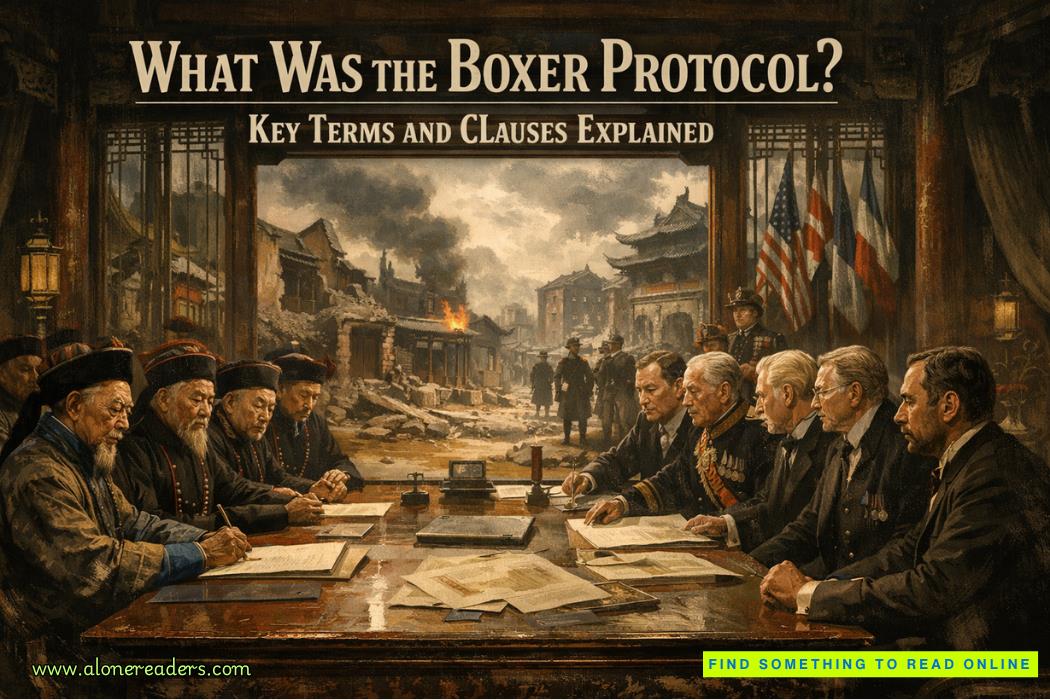
The Boxer Protocol, formally signed in September 1901, stands as one of the most consequential and humiliating agreements imposed on China during the late Qing dynasty. It was not merely a peace settlement following the Boxer Rebellion; it was a comprehensive restructuring of China’s political, military, financial, and diplomatic autonomy under foreign supervision. To understand the Boxer Protocol is to understand how imperial China was forced into a semi-colonial condition, where sovereignty existed in name but was deeply constrained in practice.
The origins of the Boxer Protocol lie in the violent upheaval of 1899–1900, when the Boxer movement—officially known as the Righteous and Harmonious Fists—rose in northern China. Driven by intense anti-foreign and anti-Christian sentiment, the Boxers believed that spiritual rituals could make them immune to bullets. Their movement gained momentum amid drought, economic distress, and resentment toward foreign missionaries and economic penetration. When elements within the Qing court, particularly Empress Dowager Cixi, chose to support the Boxers, the rebellion escalated into an international crisis.
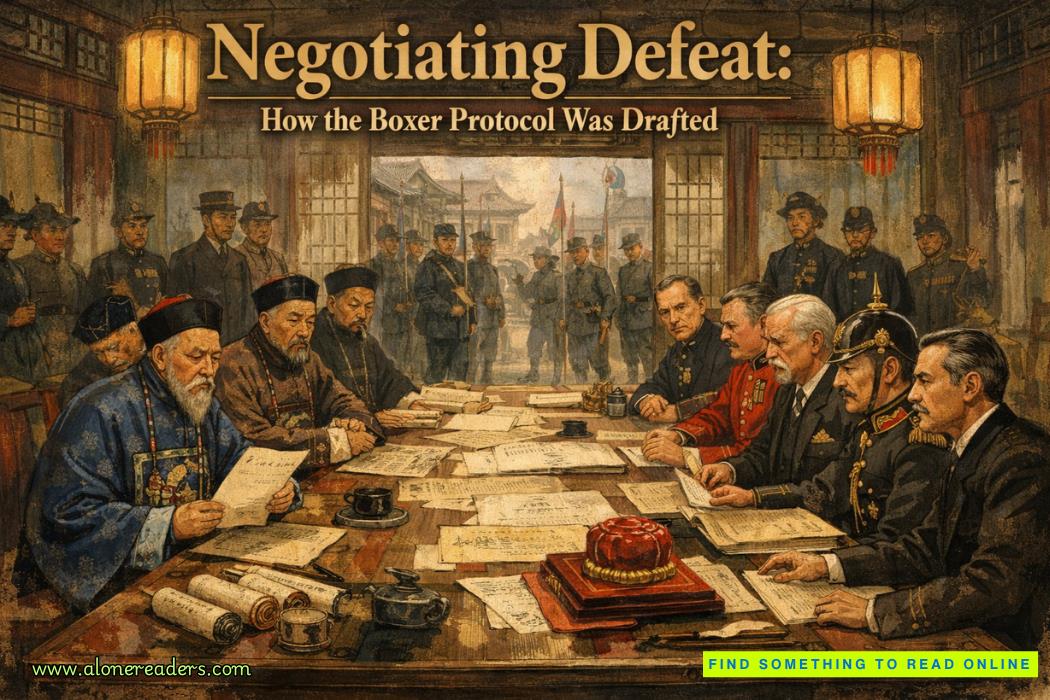
Foreign legations in Beijing were besieged, missionaries were killed, and Chinese Christians were massacred. In response, an Eight-Nation Alliance consisting of Britain, France, Germany, Russia, Japan, the United States, Austria-Hungary, and Italy launched a military intervention. Their forces captured Beijing in August 1900, looted large parts of the city, and imposed martial dominance over the Qing government. What followed was not negotiation between equals but dictated submission. The Boxer Protocol was the written embodiment of that imbalance.
At its core, the Boxer Protocol was designed to ensure three things: punishment, prevention, and permanent foreign leverage. Every clause served one or more of these objectives. The agreement consisted of detailed articles that collectively reshaped China’s internal and external governance.
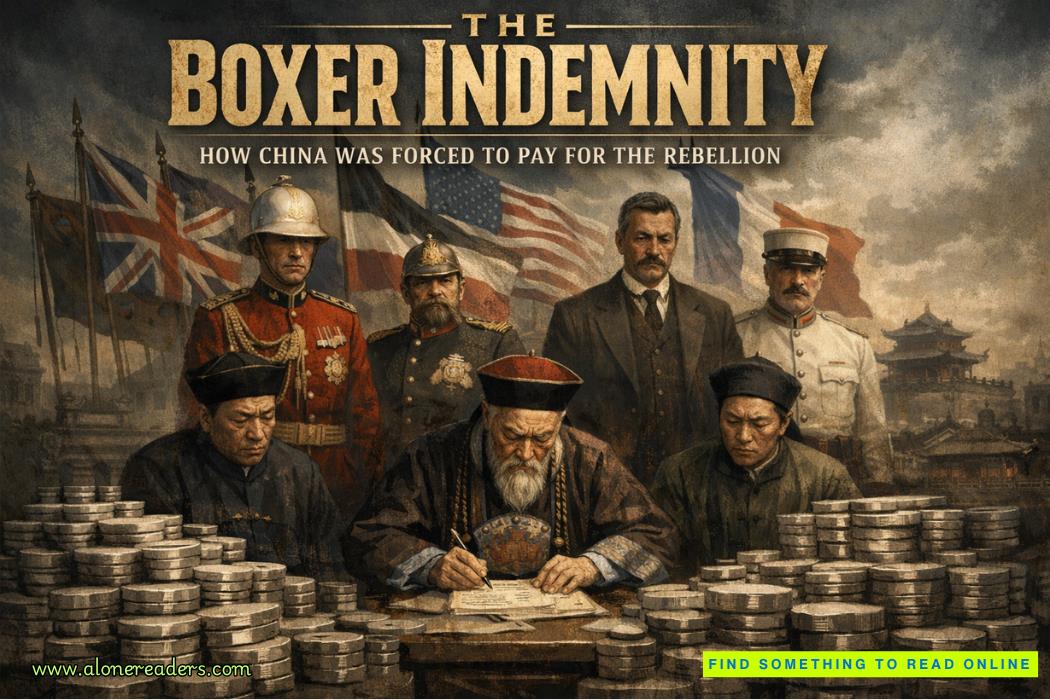
One of the most devastating provisions was the massive indemnity imposed on China. The Qing government was ordered to pay 450 million taels of silver, an astronomical sum equivalent to several years of state revenue. This indemnity was to be paid with 4 percent annual interest over 39 years, meaning the final amount exceeded 900 million taels. The payment obligation effectively mortgaged China’s future fiscal capacity. Large portions of customs revenue, salt taxes, and other state incomes were pledged as guarantees. This clause alone transformed China into a debtor state under foreign financial supervision.
The indemnity was not symbolic punishment; it was a structural mechanism of control. Because the Qing government could not meet payments through ordinary taxation, it was forced to increase taxes on peasants and merchants, deepening domestic unrest. The protocol thus ensured that the consequences of the rebellion would burden the Chinese population for generations, long after the Boxers themselves had disappeared.
Another critical clause mandated severe punishment of officials deemed responsible for supporting or failing to suppress the Boxers. High-ranking figures were executed, exiled, or forced to commit suicide. Several princes and governors were removed permanently from office. This was unprecedented foreign interference in China’s internal political system. The message was explicit: Qing sovereignty over personnel decisions was now subordinate to foreign approval.
The protocol further required that China issue formal apologies to foreign governments. Memorial monuments were erected in Germany and Japan acknowledging the deaths of diplomats, including the German minister Baron von Ketteler. These symbolic acts were deeply humiliating in Confucian political culture, where ritual dignity and moral authority formed the foundation of legitimacy. The Qing court was compelled not only to submit materially but to confess moral failure before the world.
One of the most strategically significant clauses concerned the permanent foreign military presence in Beijing. The protocol authorized foreign powers to station troops between Beijing and the sea, particularly along the railway corridor connecting the capital to Tianjin. This effectively placed the heart of the empire under foreign surveillance. The Qing government retained nominal authority in Beijing, but the physical power to defend the capital was no longer exclusively Chinese.
In addition, the entire Legation Quarter in Beijing was placed under foreign control. Chinese residents were expelled, and the area was fortified with walls, checkpoints, and permanent garrisons. It became a sovereign enclave within the Chinese capital, governed not by Chinese law but by foreign military authority. This clause alone symbolized the collapse of territorial integrity at the center of imperial power.
The protocol also imposed strict military limitations on China. The Qing government was prohibited from importing arms and ammunition for a defined period. Coastal and river defenses, including the Dagu Forts near Tianjin, were dismantled. These fortifications had once guarded the northern gateway to Beijing. Their destruction ensured that China could not resist future foreign incursions. Militarily, the empire was rendered defenseless by design.
Another clause required the complete suppression of anti-foreign societies. Any organization resembling the Boxers, whether religious, martial, or secret, was outlawed. Local officials were made personally responsible for preventing such movements. Failure would result in punishment. This provision expanded state surveillance and repression while simultaneously aligning Qing authority with foreign interests against domestic resistance.
The protocol also restructured China’s diplomatic conduct. The Qing government agreed to revise its foreign affairs system to ensure respectful treatment of diplomats and full compliance with international norms as defined by Western powers. This included changes in ceremonial protocol, language used in official correspondence, and legal protections for foreigners. The traditional worldview that placed China at the center of civilization was formally abandoned under pressure.
Perhaps most revealing was the clause demanding that China send special missions of apology to Germany and Japan. These missions were not negotiations; they were rituals of submission. Senior officials were dispatched abroad to express regret on behalf of the emperor. In practical terms, this transformed diplomacy into theater designed to affirm foreign dominance.
The Boxer Protocol also extended earlier unequal treaty structures rather than replacing them. Extraterritoriality remained intact, meaning foreigners in China were still subject to their own courts rather than Chinese law. Treaty ports continued to operate under foreign economic dominance. Customs administration remained under foreign oversight. The protocol did not introduce new equality; it entrenched inequality more deeply.
What made the Boxer Protocol uniquely destructive was not any single clause but their cumulative effect. Financial dependency, military weakness, political humiliation, territorial intrusion, and legal subordination all converged into a single framework. China was not colonized outright, but it was bound tightly within an international system it could neither control nor escape.
The psychological impact was profound. For Chinese intellectuals, the protocol marked the definitive failure of the traditional imperial system. Reformers and revolutionaries alike saw that Confucian governance, dynastic legitimacy, and moral diplomacy could not withstand modern imperialism. The agreement became a central reference point for later nationalist movements, including the 1911 Revolution that would eventually topple the Qing dynasty.
Even reform initiatives launched after 1901, such as military modernization, educational reform, and constitutional experiments, were shaped by the trauma of the protocol. These efforts were not born from confidence but from desperation. The Qing state was attempting to modernize while shackled by foreign oversight and financial exhaustion.
The Boxer Protocol also altered global perceptions of China. Internationally, China was no longer seen as a resistant empire but as a weakened state open to economic penetration. Domestically, the dynasty lost moral authority. The idea that the emperor could protect the realm—a foundational principle of Chinese political philosophy—was shattered.
Yet the protocol produced unintended consequences. Some indemnity funds were later returned or redirected by foreign powers, most notably the United States, which used its share to establish scholarships that eventually led to the founding of Tsinghua University. Ironically, money extracted as punishment helped educate a new generation that would later challenge foreign domination.
In historical memory, the Boxer Protocol represents the climax of the “century of humiliation.” It encapsulates the moment when China’s sovereignty was most explicitly compromised through legal instruments rather than battlefield defeat alone. Every clause was legal on paper yet coercive in origin, making the agreement a textbook example of an unequal treaty system.
Understanding the Boxer Protocol is essential not merely to comprehend the Boxer Rebellion’s aftermath, but to grasp the structural forces that shaped modern Chinese nationalism. The resentment toward foreign interference, the obsession with sovereignty, and the insistence on political independence in later decades all trace intellectual roots to 1901.
The protocol did not end foreign pressure on China, but it clarified its nature. Power would no longer be exercised only through warships and armies, but through contracts, debts, and legal obligations enforced by international coalitions. It was modern imperialism expressed in bureaucratic language.
In essence, the Boxer Protocol was less a peace treaty and more a system of enforced compliance. It punished rebellion, prevented resistance, and preserved foreign dominance without formal colonization. Its clauses transformed defeat into long-term dependency.
By dissecting its terms carefully, one sees that the Boxer Protocol was not about restoring order—it was about redefining authority. And in that redefinition, China lost control over its destiny for decades to come.



 The Hundred Days Offensive: How the Allies Defeated Germany in World War I
 The Second Battle of the Marne: The Turning Point of World War I in 1918
 The Spring Offensive of 1918: Germany's Final Gamble to Win World War I
 The Treaty of Brest-Litovsk: How Russia Left World War I
 The Russian Revolution and World War I: How War Brought Down the Tsar
 The Zimmermann Telegram Explained: Germany's Secret Offer to Mexico in World War I










