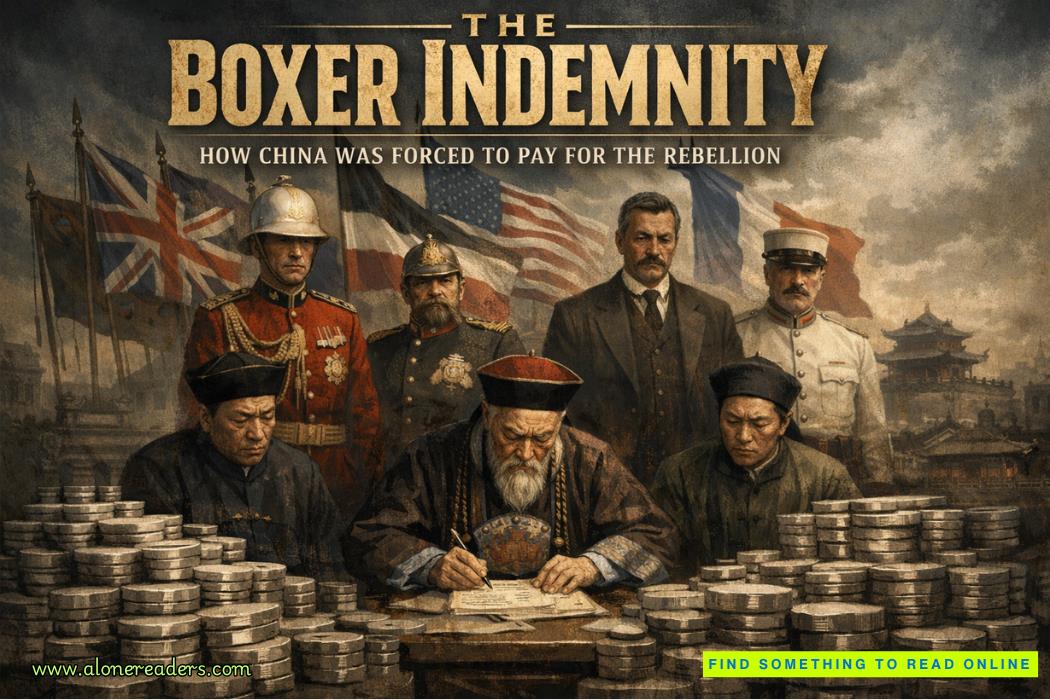
The Boxer Indemnity stands as one of the most financially devastating and psychologically humiliating penalties ever imposed upon a sovereign nation. In the aftermath of the Boxer Rebellion, China was not merely defeated militarily—it was economically shackled, politically exposed, and symbolically reduced to a subordinate power in its own land. What emerged from the Boxer Protocol of 1901 was not peace, but a long-term extraction system that transferred Chinese wealth to foreign empires for nearly four decades, draining the Qing dynasty at the very moment it struggled to survive.
The indemnity was not a symbolic punishment. It was a calculated financial instrument designed to ensure China’s dependence, enforce obedience, and reward imperial aggression under the legal veneer of diplomacy. The sum imposed—450 million taels of silver, equivalent to roughly 18,000 tons of silver—was staggering beyond imagination for a country already weakened by internal decay, corruption, famine, and repeated military defeats. Even more crippling was the structure of repayment. With annual interest fixed at 4 percent, the total amount ballooned to nearly 982 million taels, locking China into a payment schedule that would last until 1940.
To understand the true weight of the Boxer Indemnity, one must understand what a tael represented. A tael was not merely a unit of currency but a measure of silver by weight, deeply embedded in China’s taxation and monetary systems. The forced redirection of this silver toward foreign powers destabilized domestic finance, disrupted provincial budgets, and distorted the entire economic circulation of the empire. Every year, vast quantities of Chinese wealth flowed outward, leaving behind fiscal paralysis.
The rebellion that triggered this punishment emerged from desperation rather than strategy. The Boxers—formally known as the “Society of Righteous and Harmonious Fists”—were rural martial groups reacting violently to drought, missionary expansion, economic exploitation, and the erosion of traditional authority. Their belief that spiritual rituals could protect them from bullets reflected not ignorance alone, but the depth of social collapse gripping northern China. When foreign missionaries and Chinese Christian converts became targets, the situation escalated rapidly into international crisis.
By 1900, foreign legations in Beijing were under siege. In response, an Eight-Nation Alliance—Britain, France, Germany, Russia, Japan, the United States, Austria-Hungary, and Italy—launched a full-scale military invasion. Their troops marched on Beijing, looted cities, executed civilians, and imposed order through violence. When the Qing court fled the capital, China effectively ceased to function as an independent state.
The Boxer Protocol formalized this reality. While the document addressed military occupation, execution of officials, destruction of forts, and diplomatic concessions, the indemnity clause was its true core. The payment structure ensured that foreign powers would be compensated not only for military costs but for perceived insult, loss of prestige, and imagined moral injury. China was forced to apologize publicly to Germany and Japan, erect monuments to foreign victims, and accept permanent foreign military presence in key areas.
The indemnity distribution revealed imperial hierarchy with brutal clarity. Russia, Germany, France, Britain, and Japan received the largest shares. Smaller portions went to other alliance members. Each power used the funds differently, but all benefited from China’s enforced vulnerability. What made the system especially destructive was that China had no control over how the money was raised—only the obligation to deliver it on time.
To meet the payments, the Qing government increased land taxes, expanded salt levies, imposed new customs duties, and borrowed heavily from foreign banks. These loans, often secured against future tax revenue, further eroded sovereignty. Chinese taxpayers—peasants already struggling under poverty—shouldered the burden of imperial punishment for decisions they had no role in making. In effect, the indemnity became a mechanism through which rural China financed global empire.
The economic consequences were immediate and compounding. Funds that might have modernized infrastructure, reformed education, or strengthened defense were instead exported. Provincial governors found themselves unable to respond to floods or famines. Military reform stalled. Bureaucratic salaries went unpaid. The state lost credibility not because it lacked ambition, but because it lacked money.
Yet the damage extended beyond economics. The Boxer Indemnity represented a profound moral rupture. For centuries, China had viewed itself as the civilizational center of the world. Now, foreign powers dictated terms within its capital, stationed troops on its soil, and extracted tribute without offering protection in return. This inversion of historical identity produced widespread intellectual shock.
Chinese scholars, students, and reformers drew a harsh conclusion: traditional systems had failed. Confucian governance, examination bureaucracy, and imperial isolation were no longer sufficient. The indemnity thus became an accelerant of ideological transformation. Anti-Manchu sentiment intensified. Reformist movements gained urgency. Revolutionary ideas spread rapidly among students and overseas Chinese communities.
Ironically, portions of the indemnity later fueled the very forces that would dismantle imperial rule. The United States, acknowledging that it had received more than its actual damages, returned part of its share to China. These refunded funds were used to establish the Boxer Indemnity Scholarship Program, which sent Chinese students to American universities. Many of those students would later become scientists, engineers, diplomats, and revolutionaries who shaped modern China.
This paradox reveals the complex legacy of the indemnity. While conceived as punishment, it unintentionally contributed to China’s modernization. Japan, which had modernized earlier under similar external pressure, served as a living example of what transformation could achieve. Chinese reformers increasingly argued that only systemic change—not appeasement—could prevent national extinction.
The Qing government attempted late reforms: restructuring the military, abolishing the civil service examinations, introducing constitutional experiments, and modernizing education. But these efforts unfolded under the shadow of the indemnity. Every reform required funding, and every year that funding was siphoned abroad. The empire was attempting to rebuild while bleeding.
By 1911, the structure collapsed. The Qing dynasty fell, not solely because of rebellion, but because the state had lost its economic and moral foundation. The Boxer Indemnity did not directly cause the revolution, but it ensured that the dynasty would never recover the strength needed to suppress or absorb revolutionary forces.
Even after the empire’s fall, the indemnity remained. The Republic of China inherited the obligation. Payments continued through warlord eras, political fragmentation, and foreign occupation. Only in the late 1930s, amid global conflict and diplomatic renegotiation, did the system finally dissolve. By then, China had paid for the rebellion for nearly forty years—longer than the rebellion itself had lasted.
The psychological imprint endured even longer. The indemnity became a symbol invoked repeatedly in nationalist discourse as evidence of humiliation and exploitation. It joined a broader narrative of the “Century of Humiliation,” shaping Chinese political consciousness well into the modern era. It was not just silver that was taken—it was dignity, autonomy, and time.
Unlike conventional war reparations between equal states, the Boxer Indemnity was imposed upon a society denied equal status. Negotiations were conducted under occupation. Terms were dictated, not discussed. Enforcement mechanisms favored foreign creditors absolutely. In modern terms, it functioned less like compensation and more like structured extraction.
What makes the Boxer Indemnity especially significant in world history is its demonstration of how finance can be weaponized. No permanent colonization was required. No annexation was necessary. Through debt, interest, and treaty law, China was subordinated without formal conquest. This model would echo later across the globe.
The rebellion itself was brief. The payment was generational. Children born after the Boxers were crushed would grow into adulthood still funding the consequences. Punishment outlived memory, embedding injustice into routine taxation.
Today, the Boxer Indemnity remains a critical lens through which modern Chinese nationalism understands foreign intervention. It explains not only resentment but caution, not only memory but policy. The lesson absorbed was simple and enduring: weakness invites exploitation, and sovereignty without power is illusion.
In this sense, the Boxer Indemnity was more than a clause in a treaty. It was a turning point where China’s encounter with modern imperialism became fully financial, fully systemic, and fully irreversible. The rebellion may have been defeated by guns, but the nation was disciplined through debt.
The silver has long been spent. The treaties have long expired. Yet the imprint of that forced payment continues to echo through China’s historical consciousness—a reminder that the cost of defeat is not measured only in lives lost, but in decades stolen.



 The Hundred Days Offensive: How the Allies Defeated Germany in World War I
 The Second Battle of the Marne: The Turning Point of World War I in 1918
 The Spring Offensive of 1918: Germany's Final Gamble to Win World War I
 The Treaty of Brest-Litovsk: How Russia Left World War I
 The Russian Revolution and World War I: How War Brought Down the Tsar
 The Zimmermann Telegram Explained: Germany's Secret Offer to Mexico in World War I