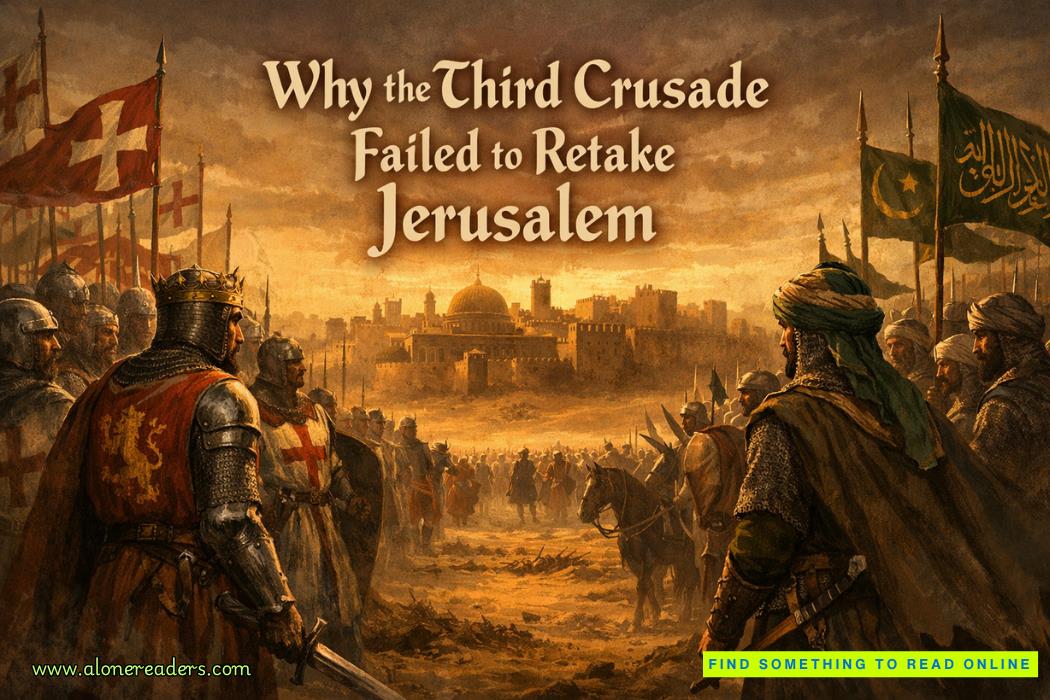
The Third Crusade stands as one of the most dramatic and paradoxical military expeditions of the medieval world. It involved the most powerful Christian rulers of the age, featured legendary commanders on both sides, and unfolded in the aftermath of one of the greatest shocks Christendom had ever known—the fall of Jerusalem to Saladin in 1187. Yet despite its immense resources, global attention, and early successes, the crusade ended without achieving its primary objective. Jerusalem remained firmly in Muslim hands, not because the Crusaders lacked courage or manpower, but because the expedition was undermined by a complex convergence of political rivalry, strategic misjudgment, logistical reality, and the calculated restraint of its greatest enemy.
The roots of failure began even before the Crusader armies reached the eastern Mediterranean. The catastrophe at Hattin had shattered the Kingdom of Jerusalem almost overnight, destroying its field army and capturing its king. When news reached Europe, it provoked outrage, grief, and religious fervor on an unprecedented scale. Three monarchs answered the call: Richard I of England, Philip II of France, and Emperor Frederick I Barbarossa of the Holy Roman Empire. On paper, this coalition represented overwhelming force. In reality, it was an unstable alliance held together by necessity rather than unity. From the outset, the crusade was burdened by clashing egos, national rivalries, and incompatible political goals.
The death of Emperor Frederick Barbarossa in Anatolia proved the first devastating blow. His army, the largest of the three, disintegrated almost immediately after he drowned while crossing a river. Thousands deserted, returned home, or died during the march. What remained arrived in the Levant fragmented and demoralized. This loss dramatically altered the balance of power within the crusade. Instead of a three-pillar coalition, leadership collapsed into a tense dual command between Richard and Philip, two men whose mutual distrust was already legendary. The disappearance of the imperial counterweight allowed personal rivalry to replace coordinated strategy.
When the Crusaders focused their efforts on Acre, they achieved a critical success, but at an enormous cost. The siege dragged on for nearly two years, consuming lives, resources, and morale. Disease spread through the camps, supply shortages worsened, and discipline eroded. Although Acre eventually fell, the victory came too late and too expensively. More importantly, the prolonged siege allowed Saladin to consolidate his hold over Jerusalem and reorganize his forces. Time, which the Crusaders desperately needed, became Saladin’s greatest ally.
The fall of Acre also intensified political fractures. Philip II, citing illness and political obligations in France, soon departed the Holy Land. His departure was not merely a loss of manpower; it stripped the crusade of unity and transformed Richard into both its supreme commander and its sole political authority. Yet even Richard’s brilliance as a battlefield tactician could not compensate for the absence of allied cooperation. What remained was no longer a crusade of Christendom but an English-dominated expedition with limited diplomatic leverage.
Militarily, the Crusaders proved formidable in open combat. Richard’s victory at Arsuf demonstrated his mastery of discipline and timing, breaking Saladin’s army in a rare pitched battle. Yet this success concealed a deeper problem. Winning battles did not translate into strategic dominance. Saladin avoided decisive confrontations thereafter, relying instead on harassment, scorched-earth tactics, and attrition. Wells were poisoned, crops destroyed, and supply lines threatened. The Crusaders, operating far from their homeland, were extraordinarily vulnerable to such methods. Every mile inland stretched logistics to the breaking point, and Jerusalem lay deep within hostile territory.
The geography of the Holy Land imposed brutal constraints. The Crusaders controlled the coast, but Jerusalem sat inland, isolated from direct naval support. Any march toward the city required transporting food, water, siege equipment, and reinforcements across arid terrain constantly watched by enemy scouts. Even when Richard’s army reached within sight of Jerusalem, commanders recognized the grim reality. They could perhaps take the city, but they could not hold it. Saladin’s mobile forces would simply cut supply routes and starve the occupiers into surrender. Capturing Jerusalem without the means to defend it would have been symbolic suicide.
Internal divisions among the Crusader leadership deepened this strategic paralysis. Disputes erupted over succession in the Kingdom of Jerusalem, particularly between supporters of Guy of Lusignan and Conrad of Montferrat. These quarrels were not minor political disagreements; they determined who would rule the Holy City if it were captured. Richard and Philip backed opposing candidates, and even after Philip’s departure, factionalism persisted. Decisions about whether to advance on Jerusalem were repeatedly delayed by these conflicts. The crusade became entangled in dynastic politics instead of focused on military objectives.
Psychological exhaustion also played a decisive role. Many Crusaders had endured years of warfare, disease, and deprivation. The initial spiritual fervor that had propelled them from Europe faded under the realities of desert warfare. Morale fluctuated sharply, especially during winter campaigns when rain turned camps into mud and supply shortages worsened. Reaching Jerusalem’s outskirts only to retreat—twice—had a devastating effect on confidence. The dream of liberation was replaced by the fear of annihilation.
Meanwhile, Saladin’s leadership proved remarkably adaptive. Contrary to popular myth, he was not merely a fanatical warrior but a sophisticated strategist and statesman. He understood that Jerusalem’s symbolic value far outweighed its military importance. By refusing reckless engagements and maintaining pressure through mobility, he ensured that the Crusaders were always reacting rather than dictating terms. He also skillfully managed unity among Muslim forces, something the Crusaders conspicuously lacked. Where Christian commanders argued, Saladin coordinated; where they hesitated, he endured.
Equally important was Saladin’s political calculation. He recognized that a total destruction of the Crusader army might provoke further invasions from Europe. Instead, he aimed for containment. By allowing the Crusaders to retain coastal territories, he reduced the urgency for another massive expedition. This long-term strategic thinking contrasted sharply with the Crusaders’ short-term obsession with Jerusalem itself. Saladin fought a war of sustainability, not spectacle.
Richard the Lionheart’s personal situation further constrained the campaign. Despite his reputation as the ideal crusader king, his political base in Europe was fragile. Philip II threatened his French territories, and news of conspiracies at home reached the Levant regularly. Richard could not afford an indefinite campaign. Every delay increased the risk of losing his kingdom. This reality weighed heavily on strategic decisions. A prolonged siege of Jerusalem—likely to last months—was incompatible with his political survival. The crusade was fighting two wars at once: one in the desert, another in European courts.
The final settlement between Richard and Saladin reflected mutual realism rather than defeat. The Treaty of Jaffa allowed Christian control of the coast from Tyre to Jaffa and guaranteed safe pilgrimage access to Jerusalem. Militarily, this was a compromise. Ideologically, it was a disappointment. Yet it acknowledged the fundamental truth of the Third Crusade: total victory was unattainable under existing conditions. Jerusalem was not lost on the battlefield; it was lost to geography, politics, and strategic reality.
The failure of the Third Crusade to retake Jerusalem was not due to lack of bravery, leadership, or faith. It failed because medieval warfare had limits that even kings and legends could not transcend. Unity proved more decisive than numbers. Logistics mattered more than valor. And long-term strategy outweighed symbolic ambition. The crusade demonstrated that the age of impulsive holy wars was colliding with a more complex geopolitical world.
In the end, the Third Crusade reshaped rather than reversed history. It stabilized the Crusader presence without restoring their spiritual prize. Jerusalem remained under Muslim control, not because it was unconquerable, but because conquering it would have required a level of unity, endurance, and political clarity that the Crusaders simply did not possess. Its failure marked the beginning of the end of crusading idealism, replacing visions of divine victory with the sobering realities of power, diplomacy, and human limitation.



 The Hundred Days Offensive: How the Allies Defeated Germany in World War I
 The Second Battle of the Marne: The Turning Point of World War I in 1918
 The Spring Offensive of 1918: Germany's Final Gamble to Win World War I
 The Treaty of Brest-Litovsk: How Russia Left World War I
 The Russian Revolution and World War I: How War Brought Down the Tsar
 The Zimmermann Telegram Explained: Germany's Secret Offer to Mexico in World War I










