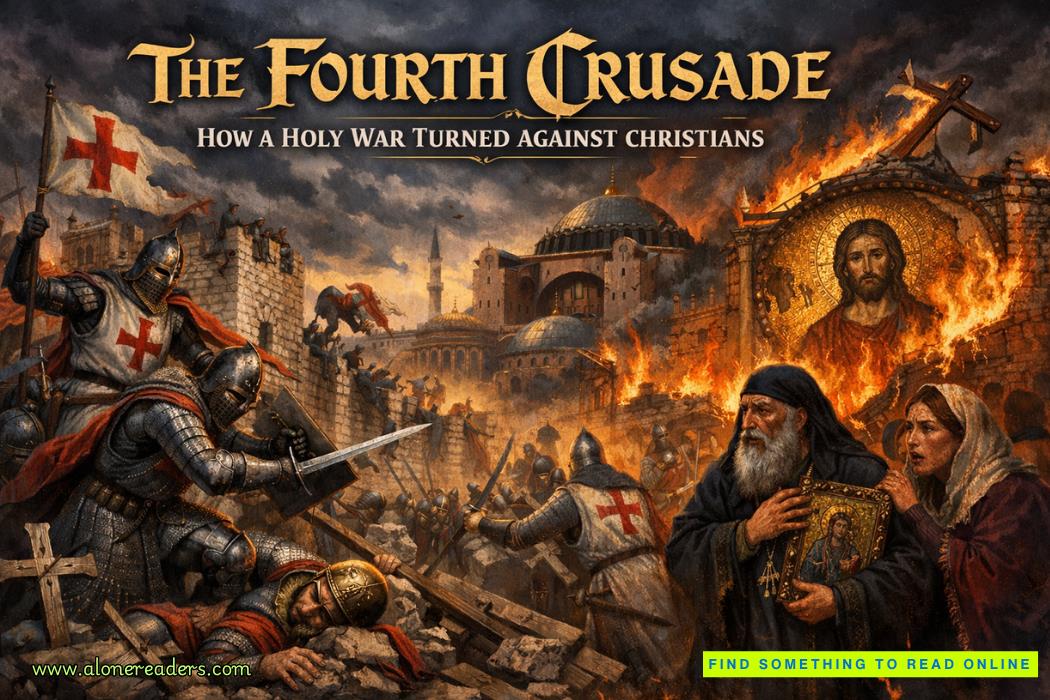
The Fourth Crusade stands as one of the most disturbing paradoxes in medieval history. Conceived as a sacred expedition to reclaim Jerusalem from Muslim control, it instead culminated in one of the most catastrophic acts ever committed by Christians against fellow Christians. What began with prayers, vows, and papal blessings ended in the violent sack of Constantinople, the greatest Christian city of the Eastern world. This crusade did not merely fail its spiritual purpose; it redefined betrayal, greed, and political manipulation within Christendom itself.
At the dawn of the thirteenth century, the crusading ideal still held immense emotional power in Western Europe. The loss of Jerusalem in 1187 to Saladin remained an open wound. Knights believed participation could cleanse sins, nobles saw opportunities for prestige, and the Church viewed crusading as a unifying spiritual enterprise. When Pope Innocent III called for a new crusade in 1198, he envisioned a disciplined, morally pure campaign that would strike Egypt first—the economic heart of Muslim power—before advancing toward the Holy Land. On paper, the strategy was sound. In practice, it became a disaster shaped by human weakness.
Unlike earlier crusades driven largely by feudal armies marching overland, the Fourth Crusade relied heavily on maritime transport. The crusaders contracted Venice to build and man a massive fleet capable of transporting tens of thousands of soldiers. Venice, however, was not a neutral servant of Christendom. It was a commercial empire whose interests lay firmly in trade dominance. When fewer crusaders arrived than expected, they were unable to pay the enormous fee owed to the Venetians. This financial crisis became the first fatal turning point.
Venice’s leader, Doge Enrico Dandolo, a man of extraordinary political calculation, offered an alternative. If the crusaders helped Venice capture the rival Christian port city of Zara, their debt would be deferred. Zara was Catholic. It was under the protection of the King of Hungary, himself a crusader. The proposal was a direct violation of Christian law. Yet hunger, debt, and momentum overcame conscience. The army agreed.
The attack on Zara marked the moment when the crusade crossed its first moral boundary. A holy army, bearing the cross on their chests, laid siege to a Christian city. Churches were looted. Civilians fled. Pope Innocent III, upon learning of the attack, was furious and excommunicated the participants. Although the excommunication was later softened, the spiritual authority of the crusade had already been fractured. What followed would shatter it completely.
While wintering at Zara, the crusaders were approached by Prince Alexios Angelos, the son of a deposed Byzantine emperor. He promised staggering rewards if the crusaders helped him reclaim the throne of Constantinople. He offered money to pay the Venetian debt, military support for the crusade to Jerusalem, and—most dangerously—submission of the Eastern Orthodox Church to Rome. For leaders burdened by debt and lacking direction, the proposal was irresistible.
Thus, the crusade’s objective quietly shifted. Without papal approval, without theological justification, the army sailed not toward Muslim lands, but toward the heart of Eastern Christianity. Constantinople was not merely another city. It was the capital of the Byzantine Empire, heir to Rome, guardian of Orthodox faith, and one of the wealthiest cities in the world. To Western crusaders, however, it had long been viewed with suspicion—too Greek, too wealthy, too independent.
When the crusaders first arrived in 1203, they installed Alexios IV as co-emperor. But the promises he had made were impossible to fulfill. The Byzantine treasury was empty. The population resented foreign soldiers occupying their city. Religious tensions exploded as Latin and Greek Christians clashed violently in the streets. Fires engulfed entire districts. Hatred hardened on both sides.
When Alexios failed to deliver payment, the fragile alliance collapsed. He was overthrown and killed. The crusaders, now unpaid and surrounded by hostility, made a decision that would echo through centuries. They chose to take the city by force.
In April 1204, Constantinople fell.
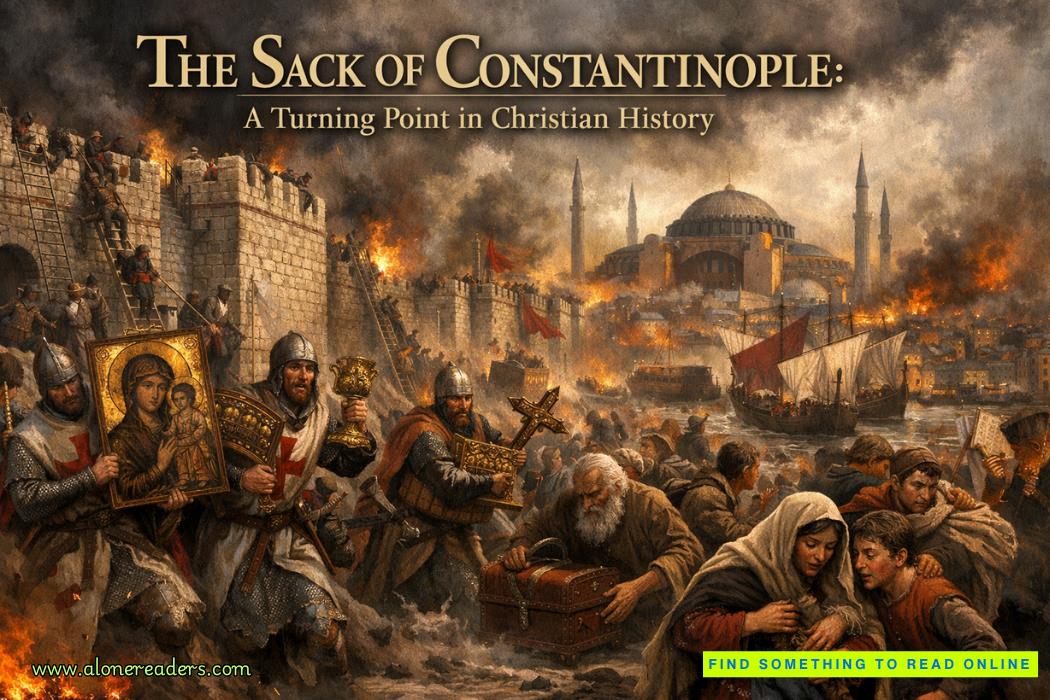
What followed was not a controlled military occupation, but three days of systematic devastation. Crusaders looted palaces, desecrated churches, and murdered civilians. Sacred relics were torn from altars. Gold mosaics were stripped from walls. Libraries containing ancient Greek and Roman texts were destroyed or scattered forever. Nuns were assaulted. Holy icons were smashed. Even hardened medieval chroniclers described the violence with horror.
One eyewitness wrote that even the Saracens would have shown more mercy.
The sack of Constantinople was not incidental chaos; it was organized plunder. The Venetians targeted ports, warehouses, and trade routes. Knights seized estates. Artifacts were shipped west—many of which still decorate European cathedrals today. The famous bronze horses of St. Mark’s Basilica were among the spoils.
In the aftermath, the crusaders established the so-called Latin Empire of Constantinople. It was weak, unstable, and despised by the local population. Byzantine successor states emerged in exile, plotting recovery. When Constantinople was finally reclaimed by the Byzantines in 1261, the empire was permanently weakened. The city never fully recovered, leaving it vulnerable to Ottoman conquest two centuries later.
The Fourth Crusade did more than destroy a city. It irreversibly poisoned relations between Eastern Orthodox and Western Catholic Christianity. The schism of 1054 had been theological; the events of 1204 made it personal, emotional, and unforgivable. To the Orthodox world, the crusaders were no longer misguided brothers, but traitors who had profaned Christ in the name of Christ.
Pope Innocent III condemned the sack after the fact, yet his outrage rang hollow. The crusade continued to exist under papal authority, and the Latin Empire received official recognition. This contradiction exposed a deeper truth: spiritual ideals had become subordinate to political convenience.
The Fourth Crusade reveals the uncomfortable reality behind medieval holy wars. Faith was real, but it operated within a world driven by debt, ambition, rivalry, and power. Knights sought salvation, but also land. Venice sought trade supremacy. Nobles sought kingdoms. The language of religion provided moral cover for deeply human desires.
What makes the Fourth Crusade uniquely tragic is not merely its failure, but its inversion. Earlier crusades failed to hold Jerusalem. This crusade succeeded spectacularly—against the wrong enemy. The cross was carried into battle not against Islam, but against Christianity itself.
In this sense, the Fourth Crusade represents the collapse of the crusading ideal. After 1204, the moral authority of crusades steadily declined. Future expeditions would be met with skepticism. The notion that violence sanctified by faith could be trusted began to unravel.
Modern historians often describe the Fourth Crusade as the moment when medieval Christendom lost its innocence. It demonstrated that religious unity could be shattered not by external enemies, but by internal corruption. The greatest blow to Christian civilization in the Middle Ages did not come from outside—it came from within.
The irony is brutal. A crusade meant to defend Christianity nearly destroyed one of its oldest civilizations. A movement born from spiritual devotion ended in cultural annihilation. And a holy war, intended to liberate Jerusalem, instead ensured that Constantinople would never again stand as the shield of Eastern Christendom.
The Fourth Crusade endures as a warning written in blood and ash. When belief becomes entangled with power, when moral authority yields to expedience, and when sacred language is used to justify ambition, even the holiest cause can become indistinguishable from crime.
It remains one of history’s clearest lessons that faith without restraint does not elevate humanity—it exposes its darkest instincts.



 The Hundred Days Offensive: How the Allies Defeated Germany in World War I
 The Second Battle of the Marne: The Turning Point of World War I in 1918
 The Spring Offensive of 1918: Germany's Final Gamble to Win World War I
 The Treaty of Brest-Litovsk: How Russia Left World War I
 The Russian Revolution and World War I: How War Brought Down the Tsar
 The Zimmermann Telegram Explained: Germany's Secret Offer to Mexico in World War I










