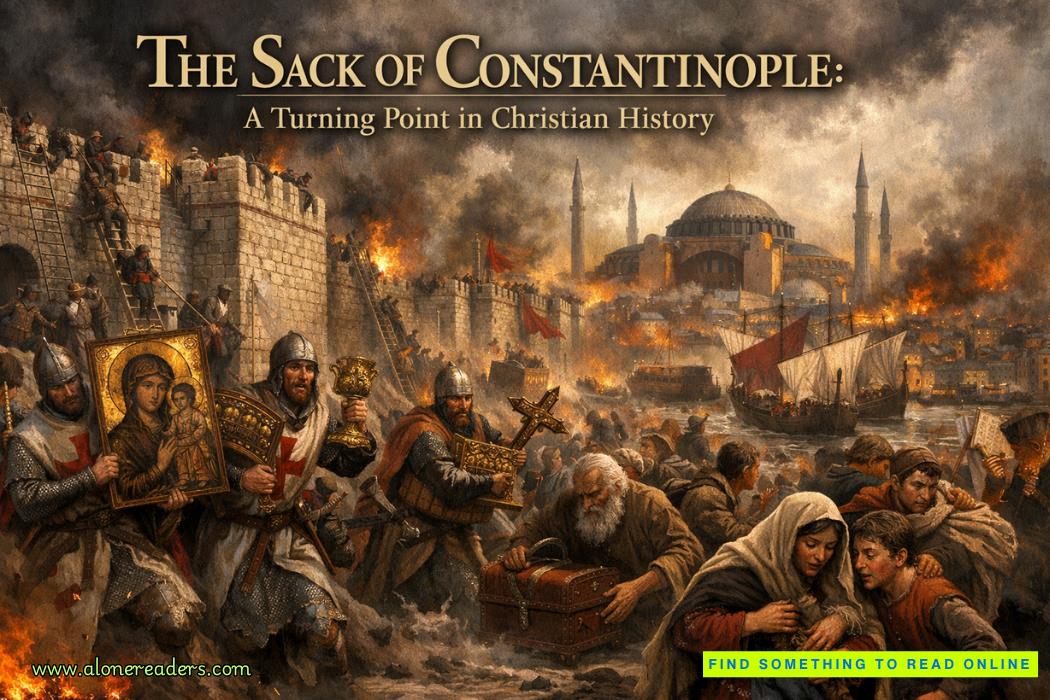
The Sack of Constantinople in April 1204 stands as one of the most consequential and tragic episodes in medieval Christian history. What began as the Fourth Crusade—a campaign ostensibly proclaimed to reclaim Jerusalem from Muslim control—ended instead in the violent assault of the greatest Christian city in the world. The event was not merely a military catastrophe; it represented a profound rupture within Christendom itself. The spectacle of Latin Crusaders looting, burning, and desecrating the spiritual heart of Eastern Christianity permanently transformed relations between East and West. In the process, it accelerated the decline of the Byzantine Empire and hardened the division that had followed the Great Schism of 1054 into an enduring civilizational divide.
By the late twelfth century, Constantinople was still the capital of the Byzantine Empire, heir to the Roman imperial tradition. Its wealth, monumental architecture, and strategic control of trade routes between Europe and Asia made it the preeminent metropolis of Christendom. The city’s defenses—particularly the Theodosian Walls—had repelled countless sieges for centuries. Yet its political stability had weakened. Internal power struggles, palace coups, and economic pressures had eroded the empire’s cohesion. Though formidable in appearance, Byzantium was vulnerable from within.
The Fourth Crusade was proclaimed in 1198 by Pope Innocent III, who envisioned a renewed, disciplined crusading effort to reclaim Jerusalem after earlier setbacks. The plan required transporting a massive army across the Mediterranean, and negotiations were opened with Venice, the dominant maritime republic of the era. Venice agreed to build and crew a fleet in exchange for substantial payment. However, when the Crusaders assembled in 1202, they could not meet the agreed sum. The shortfall placed them in immediate financial dependence on Venice.
At this juncture, the crusading mission began its fateful deviation. The Venetian doge, Enrico Dandolo, proposed that the Crusaders assist Venice in recapturing the rebellious city of Zara on the Adriatic coast. Despite Zara’s status as a Christian city under the protection of the Hungarian crown, the Crusaders attacked and captured it. This first assault on fellow Christians foreshadowed what was to come. The moral clarity of crusade rhetoric was already compromised by political calculation and economic expediency.
The diversion did not end there. Soon after, envoys from the deposed Byzantine prince Alexios Angelos approached the Crusaders. He promised enormous financial rewards, military assistance, and submission of the Eastern Church to papal authority if the Crusaders would help restore him to the Byzantine throne. For an army already burdened by debt, the proposal was irresistible. In 1203, the Crusader fleet sailed for Constantinople, transforming what had been framed as a campaign against Islamic powers into an intervention in Byzantine dynastic politics.
The arrival of the Crusaders at Constantinople was unprecedented. Latin soldiers, bearing the cross on their garments, now stood before the walls of the Christian imperial capital. In July 1203, they forced their way into the city and installed Alexios IV as co-emperor alongside his blinded father, Isaac II. Yet the promised funds proved impossible to deliver. To meet his obligations, Alexios imposed heavy taxes and confiscated church treasures, inflaming public resentment. Byzantine hostility toward the Latins grew intense, culminating in riots and anti-Latin violence.
In early 1204, a palace coup overthrew and murdered Alexios IV. The new emperor, Alexios V Doukas, refused to honor any agreements with the Crusaders. Facing unpaid debts and dwindling supplies, the Crusader leadership resolved upon direct conquest. What followed was not merely a siege but a catastrophe of historic proportions.
In April 1204, after fierce fighting along the sea walls near the Golden Horn, the Crusaders breached the defenses. Once inside, discipline collapsed. For three days, Constantinople endured systematic plunder. Churches, monasteries, and palaces were stripped of their treasures. Priceless relics—some dating back to the earliest centuries of Christianity—were seized and transported westward. The great cathedral of Hagia Sophia was desecrated; chroniclers describe drunken soldiers and sacrilegious acts within its sacred space. The symbolic magnitude of this violation cannot be overstated. The spiritual epicenter of Eastern Orthodoxy had been defiled by those who claimed to fight under the banner of Christ.
The scale of looting was immense. Gold, silver, jewels, manuscripts, and artworks accumulated over nine centuries were scattered across Western Europe. Venetian forces carried off famous treasures, including the bronze horses that would later adorn St. Mark’s Basilica. The Byzantine population suffered grievously—killings, assaults, and displacement followed the conquest. The destruction was not total annihilation, but it was severe enough to permanently weaken the city’s infrastructure and morale.
The immediate political outcome was the establishment of the Latin Empire of Constantinople. Baldwin of Flanders was crowned emperor in Hagia Sophia, symbolizing Latin dominance over the former Byzantine capital. Territories of the Byzantine Empire were partitioned among Crusader leaders and Venice. Yet the Latin regime lacked legitimacy among the Greek population and struggled to maintain control. Byzantine successor states emerged in Nicaea, Epirus, and Trebizond, preserving fragments of imperial continuity.
From a broader historical perspective, the sack marked a decisive turning point in the trajectory of Christian unity. The Great Schism of 1054 had formalized theological and ecclesiastical differences between Rome and Constantinople, but relations had remained fluid, sometimes cooperative. The events of 1204 transformed suspicion into enduring hostility. For many Orthodox Christians, the memory of Latin betrayal overshadowed doctrinal disputes. The idea that Western Christians had destroyed the Christian Roman Empire became embedded in collective memory.
The weakening of Byzantium had long-term geopolitical consequences. Although the Byzantine state was partially restored in 1261 when Michael VIII Palaiologos recaptured Constantinople, it never regained its former strength. Economic resources were diminished, territories were lost, and reliance on Italian maritime powers increased. Over the following two centuries, the empire contracted steadily. When the Ottoman Turks captured Constantinople in 1453, the Byzantine state was a shadow of its former self. While the Ottoman conquest was the final blow, the structural weakening that enabled it can be traced back to 1204.
Theological ramifications were equally profound. Attempts at reunion between Eastern and Western Churches in subsequent centuries were hampered by the bitter memory of the sack. Councils at Lyons (1274) and Florence (1439) sought reconciliation, yet popular resistance in the Byzantine world remained strong. Many Orthodox believers preferred Ottoman rule to Latin domination, a testament to the depth of resentment forged in 1204. The sack thus entrenched ecclesiastical separation not merely as a doctrinal divide but as a historical trauma.
Economically, the redistribution of Byzantine wealth to Western Europe contributed to shifting power dynamics within Christendom. Venice emerged as a dominant commercial force in the eastern Mediterranean, leveraging its gains to expand trade networks. Italian city-states benefited disproportionately from the fragmentation of Byzantine control. The sack, therefore, also represents a pivot in Mediterranean economic history, as maritime republics consolidated influence at the expense of imperial centralization.
Culturally, the dispersal of Byzantine art and manuscripts to the West had paradoxical effects. While the immediate impact was destructive, the transfer of classical texts and artistic models contributed to intellectual currents that would later influence the Renaissance. Yet this cultural transmission occurred through violent appropriation rather than exchange. It was a legacy born of rupture rather than cooperation.
The Sack of Constantinople forces a reconsideration of the crusading movement itself. It exposes the complexity of motivations—piety intertwined with debt, political ambition, and opportunism. The episode challenges simplified narratives of crusade as a unified religious enterprise. Instead, it reveals a world in which religious identity could be subordinated to strategic calculation. Christian soldiers, under papal authorization, destroyed the leading Christian metropolis. The contradiction is stark.
For historians, the event remains a focal point for understanding the fragmentation of medieval Christendom. It illustrates how internal divisions can prove as consequential as external threats. The Byzantine Empire had survived Arab sieges, Bulgarian invasions, and Seljuk advances. Yet it succumbed to an assault launched by co-religionists. The irony underscores a central historical lesson: civilizations are often most vulnerable when unity fractures from within.
In evaluating the sack as a turning point, one must consider both immediate and enduring transformations. Immediately, it reconfigured political authority in the eastern Mediterranean. Over the long term, it reshaped Christian identity, deepened the East–West divide, and altered the balance of power in Europe and Anatolia. The memory of 1204 remains potent in Orthodox consciousness and continues to inform ecumenical dialogue even in modern times.
Ultimately, the Sack of Constantinople was not an isolated aberration but a culmination of structural tensions—economic dependency, political intrigue, and ecclesiastical rivalry. Its consequences radiated outward across centuries. It stands as a cautionary episode in Christian history, demonstrating how zeal untethered from prudence can yield devastation rather than deliverance. In the burning streets of Constantinople, the vision of a united Christendom fractured irreparably, setting the stage for a transformed medieval world and a divided Christian legacy that endures to this day.



 The Hundred Days Offensive: How the Allies Defeated Germany in World War I
 The Second Battle of the Marne: The Turning Point of World War I in 1918
 The Spring Offensive of 1918: Germany's Final Gamble to Win World War I
 The Treaty of Brest-Litovsk: How Russia Left World War I
 The Russian Revolution and World War I: How War Brought Down the Tsar
 The Zimmermann Telegram Explained: Germany's Secret Offer to Mexico in World War I